
Translated material
Milestones and modernity
If Christians are against the revolution, are they - counter -revolutionaries?
Yakov Krotov : Today the program will be devoted to the collection "Milestones". The collection "Milestones" was published more than 100 years ago. To amazement, he suddenly became relevant. I would call an article by Iceberg the article by Zinaida Mirkina in the "Russian newspaper". The article was published a couple of weeks ago, in which the collection of “milestones” is quoted along with Krishnamurti as evidence that of all the revolutions only the revolution of the spirit is legitimately legal. And now the author of the collection "Milestone" in 1909 after the first Russian revolution criticized the revolutionary movement and the revolutionary intelligentsia. Therefore, today in 2014 in Russia, any talk about the revolution, any conversations at least about the Russian revolution, even about not Russian, even about Bolotnaya, even about Sakharovsky Prospekt, even about the Maidan - these are all indicators of anti -spirituality and spirituality. Therefore, let's study the collection "Milestones" so as not to step on the rake of soullessness and violence.

If Christians are against the revolution, are they - counter -revolutionaries?
The text of the copyWidth PX Height PX
The url has been copied to your clipboard
No Media Source Currently Available
0:00 0:54:59 Download the media fileToday we visit historians of philosophy, culturalists Igor Grigoryevich Yakovenko and Vasily Viktorovich Vanchugov .
I want to ask what people meant in 1909 meant? Why was the collection so popular at that time? Why was the deceased Vladimir Ilyich Lenin so inspired by him? Is it really relevant today or not? Accordingly, the first point is the article by Nikolai Berdyaev, which in 1909, perhaps, was not the most famous of the authors, but he was a core in the harness. He became famous after 3 years by the book "The meaning of creativity." And the main idea of his article, as I understand it, is that the Russian intelligentsia, democratic, revolutionary is indifferent to the truth, is ready to despise the truth, ravine, lie, etc. Is it fair 100 years ago? How true is this today?
Vasily Vanchugov : I would like to note such an amazing phenomenon that at that time and in our time many collections are produced, but not everyone is successful. Just seven authors here, seven characters fell into a collection, in immortality. And thanks to one publication, it was possible to rest on his laurels since then. And indeed he turned out to be a ticket to life for Berdyaev. Here such a good platform turned out to be - to speak a set of philosophical ideas and put them into practice. The successful form was selected.
Berdyaev is generally a master of aphorisms. Here he noticed a vice of the intelligentsia. But immediately we must clarify, this passes through a leitmotif through the entire collection, division into intelligentsia and intellectualism. And we must not forget that the authors of the collection are also representatives of the intelligentsia who criticize the intellectualism. Berdyaev notes the most important vice of our intelligentsia - a pragmatic, utilitarian attitude to philosophy. And this pragmatism has nothing to do with philosophy itself. It is harmful to philosophy. The necessary ideas are extracted from philosophy. Thus, there is a deformation, distortion of philosophy. All this leads to the conviction that philosophy gives some salvation. Berdyaev also shows a passion for European, foreign philosophy, thereby forgetting his own philosophical tradition.
This utilitarian attitude leads to the fact that today we are utilitarian to philosophy, tomorrow we begin to relate utilitarian to religion, to some more values. And since we had hopes for some values, and they suddenly do not live up to our expectations, we instantly throw them away as an unnecessary thing and take another. This utilitarian attitude to truths leads to nihilism, to cynicism and anti -culturalness.
Yakov Krotov : But Berdeyav’s problem is not only that his own is not his own. The collection made a scandal because the main impulse of the Russian culture of that time was European. But Europe is different. And when Berdyaev scourged the passion for foreign philosophy, it was about European materialistic philosophy, about rough materialistic. And in this sense, when he spoke of Russian philosophy, he spoke only about its religious component, which was rather thin. Even at the beginning of the twentieth century, most philosophers of Russia were positivists.
Igor Grigoryevich, in your opinion, is philosophical truth or religious truth? Was Berdyaev cunning in this case?
Igor Yakovenko : Regarding the pragmatic attitude to philosophy. This applies not only to philosophy. In Russia, there is nothing of the ideological constructions, from logical, philosophical, moral, to which the Russian intellectual or an active figure does not belong pragmatically.
Yakov Krotov : Is this intelligentsia so harmful of all Russian classes?
Igor Yakovenko : No, this is general cultural. This applies to officials, this applies to large, small, old.
Yakov Krotov : The intelligentsia is worse than other social groups or better?
Igor Yakovenko : I think that the intelligentsia in this regard is no worse than Russian officials, Russian ideologists. Maybe even partially better.
The fact is that in general, the collection of "milestones" is an important page in our spiritual history. There are a lot of interesting and important truths. This does not take away my deepest conviction that in the "milestones" we are dealing with some ideology, ultimately.
Yakov Krotov : You said it that you immediately want the law on the prohibition of swearing ...
Igor Yakovenko : God forbid! Once, the Ambassador of France to Russia Maurice Paleologist wrote down that when a revolutionary is going to overthrow power somewhere in Europe, they have some plan in their heads. He will overthrow this power and at this place such institutions will be built, such norms, such values. He overtakes this in the name of some plan. The revolutionary of the East Slavic, Russian in particular, overthrow at all. And in this sense, from the point of view of this feature that Maurice Paleologist catches, I completely share the pathos "milestone". Indeed, Russia is a country in which a lot of people recently (in the sense of generations) is inscribed in the state and civilization. All the time there is a conversation not about changing the political regime, social institutions, but simply to distinguish everything to the ground. Under this lies a layer of barbaric early state consciousness, which sweeps everything.
As for the denial of the revolution in general, then, from my point of view, this is the usual conservative reactionary ideology. The revolution is a necessary, not removed stage of the world historical process. If we turn to the idea of human rights. After all, they were also formed through revolutions.
Vasily Vanchugov : Does all good deeds precede violence?
Igor Yakovenko : No. The fact is that the revolution, as the currently forgotten and categorically unmalous comrade Karl Marx said, the locomotive of history. It must be understood that the revolution, at least in the last 500 years of world history, is a completely carried thing. Moreover, if you and I are impartially and seriously treated, then we will find that revolution is a time of ideal being. People who make a revolution plunge into the illusion that tomorrow the world miraculously transform and everything will be fine.
Yakov Krotov : Lord Jesus Christ for the revolution or against?
Igor Yakovenko : I think that his teaching lies in a completely different space. This is a spiritual revolution, if you like.
Yakov Krotov : Still, according to Krishnamurti - the revolution of the spirit.
Igor Yakovenko : Yes. And then the Lord spoke of the kingdom, which is not from the world today. We are talking about the revolution taking place in the world of this.
Yakov Krotov : And the counter -revolution? Berdyaev counter -revolutionary?
Vasily Vanchugov : Regarding the imaginary figure of a Russian revolutionary, a Russian intellectual who blows everything, but we will build later. Two types of revolutionaries, two types of intellectuals - Pisarev and Chernyshevsky. Pisarev - let's break everything, that which is strong, then, there will remain, thereby, justifying the right to its existence. Chernyshevsky still creates a picture. He creates the future first. The novel "What to do?" This is a description of a possible future under which we must already carry out a number of actions.
Yakov Krotov : I think that most of our listeners are more familiar with other names. Chernyshevsky and Pisarev in the era "milestone" correspond to Milyukov and Lenin. Both are sufficiently aroligative. For both of them, the Milestones were unpleasant for both, because the authors of the “milestone” have some positive word. They seem to share the ideal of revolution, they want a constitution, but they still want religion. And this is extremely strange for Milyukov, because it is not from that front to help in the fight against Lenin. He does not need religion. And suddenly Berdyaev comes and says that religion is needed. Was he right?
Vasily Vanchugov : I relate to Berdyaev, because he will say in one place that it is necessary ...
Yakov Krotov : Good. Bulgakov, Frank ...
Vasily Vanchugov : In general, we must understand that in this set of statements, in the installation, which we accept as something well thought out. It was a reaction to a former revelry of positivism, nihilism, provoking atheism. By the way, we forget that not revolutionary intellectuals, the intelligentsia, but the spiritual environment, played a large role in the growth of atheism and nihilism.
Yakov Krotov : Did they renounce? This means already a former spiritual environment.
Igor Yakovenko : And someone did not renounce, but it would be better if they renounced. We are talking to you about what people saw.
Vasily Vanchugov : Yes, this is an increase in the thesis for religiosity, maybe the reason was partly emotional. We are so arranged on antitheses. It is necessary to contrast something - temporary power intellectual solutions of the problem.
Igor Yakovenko : What can be more anti -religious than observing official religiosity, state -owned denomination, triumphant? It's monstrous!
Yakov Krotov : official religiosity is very bad. But observing him the only Pharisee (state -owned or not state) significantly more attracts temptations. Let's try to throw the bridge. It turned out a very strange situation. The direct successors of Lenin are Orthodox! We have Orthodox Lenin, so collective. Bulgakov’s claim was removed. We have no atheists. We have even the Orthodox ultra. And it turns out that this combine is no better. What turns people away from the Church today? Official religiosity? No. They are averted precisely by the combine of state religiosity and official anti -religiosity. I do not understand how this is combined, but it is combined. These are the Orthodox Communists in essence. Is there a state religiosity in Poland? Eat. Is there in Germany? Eat. And in Italy it is. But here the official religiosity side by side with the successors of Lenin goes. They grabbed in some unheard of bunch! And this caused a complete shock.
Igor Yakovenko : I think that people averts the lack of freedom in this drawing (he should accept, believe and rejoice) and some self -serving ideological interest that is visible behind this.
Yakov Krotov : These Orthodox Leninians are now more and more about the soul. But it turns out that hell is much worse than radish. It turns out that the atheist revolutionary is much worse than the Orthodox revolutionary. Then the conversations about the revolution of the Spirit are a club in the hands of yesterday's revolutionaries. So they seized power and now shout - that's it, the train has gone, now we are engaged in spirit! Is it honest?
Igor Yakovenko : In my opinion, this is an eternal plot. Once there is some revolution. The revolution occurs under the flag of gaining freedom - spiritual, social, under the flag of comprehension of some truth. And then the forces that were upstairs declare this gained truth to the last instance and roll up the situation with asphalt - so we have gained this truth and that’s it! It was more than once in history.
Yakov Krotov : Not a believer Christian is saying your lips now. The whole Russian modern intelligentsia is now saying your lips. But this is cynicism at the level of Anatol France "The uprising of the Angels." History does not confirm this.
Igor Yakovenko : I'm talking about the trend that exists. And if society does not confront it, if it allows this tendency to roll up and declare a doomed truth by the latest instance, then this society is simply ...
Yakov Krotov : French Revolution, English, American, but we do not see the celebrations of the checks there, relatively speaking.
Igor Yakovenko : I'm talking about Russia. Just when society has the potential for gaining freedom, it does not give these conservative forces to expand what I just talked about. This is the problem.
Yakov Krotov : But are the authors of the “milestones” that emphasized atheism as one of the main vices of the revolutionary intelligentsia?
Vasily Vanchugov : We must look specifically historically. We fall into the arms of Chaadaev, who explained the sins of our Fatherland, mansion, reproach for the world just by the fact that our government is not the same, and above all the church is not the same.
Yakov Krotov : In the twentieth century in Italy, Germany, a powerful Christian democratic movement that opposes nihilism in this revolutionary movement. So the authors of the “milestone” do not represent in this sense an absolutely legitimate European Christian line? The revolution should be the revolution of the spirit, but it should still be a revolution.
Vasily Vanchugov : For me, the revolution of the spirit is not entirely clear. The social revolution is understandable. There is a system of markings that allows us to measure and understand where there are qualitative changes where there are quantitative ones, and where what. As for the revolution of the spirit, it seems to me that this is the most unsuccessful combination. As for the spirit, evolution is possible there.
Yakov Krotov : Okay, I am so paraphrasing the revolution of the spirit - you don’t look, you are not free, do not poke with any reforms and revolutions, but you are sitting to write a protocol of interrogation and make a revolution of the spirit inside yourself.
Igor Yakovenko : You can have everything you want to re -lamp and serve in a feuilleton form.
Yakov Krotov : Where is Sofism?
Igor Yakovenko : Sophism here is that what you drew, suggests just the lack of the main value of Protestantism - the value of freedom.
Yakov Krotov : Inner freedom with you is the hut of Uncle Tom.
Igor Yakovenko : As I understand it, this problem is that a person is a moral creature. He is doomed by the creator from some growing up to the grave board to constantly choose between good and evil. And now the totality of these elections is the most important, essential, genuine content of human life.
Yakov Krotov : Polish philosophy historian Andrzej Valitsky believed that the best article in the collection is Kistyakovsky’s article about the right, that she was the only one of all that was indistinguishable, turned out to be the most European, positivist. Christianity preaches grace as an antithesis by the law. And suddenly, among these defenders of the Christian position in the world of oppression, etc. The author is the author who writes about the law and law. What is the trick here, as they say now? Why does the right suddenly appear?
Vasily Vanchugov : If I were put before the election, you must choose one author, with whom you will have to live on the basis of views, I would choose Kistyakovsky. Kistyakovsky hit the most sick place. He found, felt the most important vice of our intellectuals and intelligentsia.
Igor Yakovenko : Russia is an extraordinary country. This is a vice or organic of Russian culture. A person, the bearer of Russian tradition, Russian culture, sees power, if it is sacred power, that is, the present, as an essence located above the right.
Yakov Krotov : Kistyakovsky anti -Russian man?
Igor Yakovenko : Kistyakovsky as a Russian person who loves his country is trying to compensate for this situation and introduce a legal dimension.
Vasily Vanchugov : Kistyakovsky extremely concern. Without leaving generalizations, he has a conversation on the merits.
Yakov Krotov : We must remember that the authors of the “milestone” wrote the Mistress. Criticizing the intelligentsia, they often did not criticize her double, who was sitting on the throne. Because censorship would not miss this. But there is another silence. They perceive pre -revolutionary life, the life of 1909, as a given. And they do not understand that Russia in which they live, in a sense, is Europe. In this sense, there is a qualitative difference between Russia until October 25 and after.
Igor Yakovenko : As for Kievan Rus and further development, this, sorry, was a barbaric outskirts in which the right in the sense in which we use ...
Yakov Krotov : True Yaroslav the current document is the usual legal structure of all European barbaric peoples.
Igor Yakovenko : So the barbarians had Salic truths in what century? In the VII, VIII, IX centuries. And here it was drawn, sorry, to Peter the Great. And real processes begin in the 19th century. If there was legal consciousness in Russia, then the Cheka would not have happened here.
Yakov Krotov : Do you think that the Cheka represents the Russian tradition, but does Kistyakovsky not represent?
Igor Yakovenko : I claim that the Cheka represents a large tradition in relation to the Kistyakovsky tradition. The choice between Kistyakovsky and the Cheka was the choice of Russian society.
Yakov Krotov : The collection "Milestones" had a second release. The authors did not believe that the tradition that was a majority until October 25 won. Они считали, что революцию свершило меньшинство, что Россия вовсе не продолжилась, а прервалась, исчезла в бездне.
Игорь Яковенко : Я понимаю и вижу логику этих людей. То их понимание России и та Россия, которая была для них Россией, в некотором смысле кончилась. Но мое понимание исторического процесса и логики истории таково, что если в обществе происходит какой-то процесс, в 150-миллионном обществе, то он происходит только с санкции большей части этого общества. Осознанная эта санкция или не осознанная - не бывает процессов, которые происходят вопреки обществу.
Яков Кротов : Россия 2014 год и Россия 1909 года. Правовое сознание одинаковое разве? Кистяковских больше нет. Произошло качественное изменение? Или та антиправовая идеология, которую критиковал Кистяковский, из маргинальной стала господствующей?
Игорь Яковенко : Сначала она стала господствующей. Где-то с 60-х годов ХХ века, с модернизацией советского периода, с переходом от советского к постсоветскому времени происходит некоторое нарастание тех качественных характеристик культуры, которые были до 1917 года.
Яков Кротов : Процесс Синявского и Даниэля - это показатель того, что советская власть постепенно становится правовым государством?
Игорь Яковенко : Не этого. Показателем становится запись этого процесса, издание ее правозащитниками за границей, протесты против этого и заведомо бешенные конкурсы на юридические факультеты после 1992 года. Это меняет ситуацию. Есть такая страшная штука под названием диалектика истории. Для того чтобы однажды пришла свобода, сначала приходит закрепощение.
Яков Кротов : Что-то это пахнет тем, что для того чтобы жениться, надо сходить в публичный дом.
Игорь Яковенко : Я этого не говорил.
Василий Ванчугов : Мне кажется, что еще нет тех условий, к которым призывал Кистяковский. Он призывал использовать право, юридическую систему, использовать весь инструментарий, который существует для установления социальной справедливости, для добра. Судебная система есть тот канал, сквозь который добро может проникать в общество, с помощью которого можно противостоять главному оппоненту любого интеллигента - власти.
Игорь Яковенко : Вспомним советские выборы. Это была полная профанация выборов, ибо выбора не было. Но с точки зрения историка я утверждают, что приучение 170 миллионов к хождению на выборы есть шаг вперед по отношению к идее самодержавного монарха. То есть идеологически санкционированная деспотия хуже, чем проституированная советская демократия. И приучение к выборам создает следующий шаг, когда можно будет просто выбирать.
Яков Кротов : А я вам скажу словами профессора Лондонской школы экономики Теодора Шанина, что кошмар революции был не в том, что она свергла самодержавие с его довольно произвольным отношением к праву. Революция уничтожила крестьянский мир. А этот мир был правовым явлением. Обычное право крестьянской общины было очень четко структурированным. Крестьянин не был анархистом. Крестьянин жил по праву, по закону. И в этом смысле революция и, конечно, 20-е годы не столько модернизировали Россию, сколько отбросили ее в какой-то долюдоедский период. Потому что крестьянство было уничтожено, мир как община был уничтожен. Были сломаны правовые традиции, которыми жила Россия на протяжении 1000 лет.
Василий Ванчугов : Тот же Кистяковский бросает упрек в сторону интеллигенции с ее иллюзией, что есть русская община, дающая органический синтез права и морали. Он говорил, что задача интеллигенции - вводить дифференциацию, разводить мораль и право и четко работать с двумя сферами.
Яков Кротов : То, что было создано после 1917 года - это соединение аморальности и бесправности.
Игорь Яковенко : На свете никогда не существовало ни одной традиционной культуры, внутри которой не было своего обычного права. В этом смысле русская крестьянская культура удовлетворяла универсальным закономерностям формирования традиционного общества. Конечно, оно было это обычное право. Но вот экономическая антропология свидетельствует, что когда на архаические племена сваливается рынок, не большевики, а рыночные отношения, происходит распад и деградация культуры. Можно очень много валить на большевиков, но в России деградация и крестьянской общины, и общества была исторической неизбежностью. Россия отстала в развитии веков на 6! Если бы не было коммунистов, был бы фашизм.
Яков Кротов : Еще один пункт в "Вехах", насколько он важен - противопоставление святости и подвижничества. Ведь русскую дореволюционную интеллигенцию Николай Зернов сравнил с орденом. Когда для интеллигента было обязательно личное бескорыстие, готовность пожертвовать своей жизнью и т. д. И Булгаков очень остроумно и не безехидства говорит, что это все очень мило, но святость лучше. В результате прошло 100 лет. Мы и святых не наблюдаем, и подвижники куда-то расточились. Так что, авторы "Вех" не в ту сторону целили? What happened?
Игорь Яковенко : В обществе, в котором вообще исчезло подвижничество - это общество снято Господом с довольствия духовного, и оно умирает. Я не думаю, что у нас исчезли подвижники. Другое дело, что часто мы их видим в контексте ретроспективы, мы не все замечаем, что вокруг нас происходит и т. д. Я не верю в существование общества, в котором нет подвижников.
Василий Ванчугов : Другое дело, каков механизм подвижничества, кто для кого является подвижником.
Яков Кротов : 90-е годы польские реформаты и российские люди, которые говорили, что мы аналоги польским. Но польские реформаторы не составили себе многомиллионных состояний. А некоторые как ездили на автобусе, так и сейчас ездят.
Игорь Яковенко : Составил ли себе состояние Егор Гайдар? Не составил. Составил ли себе состояние недавно от нас ушедший Починок? Не составил. Were.
Яков Кротов : Вы понимаете, на кого я намекаю?
Игорь Яковенко : Я говорю о тех, о ком я говорю. Так что, среди тех людей, которые сделали 90-е годы, есть и те, кто составили миллиардные состояния, и те, кто хапнули 5-10 миллионов. На фоне сегодняшней жизни видятся монахами и себя иссушающими эти 5-6 миллионов. В этом ряду были и абсолютные бессребреники, те, кто немножко хапнули, и те, кто откровенно в четыре рта.
Яков Кротов : Но идеал-то был заявлен хапка! А кто-нибудь сказал, что блаженный нищий духом?
Игорь Яковенко : Кто бы спорил! Но ведь это обращено к отдельному человеку. Я не верю в общество праведников.
Яков Кротов : Вы верите в общество грешников?
Игорь Яковенко : Я верю в то, что грешники всегда доминировали, доминируют и будут доминировать. Я не верю в светлое будущее.
Яков Кротов : Насколько лукавы или не лукавы те люди, которые сегодня с криком "Да здравствуют, "Вехи"!", "Да здравствует, революция духа!" призывают к консервации существующего политического строя в России?
Василий Ванчугов : Бердяев искал себя. Те, кто сегодня ищут. А что плохого в поиске?
Яков Кротов : Они не ищут. Я говорю о людях, которые поднимают "Вехи" и говорят - стоп, только революция духа!
Игорь Яковенко : Это нормальное классическое идеологическое обслуживание власти предержащей.
Яков Кротов : Согласны?
Василий Ванчугов : Нет. Я думаю, здесь полагание - а вдруг поможет, а вдруг сыграет?
Игорь Яковенко : А кому поможет, в каком отношении сыграет?
Яков Кротов : На этом мы завершим программу.
-
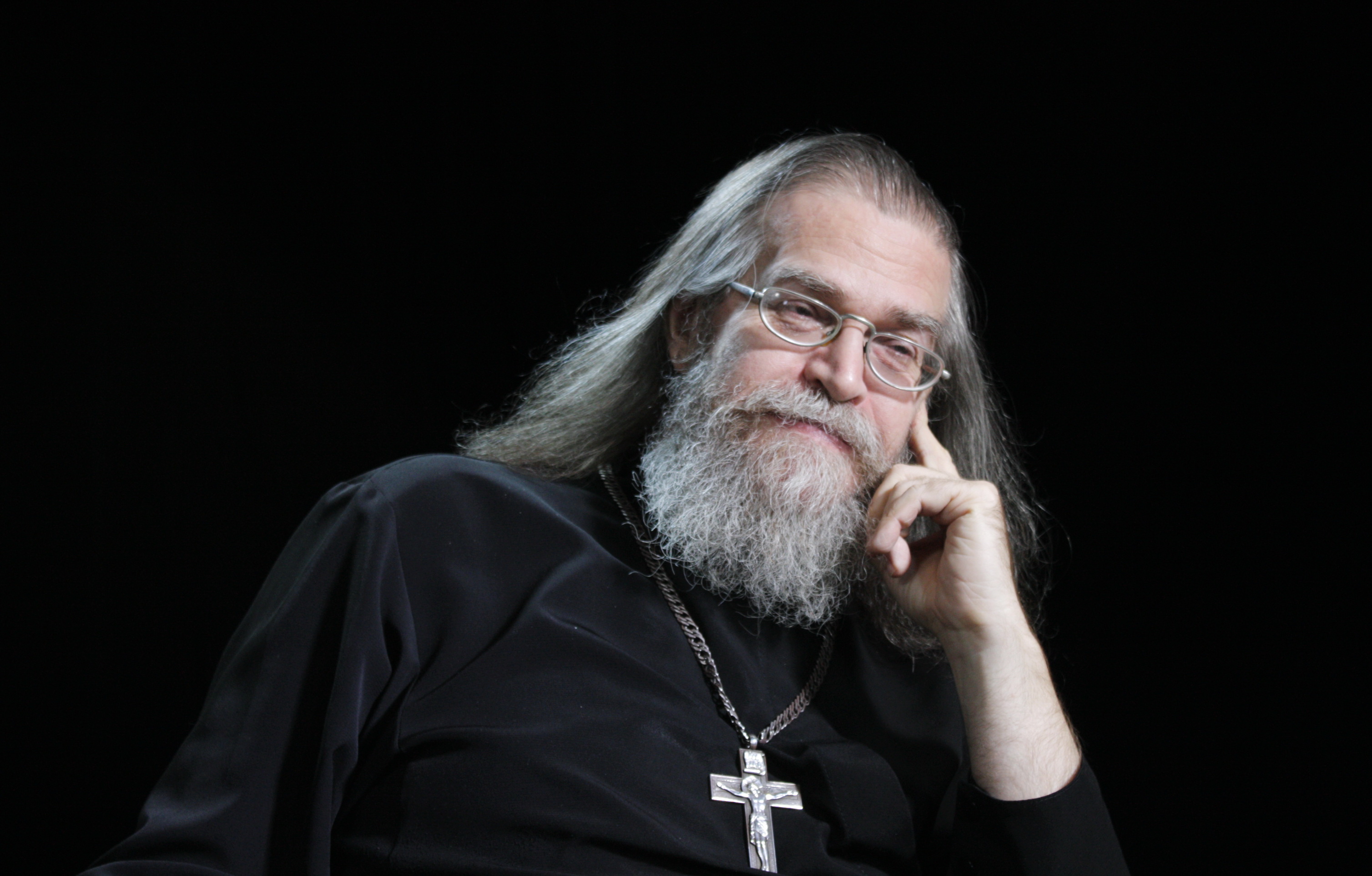

Yakov Krotov
Historian and priest, leading Radio Freedom Radio "Between Vera and Belief"
ykrotov@yahoo.com