
Translated material
NATO: Antro -Russian defense
Ukraine and Crimea did their job: at the next summit in Wales, NATO members are expected to accept a new collective security strategy

The Supreme EU representative for foreign affairs and security policies Katherine Ashton and the Secretary General of NATO Anders Fogs Rasmussen had something to discuss at a meeting in Brussels. June 25, 2014 /Photo: Francois Lenoir /Reuters
Sunny morning on June 25, NATO headquarters in Evere, a suburbs of Brussels. Prior to the meeting of foreign ministers of the alliance countries, less than half an hour remains, the Audi and BMW of the main diplomats of Norway, Great Britain, Germany, the EU Supreme EU, Baroness Cabinets Catrino, dressed in a bright green cardigan, drive up one after another. There can be no question of an escort or protection and a question, everything is very routinely, one of the ministers literally for 5-10 seconds slows down a step for a short statement for the press. And suddenly, a motorcade of a dozen minibuses, police cars, motorcyclists occurs from the ground. “The Americans arrived,” one of the journalists says with knowledge.
From a long black Cadillac comes out a tall, Hole Secretary of State John Kerry, from the rest of the cars - a numerous retinue. Kerry enters the building with a confident step, waving to journalists: "Hello guys, how are you here?" - His Cadillac remains standing near the front door, blocking the road. The Luran Fabius Foreign Minister of Foreign Affairs, who arrived in the limousine, has to modestly settled on the side, the French Minister almost imperceptibly got out of the car and slipped past the American motorcade.
“Until now, France has interfered with America, today America interferes with France,” the Belgian colleague standing nearby commented with a grin.
The hint is generally understandable: the unity of the NATO ranks at the peak of the Ukrainian crisis is shaken by the frank reluctance of Paris to abandon the Russian helicopter carrier transaction “Mistral”. They say that on the eve of the Brussels meeting, Kerry once again persuaded Fabius: they say, the ships are ready to buy NATO. Paris in response - neither nor nor. That in the language of politics, of course, there is no: € 1.2 billion - this is the amount of the contract - they are not lying on the crisis of the pan -European road. In addition, Russians offer live money and have already paid an advance.
These two approaches - more decisive and more cautious - are clearly visible in everything that the West is taking now, reacting to the Ukrainian crisis.
A specific conversation
Actually, foreign ministers gathered in Brussels to prepare the agenda of the NATO summit, which will be held in Wales on September 4–5. This was the rare case when the entire previous work of the referendum on the preparation of documents went down the mash: in addition to the Ukrainian puzzle of many in NATO, she confused the exploded situation in Iraq. And then the Americans began to actively advocate for increasing the military budgets of the alliance countries, which is now very inappropriate for Europeans. As a result, almost all issues in Brussels were discussed with an eye on Ukraine: a further expansion of NATO, and measures to ensure the safety of the alliance members, and relations with Moscow ...
The words “Russia” and “Ukraine” sounded everywhere: in the dining room of the headquarters, during television stand-ups, at press conferences, in interviews, conversations by phone ... Even curves were connected with Ukraine. Ukrainian journalists disappeared the national flag, which they wanted to put on their table in the press center. They immediately laid the guilt for the loss on Russian colleagues. In response, they decided to make a gesture of goodwill and bought the Ukrainians a new flag. Ukrainians thawed a little and even began to talk with representatives of a neighboring aggressor country. It was not easy to communicate, however: how can you answer the question: “When your Putin will take his own m ... Kov from Ukraine?!”
"
“Nobody believes Putin anymore. It is not immediately idiots work, everyone understands: if tanks are still going across the border, then the war continues ”
"
However, the same question, although in other terms, was asked by NATO politicians. “Putin’s request (to the Federation Council. - The New Times) to withdraw from him the right to enter troops (to Ukraine) is a positive step. But everything can be returned back in 10 minutes, and everyone knows this, ”John Kerry explained to reporters during a briefing. “There will be more benefit if Putin publicly calls for separatists to lay down a weapon.”
According to the Secretary of State, in the absence of specific steps to de -escalate the situation in Ukraine, Moscow will inevitably wait for new strict sanctions, including against individual sectors of the Russian economy. “Specific steps” are not negotiations in Donetsk with the participation of Russia's ambassador Mikhail Zurabov and the leader of the Ukrainian Choice of the Ukrainian Choice of Viktor Medvedchuk (material about him - on page 34). The dialogue in the format as the correspondent of The New Times was convinced, few people perceive in Brussels and Washington seriously. And for many here, the mystery is still why it was suddenly the Chancellor Merkel on June 25 personally spoke out for participating in the negotiations of Medvedchuk, the existence of which she hardly suspected to the current events. “Not otherwise than Putin persuaded her,” German journalists joke on this occasion.
The list of requirements for the Kremlin is quite specific: to allocate troops from the border, stop supplying weapons and volunteers to the rebels in the Donbass and finally stop the propaganda support of the separatists. “The main problem is that no one else believes Putin,” the NATO source explained The New Times. “It is not immediately that idiots work, everyone understands: if in Moscow some correct words are spoken, and tanks are still coming across the border, then the war continues.”
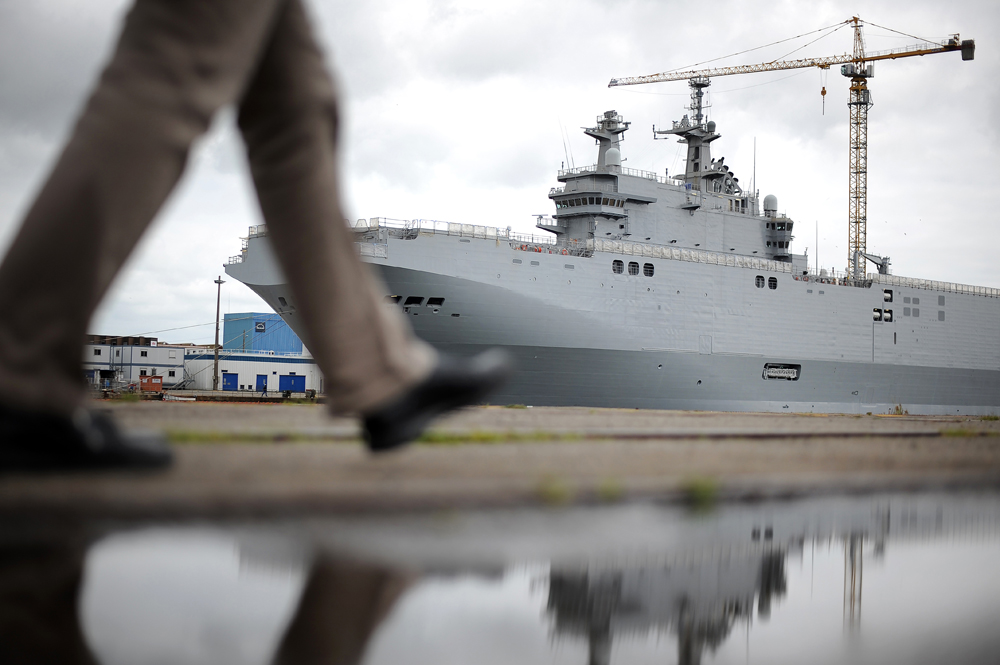
Russia has already made an advance payment for the French Mistrals. Paris does not intend to refuse the codes /Photo: Jean-Ebastien Evrard /AFP
U -turn to the east
The option of NATO’s military intervention in the Ukrainian crisis is not considered under any circumstances (“Ukrainians must solve their problem on their own,” repeated NATO Secretary General Anders Fogg Rasmussen). But in Brussels everyone is already clear: by September, the tension around Ukraine will not settle, the topic is destined to become one of the central and at the summit in Wales. Therefore, it was decided to include the issue of creating special trusts in his agenda, with the help of which the West (NATO) will finance the modernization of the Ukrainian army. According to the sources of The New Times, the total volume of this fund can be € 12-13 million for the next two years. Money will be spent in four main areas: reforming the command and management system, cybersecurity, trainings for personnel and logistics. In addition, NATO will help Kyiv with the solution of the problem of retirees and their socialization after leaving the service.
“It is clear that Kyiv also needs military equipment and modern weapons, the Ukrainian army is in a terrifying state, but there will be no supplies of NATO weapons,” one of the sources of the magazine assured. True, he immediately added: "NATO members can help Kyiv and outside the alliance."
By the way, on a bilateral basis, Ukraine is already helping: for example, the US Ambassador at NATO Douglas is poured reminded journalists in Brussels of Washington’s loan of $ 1 billion and gratuitous assistance, which since the beginning of 2014 has already amounted to $ 148 million.
"
“In March - April, we were all in complete confusion. No one understood how far Putin would go and, most importantly, how to answer it "
"
Expert groups of member countries are instructed to prepare proposals by September on a block of issues regarding further coexistence with Russia. “Donbass is in the coming months, Putin is in the coming years,” one European diplomat figuratively remarked the headquarters of the Alliance. Therefore, the summit in Wales will focus on the prospect: how to live on, having such a strong aggressor on the eastern borders?
According to the Lyut Ambassador, the “illegal annexation of Crimea” changed the balance of power in the world, forcing Western democracies to rally. “For 20 years, we tried to build partnerships with Russia, but aggression against Ukraine fundamentally changed the landscape landscape, it challenged our vision of a single, free and peaceful Europe,” the Secretary General of Rasmussen echoed Lyut.
“In March-April, everyone was completely confused here,” the assistant to one of the European ambassadors in NATO told the magazine. - No one understood how far Putin would go and, most importantly, how to answer it. Nobody was ready for a military operation, it seemed that Moscow was going to attach to itself the whole southeastern Ukraine and Transnistria. ”
Now, according to the interlocutor of the magazine, everyone calmed down a little: the troops in the Donbass Moscow most likely would not be: “It became clear in which direction to work - it is necessary to strengthen the collective safety of the alliance members in order to exclude the slightest possibility of aggression from Russia. In general, NATO unfolded east. ”
As the New Times explained to the mission employee at NATO one of the Eastern European countries, the most Moscow country of the Baltic and Poland are scared. They also insist on the speedy adoption of Georgia, Montenegro, Macedonia and Bosnia and Herzegovina in NATO, and on a significant increase in the alliance contingent on its territory. But the States and the Old Europe do not agree with them, which, according to the remark of one NATO official, "do not want to once again tease Putin."
Business against sanctions
The Kremlin’s main lawyers are business circles interested in continuing profitable ties with Russia. So, on June 26 it became known that the American Chamber of Commerce and the National Association of manufacturers purchased an advertising place in the American media to publish an open letter to President Obama about the inadmissibility of serious sanctions against Russia. Sanctions, the content of the letter, aware British Financiel Times, will be painfully affected by "ordinary American workers" and will lead to loss of jobs.
| *“The Third Energy Pack of the European Union” obliges to share manufacturers and sellers of gas and owners of main pipelines, forcing access to the “southern flow” of third -party companies. |
Meanwhile, in the EU, a split on the same issue was indicated at a much higher level. Not only is Paris, despite the persuasion of the Americans, he did not refuse the Mistrall sales transaction, and in Vienna on June 24, in the presence of Vladimir Putin, an agreement was signed on the construction of the South Stream gas pipeline through the territory of Austria. And this despite the sharp criticism from Brussels (the European Commissioner in Energy Gunter Ettinger in a harsh form demanded to freeze the South Stream), indicating the violation by the participants in the project of the Rules of the European Energy Charter*.
At first glance, the issues of sanctions against Russia do not concern NATO. But the alliance is not a purely military organization, it is strong in it and the political component. “Ministers (Foreign Affairs of the Alliance) are not generals, they do not plan military operations,” the source of The New Times recalls at the NATO headquarters. “But as politicians, they have to remember their voters.” And public opinion in the West, the interlocutor of the magazine hints, is quite rigidly tuned against Russia.
“We have a difficult task - to respond to the situation in a balanced, without heating up the situation, that is, without a significant increase in the NATO contingent on the eastern lines of the alliance, to conduct a spectacular and effective rotation,” the NATO diploma’s closest plans indicated.
The paradoxes of the moment
It is hardly possible to accept new members in the near future, including Georgia. The hopes for the “road map” for Georgia joined NATO are finally buried, despite Rasmussen's bravura statements that “Georgia will certainly become a member of NATO, it has already close to this.” At the summit in Wales Tbilisi, most likely, they will only be offered a package for “enhanced cooperation” with an alliance.
“Do not believe Rasmussen, Georgia will not become a member of NATO until it has territorial problems,” the source of the magazine grinned in the conversation from The New Times. Yes, the charter of NATO does not formally impose restrictions on the entry for a candidate country with territorial disputes. Nevertheless, they understand: Abkhazia and South Ossetia are a problem that at any moment can lead an alliance to direct confrontation with Russia.
But if Tbilisi suddenly decides to recognize the independence of South Ossetia and Abkhazia, this is from a formal point of view - will increase his chances of joining NATO, the NATOs make it clear. Such a paradox.
But in Brussels they are ready for an accelerated entry into the Alliance of Sweden and Finland. In the political tops of these neutral countries, the NATO theme has been especially actively extended in recent months. “They will be accepted without questions, just applications are enough to start the negotiation process,” the source at the NATO headquarters explains.
And then another paradox is visible: Moscow, preoccupied with the way to protect itself from the expansion of NATO for many years, as a result in a few months did everything so that the alliance rally against a restless neighbor in the east. It seems that the new bipolar world is no longer a threat, but quite tangible realities of modern politics.