
Translated material
Under fire
A truce ended in eastern Ukraine, but for the inhabitants of Slavyansk, fire did not stop for a minute
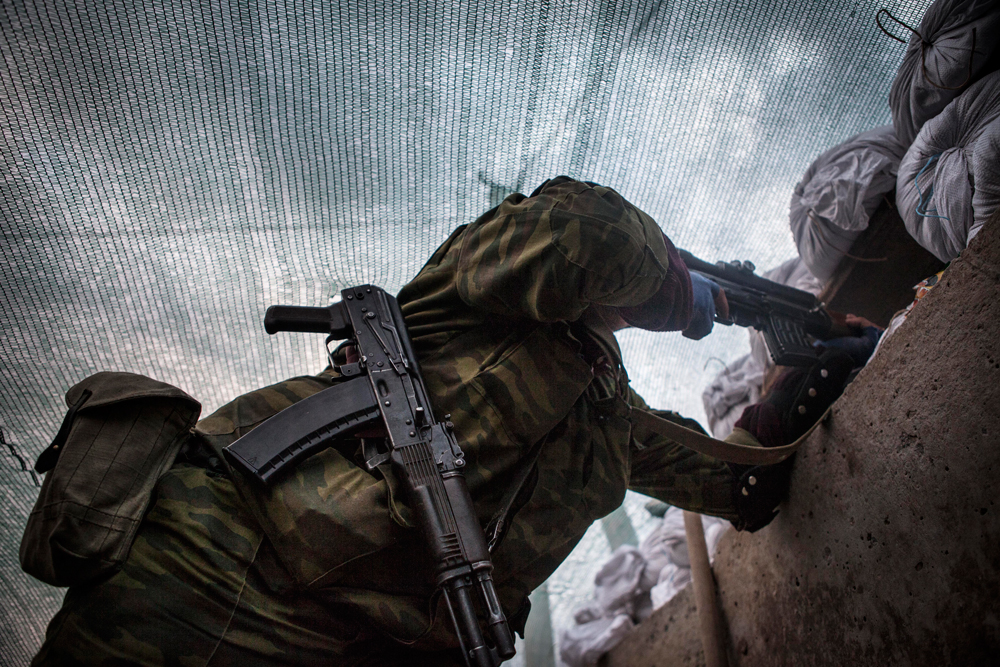
Photo: Michela Yakkarino
Everything changes, and nothing is in place. Having arrived from Slavyansk home to Italy, I see: in Europe, few are trying to understand what is actually happening in Ukraine. Many do not go beyond newspaper headings or a glimpse of phrases in the final of news release. This is enough for them to believe: the word "truce" there, in the east of Ukraine, indeed means the lack of war. Everything changes in Slavyansk too. Friends call me from there and say: “When you return to us, you will see that everything got worse - even more checkpoints, even more bombs ...”
For the one who was in the Donetsk and Lugansk regions from the very beginning of clashes and after, when the tension only grew every day, such words as “truce”, “reconciliation” and “ceasefire” are an empty phrase. Their meaning was not observed for a second in this corner of the Earth, where more and more flimsy barricades, more and more destroyed by mortar shooting of the house, did not stop protecting the wounded wounded in the rain from bombs and bury the dead. Where they did not stop shooting helicopters with people and arrange ambushes on checkpoints.
For many weeks now, the war in the east of Ukraine has ceased to be news. Yes, and the word "war" in Europe has already stopped pronouncing. In April, the European media entertained the fact that they compared the confrontation between pro -Russian and pro -Ukrainian forces with a new Cold War, called it a “prologue to the Third World”, the battle between Russia and America, which encountered on the Dnieper.
Now newspapers support the proper level of sales thanks to the World Cup and the advance of the militants of the Islamic state of Iraq and the Levant on Baghdad.
Special correspondents sat on the plane and went to other places, throwing an unresolved confrontation to their fate, a deadly game without leaving the impasse, unexplained, unexplored ... Ukraine with all (well, or almost all) is forgotten. Only Russian journalists remained there, who were the only ones who did not escape from Slavyansk, who had been living under shelling for two months now. These are mainly telecorremanders and operators, still very young guys who settled far from the five -star hotels of Donetsk, where their foreign colleagues preferred to be located. "
Only Russian journalists remained in Ukraine who were the only ones who did not escape from Slavyansk
”Igor Kornelyuk on June 17 was with pro-Russian militants, when rain from mines, allegedly released from the standpoint of Ukrainian troops, fell on them. A day later, another corpse was found, and another Russian family was dressed in black: the body of the sound operator Anton Voloshin was discovered without signs of life at the checkpoint in Lugansk. The Russian Duma with the lips of the vice-spiker Sergey Zheleznyaka, Without even requiring official clarifications, Kyiv immediately accused of the deliberate murder of those who are looking for the truth and “trying to make it public: our reporters are detained, taken hostage, demanding a ransom, and then they are coldly killed”.
I do not share the political views of Zheleznyak and the Russian ruling elite as a whole. But having lived a month in Slavyansk, I do not find the courage to refute this statement. As I do not find it possible to enter into a discussion with those who begin to disassemble on the shelves, which idol served Korneluk and Voloshin.
When the journalists die - anywhere on Earth - it did not occur to me personally to find out what political camp they sympathized with. Everything is much simpler here: circumstances and duty threw them into the bee of war, for which none of the politicians wants to bear real responsibility. So it was in the Balkans, in Chechnya, in the countries of the Arab Spring. And now - in Ukraine.
During the time that I was in Slavyansk, four reporters were killed here. The Italian photographer Andrea Rocelli was thirty years old. His Russian namesake Andrei Mironov, translator, was exactly twice as older. None of us, who were at that time in the conflict zone, reconciled with their death: we continued to look for explanations and build hypotheses. This is all that remains for you if you survived, and your colleagues died. Then, in the gloomy list of those about whom everyone will be forgotten (as they forget about this war), Korneluk and Voloshin were inscribed.
Watching from here, from Europe, as the Ukrainian conflict is covered with a film of indifference and oblivion, I see only one positive: thank God, European geopolitics experts ceased to divide Ukraine into four parts. They have been happy to do this for months on the pages of the main European newspapers. And now, apparently, they realized that the Ukrainian question is much more complicated and confusing than it seemed to them, and every day is becoming more and more complicated. Therefore, they (along with their audience) simply decided to forget him. And they remembered - not for long - only when the war again took the life of journalists.
Journalistic attempts to reconstruct events after the death of colleagues always carry something rhetoric and incorrect. The best thing is to just give them a tribute to memory, silence or farewell applause.
Those who survived ask about the same questions: the dead, were they poorly informed? Or did they not have enough experience? Or professionalism? Or maybe they did not take appropriate precautions?
Leave all these conversations. Leave attempts to look for prudence - in the work that pushes you towards the fire, in the direction from where everyone runs away, his prudence is simply not. There is only a desperate fearlessness that, alas, does not live in someone else's memory for a long time.