
Translated material
Before the end of the end
The First World War, the century of which is celebrated this year, radically changed Europe and the world. What ideas, decisions and plans anticipated and prepared it?
*The New Times begins to publish a cycle of articles about one of the main events of the twentieth century * 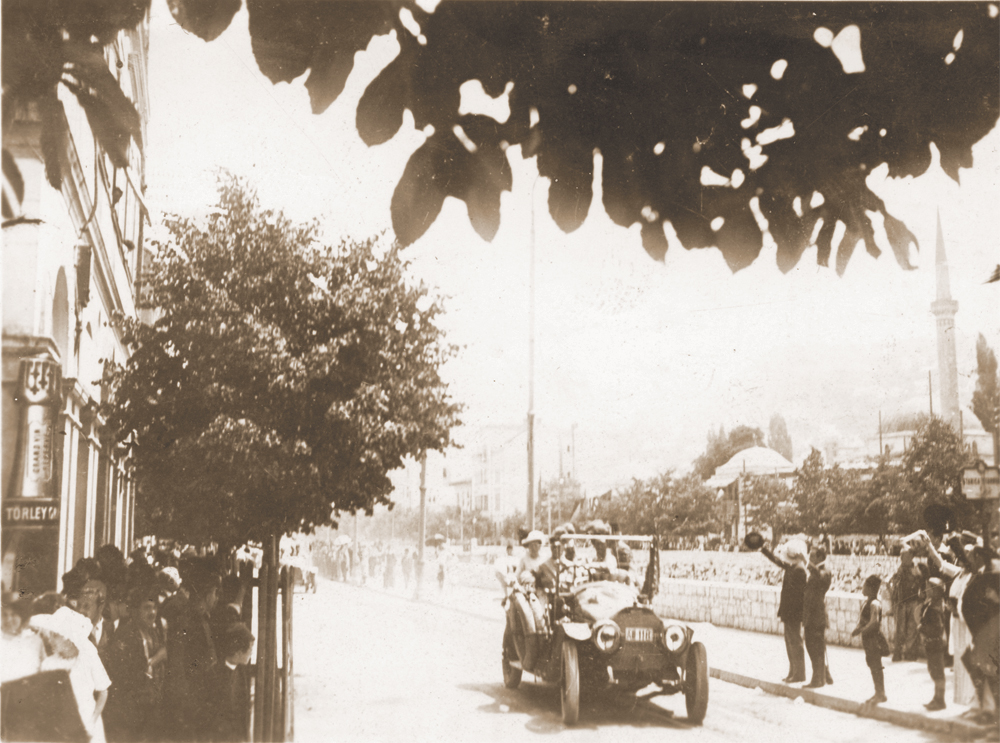
| *The exhibition "War who has finished in the world" opens in the multimedia art museum July 4, 2014. |
The military period of history has ended. I say, of course, En Grand. There can be no question of any immediate disarmament, but I am firmly sure that neither we nor our children of large wars-real European wars-will see, and our grandchildren and the small wars-somewhere in Asia or Africa-will also know only from historical works. ” So reasoned “at a tea table under the palm trees” somewhere on Riviera a large Russian official, bred by Vladimir Solovyov in “three conversations” written in 1899-1900. This was then the general opinion of the entire “civilized world”. The “real” large and long pan -European war has not been since 1814, from the time when the troops of the Russian Emperor Alexander entered Paris. The last war of European states among themselves-the Franco-Prussian-was virtually a short three-month military campaign (August-October 1870), a bloody knightly fight. After it, wars in Europe were successfully avoided. The thin ruling layer of European states was the only cultural, and largely related: representatives of the same aristocratic genera were in the armies and were in the civil service of many countries of the continent. A dense railway network, a developing steamer message made foreign travels with the norm for rich and educated people. The unity of Europe was very contributed to both the rapid growth of international trade and the new instant means - telegraph. What is the war? The world, a strong world for centuries. Everyone was sure of this, except for the anachronically thinking old warrior, revolutionary radicals who have excited the attacks of falling asleep Europe, and the eccentrics of philosophers who distinguished the terrible grimace of the coming war behind the pink haze of the world. Philosophers, among them Vladimir Soloviev, turned out to be prophets. Or maybe they clicked the disaster? 
The European commandments in 1859 Charles Darwin published its most famous work “The origin of the species”, in which he connects the development of wildlife with interspecific and intraspecific struggle for existence. The British philosopher Herbert Spencer extends these natural-scientific observations to the human race-both people separately, and peoples as collective personalities conduct a struggle for a place under the sun. And this is not enough space for everyone, Thomas Maltus also taught. Let the strongest win - this is the key to progress. In Germany in the 1890s, Friedrich Ratzel formulates the principles of “geopolitics” (“anthropogeography”)-teachings that the states and peoples, like animal populations, are conducting a natural struggle for “living space”. His ideas immediately gained popularity. Peoples as collective personalities are a legacy of romantic nationalism. The struggle of peoples for living space is the social development of Darwinism. The cult of power is a direct consequence of the substitution of Christianity with positivism. A person is not free in the choice between good and evil, but determined by his nature. The knowledge of the laws of the world and himself puts a person over good and evil, making these concepts outdated religious trash. Science cancels morality, making it either a natural necessity or a prejudice. Thus, the Frenchman Auguste Comte thought, the Englishman Herbert Spencer, the Germans Ludwig Feuerbach and Friedrich Nietzsche, the Russian Peter Tkachev. The combination of positivism, social darwinism and romantic nationalism creates a new European - at the same time self -confident and afraid that others will bypass him in the struggle for existence. "
“I am firmly sure that neither we nor our children of large wars - real European wars - we will see”
“Meanwhile, the cultural world experienced a technical revolution of an unprecedented scale. For those who were lucky or, if you like, who managed to“ make yourself ”, life quickly becomes not unreasonably pleasant - remember Oscar Wilde's heroes. To part with such a life on the battlefields, to give to the slaughter of the God of the War of their loved ones - therefore, the war - absurdity, barbarism, there is no place in a civilized world. But, but, but, but, but, but, but, but, but, but, but On the other hand, your people can be an outsider, it can lose in the international struggle for a place under the sun. And the peoples of the bourgeoisie, and the then relations of the metropolis with the peoples of the colonies subject to them were far from humanity - greedy, cynicism, the idea of the superiority of the highest race over the natives. And this was also projected on a possible relationship of those who won the race with the losers. Therefore, keeping the European world, it is necessary to achieve hegemony over other peoples with bloodless means. Thanks to the massive printing and widespread newspapers, the ideas of philosophers at the end of the 19th century spread very quickly in societies. Elitarian became popular in years. The three strongest
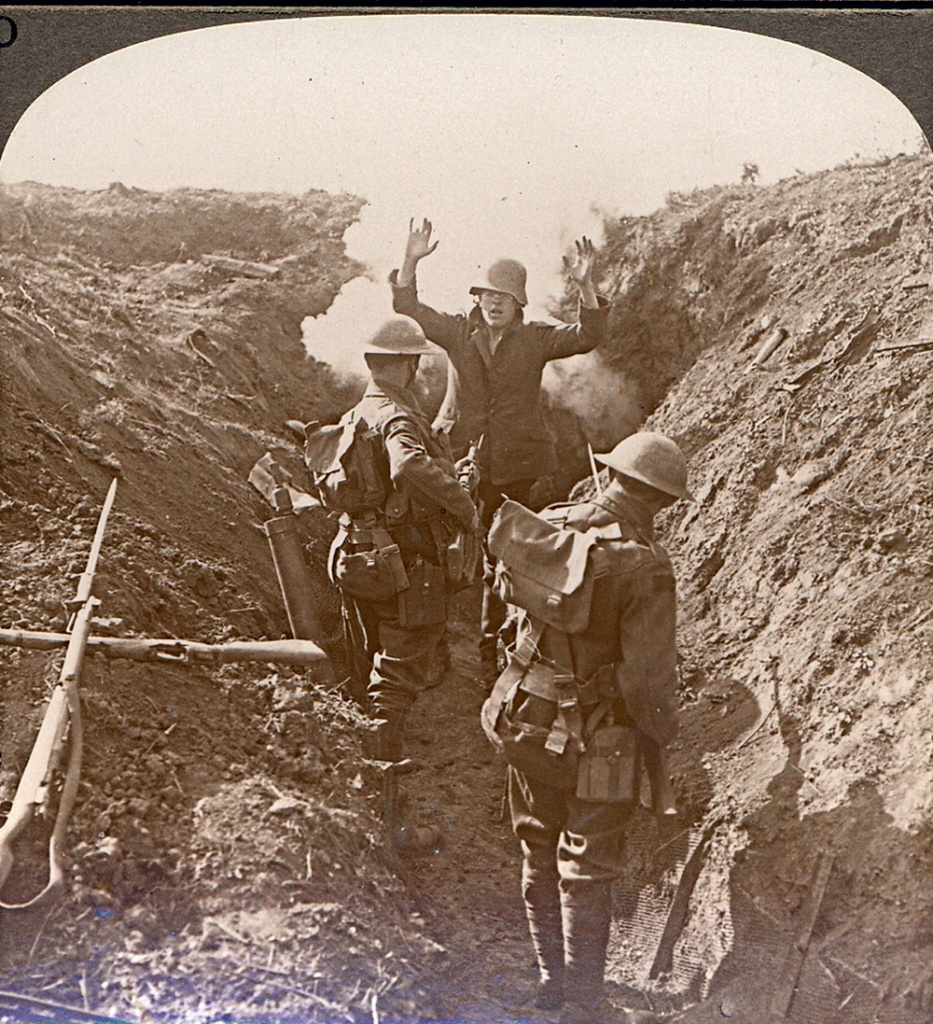 |
| British soldiers are captured by German |
Super -Personal, and the only one, in the 19th century was the UK. After the Civil War, Cromwell and the glorious revolution, she did not know crushing defeats and from all European wars came out of the undefeated one. And this happened not so much because of military power as due to economic power and skillful diplomacy. The first steam machines, the first ships, again driven by steam, railways, rifled weapons-all this was mastered and massively produced in the UK. Thanks to the exceptional enterprise, personal freedom, and the early democratic forms of their state, as well as a sense of personal responsibility for all their actions, the British, characteristic of the middle of the 19th century, conquered most of the world. After the defeat of the Franco-Spanish fleet under Trafalgar in 1805, Great Britain had no rivals at sea. For an island state, which also had an extensive overseas empire, this was extremely important. Protected by the sides of his ships, first oak and then chained in steel armor, the British empire could live calmly. In 1875, coal was extracted in the British Isles and cast iron was smelted more than in the rest of the world. By force, bribery, skillful game on the contradictions of potential rivals of Britain the rule of the world. France recognized its power in 1815 after Waterloo, Russia-after the Crimean disaster of 1855. The rest of Europe, fragmented into many small states, did not go into account. Under the respectable power of Queen Victoria, who reigned two -thirds of the century (1837–1901), an empire over which the Sun never entered was prosperous. But in the 1860s, the situation began to change. A new superpower arose on the continent. It was Germany Chancellor Bismarck. Having defeated Austria, Denmark, France in short victorious wars, Prussia united German -speaking lands with a complex system of interstate unions. The Germans could have competed with the British earlier by hard work, education, technical ingenuity, and Protestant responsibility. But for national greatness they lacked state unity. Now it has appeared. Germany began to catch up with all the parameters, and by 1913 she overtook the UK. She created the best army in the world and quickly approached the "lord of the seas" in the number of first -class warships. Both nations, and the Germans and the British, consisted of free educated citizens and were exclusively consolidated not by the external power of the tyrant, but by the internal consciousness of their mission. In recent decades of the 19th century, another great power was built behind the ocean-the North American United States. By 1913, they left far behind both Germany and the UK. The United States became a symbol of the new, coming world of the twentieth century - the world of huge factories, skyscrapers, high -speed railways, in electric light of cities, industrial agriculture and broad democracy. But America has not yet intervened in European disputes.
Search for allies
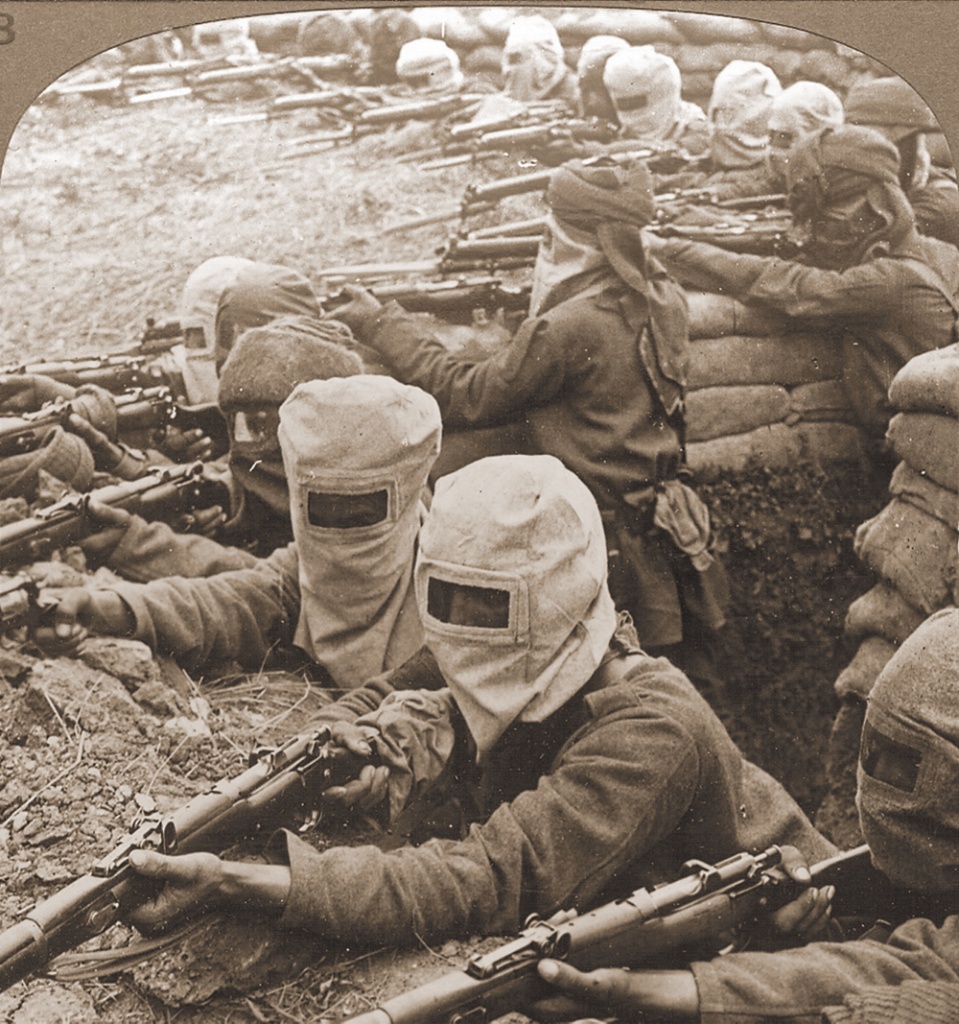 |
| Infantry in gas masks shooting at the retreating enemy. Collection of P.V. Khoroshilova |
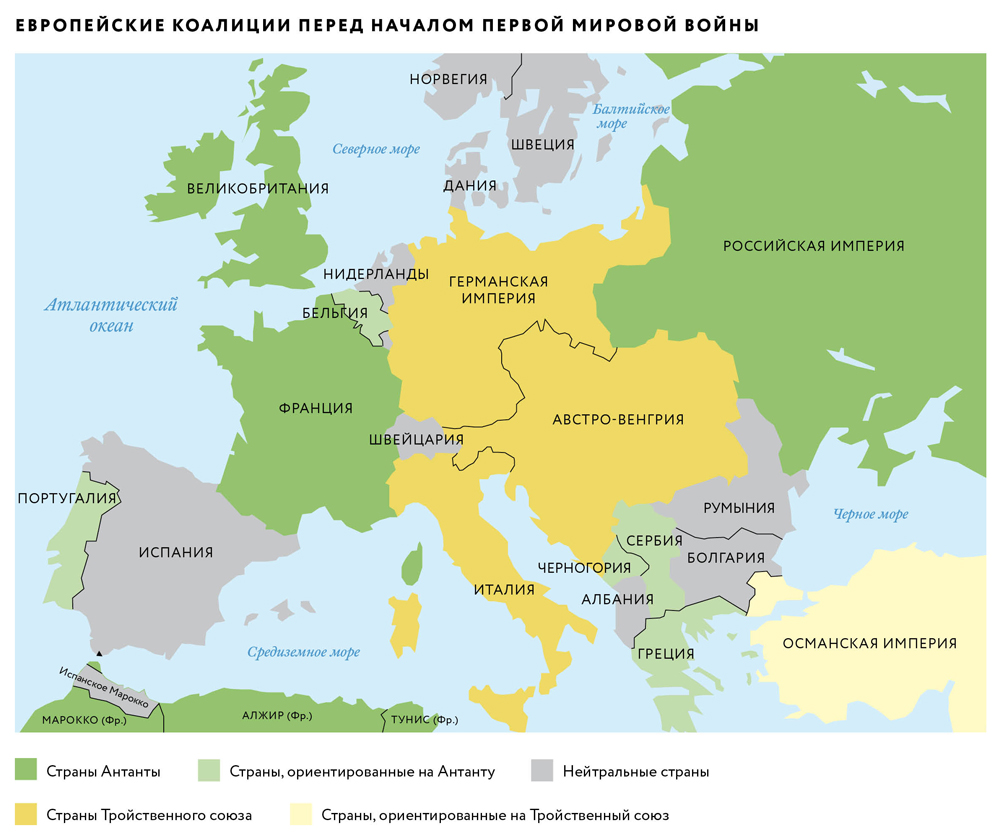
So, since the war in Europe, according to the general opinion, was excluded, the rivalry of the superpower - England and Germany - could only be conducted in the system of political unions. The era from the Franco-Prussian war to the First World War became time when the diplomats replaced the generals and admirals-the system of two coalitions developed in Europe. The main role in these coalitions was played by three powers - the Austrian Empire, the French Republic and the Russian Empire. Behind them were the Italian kingdom and the Turkish great Sultanate.
After the battle between Austria and Prussia under Sadovaya (Northern Czech Republic) in 1866, Austria for a long time became a younger ally of Germany. The unity of language and history strengthened this union. But Austria was far from as monolithic as Germany. The empire, which was called the “patchwork”, teased cruel ethnic conflicts - first with the Hungarians, then with the Italians and Slavs. If the boundaries of Germany coincided largely with the boundaries of the resettlement of the Germans, then about Austria and even about the double Austria-Hungary (since 1867) this cannot be said-the Slavic regions in the south (Croats, Slovenians, Bosnians) and the Slovaks, Poles, Ukrainians, Russian, Rusyns) destroyed the German-Hungarian binomination, threatening the collapse of the whole complicated structure "Dual monarchy." The Slavs of the Austrian Empire, with the exception of the Poles, with hope looked at Russia and it was with it that they combined their aspirations for autonomy and freedom from the Germans and Hungarians. Fear of Russia even more random Vienna with Berlin.
With the mediation of Germany, Italy and Austria, it was possible to settle territorial disputes in the Balkans and in Tyrol. Italy was a weak, still not prevailing country, rather a blind garibaldi from gypsum, and not crushed, like Germany Bismarck, from steel. Her poor, largely illiterate people (if in Germany, out of a thousand recruits, two were illiterate, then in Italy - 306) he was massively going to work in the New World. But the Italian kings, after Napoleon III was the rejection of Piedmont, their tribal domain, Savoy and Nice, were extremely anti -French and revenge. Germany and Austria accepted Italy in the Union, which finally developed by 1887 and became called triple. At the same time, Germany tried to get Turkey as an ally by all her might. The once vast state of the Great Sultans, back in the middle of the 17th century, forced the Germans, Italians and Hungarians, was now called only "sick man in Europe." A piece of a piece was falling away from him - both in the Balkans, and in Africa, and in Asia. Arabs, overwhelmed by the awakened national feeling, raised uprisings against the Turks. The Germans promised the Sultan strength and stability, and they themselves saw his state with a bridge to British India and to the possessions of the French and the British in North Africa. Gradually, to the displeasure of the Russians and the British, the great Sultanate became a younger ally or even the vassal of the German Empire.
"
Germany began to catch up with all the parameters, and by 1913 she overtook the UK. She created the best army in the world
“France, which has lost its dominance in continental Europe after the defeat of Napoleon I, was even more humiliated and weakened by the defeat of 1870, when the German -speaking gag -speaking provinces of Elsas and Lorraine was rejected. Ethnically monolithic France was torn apart and mutual hatred of the Republicans and royalists, the mutual hatred The Catholics of the Liberals, a wave of public turmoil, raised by the Great Revolution of the late XVIII century, did not fall, giving birth to a revolution after the revolution - 1830, 1848, 1871 ... At the same time, the French made the French with the sworn enemies of the Germans It was less than 2/3 of the German and about 4/5 of the Austrian industry. With a long border with Germany and military weakness, France needed reliable allies.
The most natural and desirable for France was an alliance with Great Britain. But that, having many conflicts with France in the division of colonial spheres, was in no hurry to give obligations to a continental neighbor. Not hoping to rely on England and, moreover, realizing that its land forces are relatively small, and the war will unfold on land, the French turned to Russia, which in the last hundred years they often fateful and rarely have been in the alliance.
The choice of Russia
The immense territory and the enormous population (almost three times higher than the population of Germany), colossal natural resources and a rapid, comparable to the United States, made Russia a welcome ally. Russia possessed the largest army in the world. Despite the defeats that she suffered in the Crimean and Russian-Japanese wars, and the French and the Germans considered the Russian army a “steam rink”, which could roll Europe hostile to her.
But Russia was a difficult ally. And the point was not only in the absolutist political regime. Like France, Russia experienced huge social stresses, but here they were generated by long serfdom. Formally, peasant non -freedom was canceled in 1861, but its consequences not only did not weaken, but even exacerbated. The Damocles sword of black redistribution hung over Russia. A significant part of the formed layer of the empire was on the side of the people against the imperial power, making up the "caste" of the intelligentsia. Liberals came out of the intelligentsia, striving to limit the king’s power, and the radicals, eager to destroy the building of the empire to the ground. To this, acute interethnic conflicts in Poland, in the Caucasus and in the Baltic provinces were added. The vast majority of Russian citizens were illiterate, ignorant and poorly adapted to rapidly changing living conditions. If the socio-economic development of the North American states was a powerful progressive process, then Russia's rapid development was seen, and it was feverish, in many ways unhealthy.
The archives of the German Ministry of Foreign Affairs discovered after World War II and the archives of the German Foreign Ministry showed that the leadership of the German Empire planned to achieve world hegemony through Russia's submission. There were various scenarios of such submission - from allied relations to conquest, rejection of the Western regions and the creation of a vassal state in Great Russia. The huge natural wealth of Russia and human resources would make Germany invincible. Talking about the "marriage of a courageous German active principle with feminine limp Slavs" were widely widespread among the Germans. By the beginning of the twentieth century, Russlandpolitik became an obsessive idea for the Germans.
"
Italy was a weak, not yet prevailing country, rather a blind garibaldi from gypsum, and not crushed, like Germany Bismarck, from steel
"The Russian Imperial House and the Russian Aristocratic Elite, the German Empire was much more sympathetic than the Republican France. The Russian army was built on the model of German, with Germany there were close dynastic relations and mutually beneficial commercial relations. But under the alliance with it, Russia was lowered to the second-grade ally, became agrarian-ravine and human continuation industrial In addition, the Austro-German Union was largely aimed at monitoring the Slavic world of Central and Southern Europe.
The alliance with France was equal and equal to both countries. Like France, Russia felt very vulnerable in the face of growing German power. In spirit, the republican “godless” France was alien to the absolute monarchs, especially the conservative Alexander III, but the sober political calculation prevailed over emotions. Игнорируя прогерманские круги Санкт-Петербурга, в 1891 году Александр III избирает союзником Францию. «Нам действительно нужно сговориться с французами и, в случае войны между Францией и Германией, тотчас броситься на немцев, чтобы не дать им времени сначала разбить Францию, а потом обратиться на нас», — давал царь в 1892 году указания МИД России. В добавление к политическому союзу в 1892 и 1894 годах между Францией и Россией были заключены секретные военные соглашения.
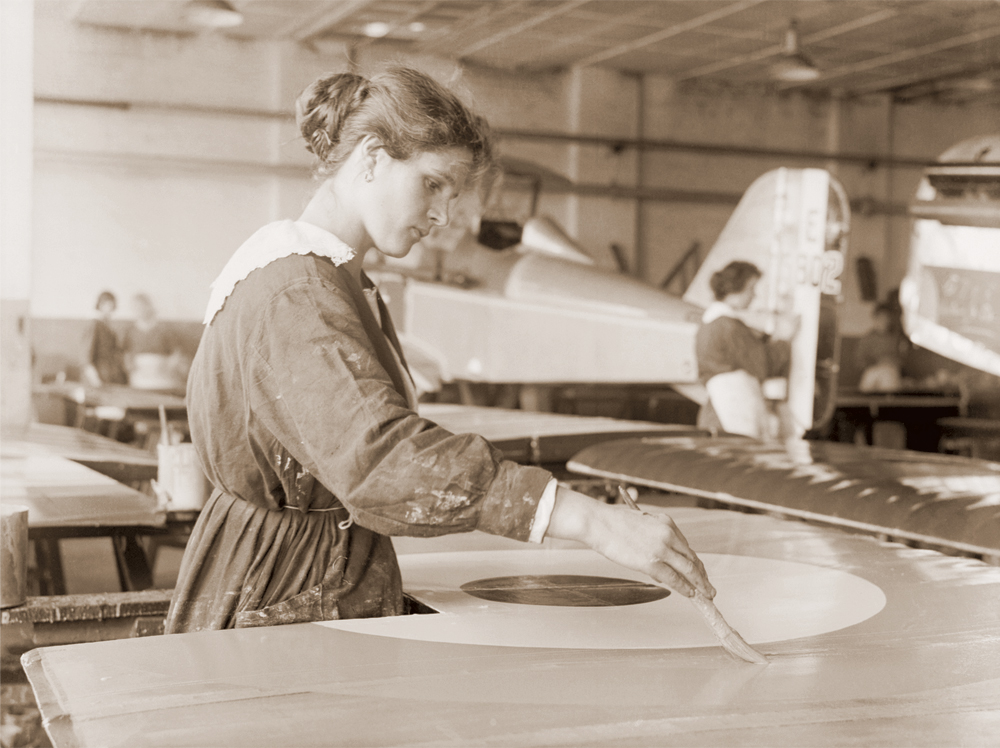
Рабочая фабрики Austin Motor Company в Бирмингеме рисует круг на крыле самолета SE5A. Сентябрь 1918. Собрание Имперского военного музея, Лондон
Entente
В 1898 и 1901 годах две европейские сверхдержавы — Великобритания и Германия попытались заключить союз между собой. Но переговоры закончились неудачей. Лондон отказался предоставить Берлину свободу рук в континентальной Европе. Англичане ясно понимали, что подчинив себе все европейские державы, Германия все равно не перестанет соперничать с Британией, в том числе и на морях. И тогда шансы на победу будут существенно хуже, нежели при союзе Англии с рядом держав континента. А особые отношения Англии с Францией не устраивали Германию. В конце концов в апреле 1904 года Англия и Франция, к великому удивлению и огорчению Берлина, вступили в согласие (Антанту). В 1907 году Великобритания, до того скорее враждебная России из-за соперничества на многих колониальных театрах — в Китае, Центральной Азии, Иране, Турции, — заключила и с ней такое же согласие, как и с Францией. Сложилась трехсторонняя Антанта — самая сильная коалиция Европы. С ней союзническими договорами были связаны Сербия, Греция и Бельгия.
В 1912 году военные силы сторон были следующими:
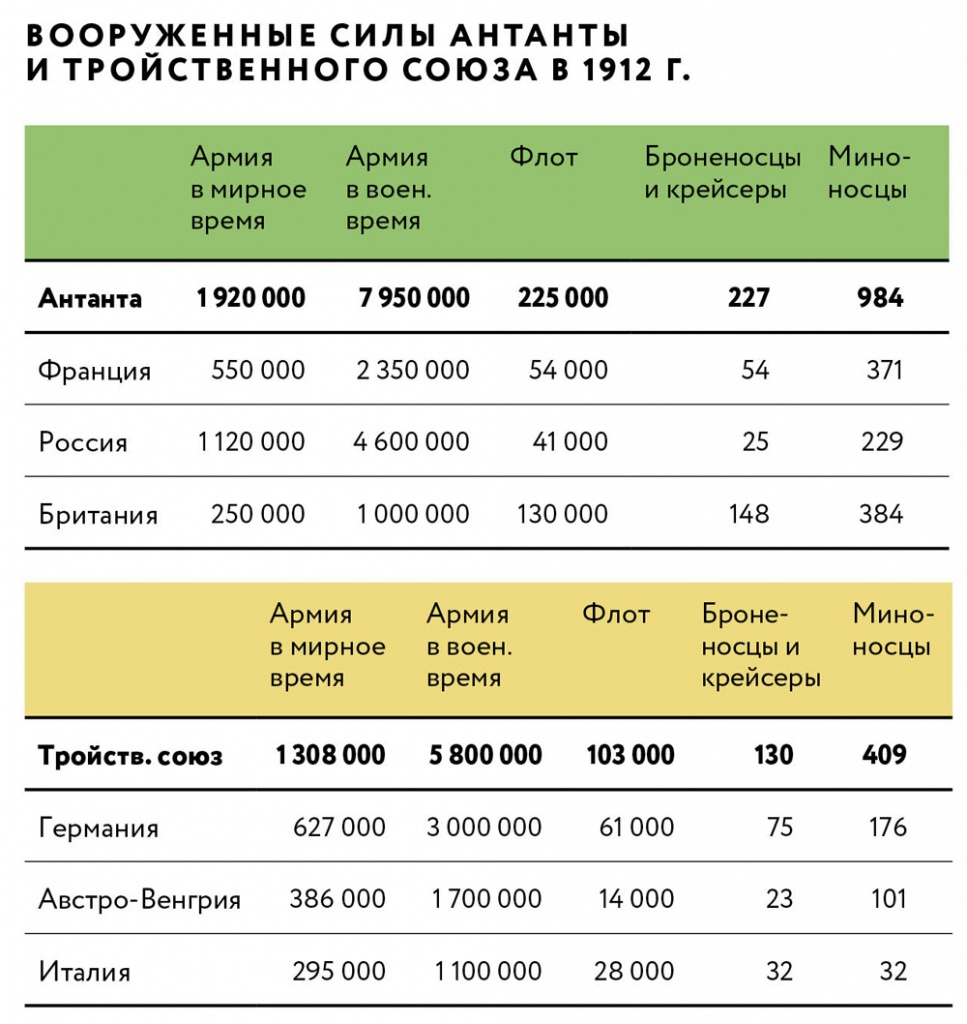
Германия имела протяженные сухопутные границы с Францией и Россией, Италия — с Францией, Австрия — с Россией. Тройственному союзу в случае войны пришлось бы воевать на два фронта. Немецкие генералы этого очень боялись, понимая, что объединенные силы Антанты их превосходят. Англия главенствовала пока еще на морях, и Тройственный союз ожидала жесткая блокада. Своих людских, природных и сельскохозяйственных ресурсов Германии, Австрии и Италии было явно недостаточно для ведения долгой современной войны, требующей постоянного производства вооружения, боеприпасов и продуктов питания. Войну, если она все же начнется, надо было провести быстро (блицкриг) и одновременно вести ее только на одном фронте. Тогда шанс на победу имелся. В ином случае разгром Тройственного Союза был практически неизбежен.
Немцы всеми силами пытались разрушить союз Франции, Англии и России. Один раз, во время встречи императоров Вильгельма и Николая в Бьёрке в 1905 году, это почти удалось — германский император уговорил российского. Но воспротивились министры, возмутилась Дума, и Николай II отказался от своих слов.
"
Русские о планах Германии были прекрасно осведомлены — начальник австрийской военной разведки полковник Альфред Редель был русским шпионом
” Терпя дипломатические неудачи, немцы сосредоточились на том, в чем были особенно сильны — скрупулезном, тщательном планировании. С самого момента заключения франко-русского союза, с 1891 года, германский генеральный штаб под руководством Альфреда фон Шлиффена разрабатывал такой план войны на два фронта, при котором одновременно пришлось бы воевать только с одним противником. Суть плана состояла в следующем. Русская армия из-за технических слабостей – плохих и редких железных дорог, полного отсутствия шоссейных, а также общей славянской нерасторопности будет осуществлять всеобщую военную мобилизацию 105-120 дней. Германия же должна провести мобилизацию в кратчайшие сроки – за 15 дней, разгромить Францию за шесть недель с помощью действующей на южном направлении Италии, а потом всеми силами броситься на Россию, еще не закончившую мобилизацию, и раздавить ее. Отвлекающие военные действия, до нанесения решающего удара Германией, должны осуществлять против России Австрия и Турция. Немцы, в крайнем случае, были готовы сдать русским всю Восточную Пруссию с Кенигсбергом и уйти за Вислу под защиту привислянских крепостей в Торне и Данциге; австрийцы – пожертвовать Галицией, но только не снимать до разгрома Франции войска с западного фронта.
Координация германского генштаба с австрийским была полная. Русские о планах Германии были прекрасно осведомлены — начальник австрийской военной разведки полковник Альфред Редель был русским шпионом и до 1913 года сообщал все тайные разработки германского и австрийского генеральных штабов в Петербург.
Хотя державы Согласия надеялись, что их союз, особенно после присоединения к нему Великобритании, остудит горячие головы в Берлине и предотвратит войну, они тем не менее готовили свой план военных действий на случай германского нападения по Шлиффену. «План XVII» Антанты предусматривал, что Россия силами двух армий начнет военные действия против Германии и силами четырех армий — против Австрии уже через две недели после объявления войны, не дожидаясь завершения мобилизации. Это заставит немцев снимать дивизии с западного фронта и перебрасывать их на восток для спасения Восточной Пруссии и своего австрийского союзника. План Шлиффена таким образом будет сорван, и Германия, вынужденная воевать на два фронта, проиграет.
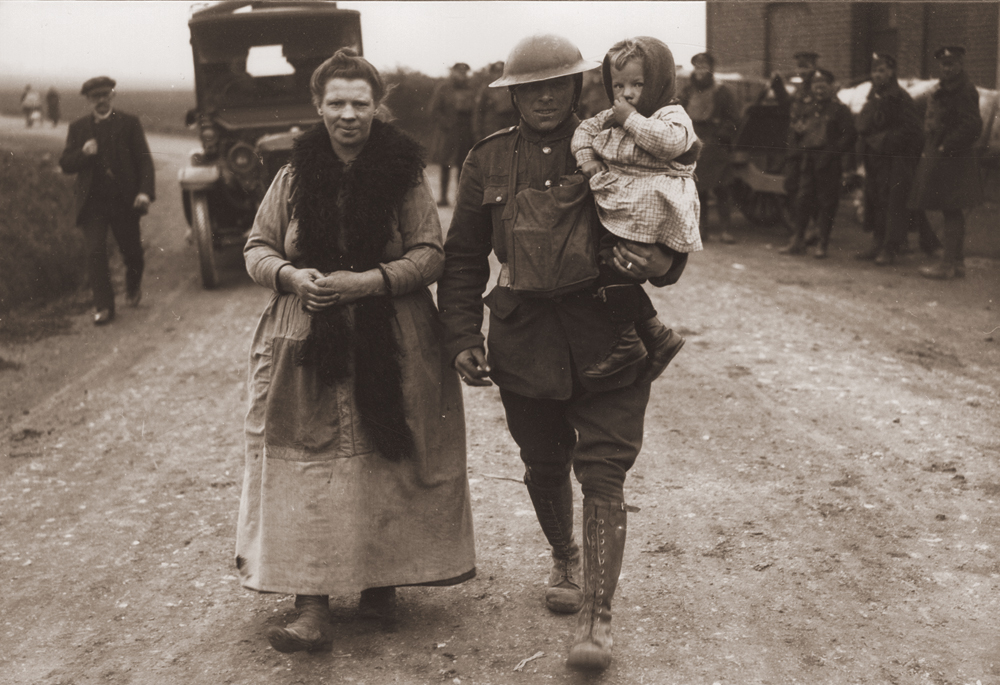
Англичане в Бельгии. Частная коллекция, Франция
«Теперь или никогда»
| *Текст записки опубликован в журнале «Красная Новь», №6 (10) за 1922 г. |
Франция прикладывала немало усилий, чтобы помочь России развить сеть железных дорог и мостов в прифронтовой полосе. В 1912 году Россия приняла, а с 1914-го начала осуществление Большой военной программы, которая, в частности, к 1917 году сокращала сроки всеобщей мобилизации до 18 дней и существенно модернизировала вооруженные силы. С завершением этой Большой программы план Шлиффена становился совершенно нереализуемым. «В 1918 году, если им удастся выполнить свою программу, русские окажутся в Берлине быстрее, чем немцы – в Париже», - считали в германском генеральном штабе. В Берлине в 1913–1914 годах стали говорить об «упреждающем ударе». Напротив, Россия в войне была не заинтересована вообще. Очень многие здесь понимали: война может быстро перерасти в революцию. Один из видных сановников империи, бывший начальник департамента полиции и министр внутренних дел Петр Дурново в феврале 1914 года подал императору записку об опасности войны для России. Если военные действия будут складываться для нас неудачно, писал Дурново, то «социальная революция в самых крайних ее проявлениях у нас неизбежна, так как нынешний строй позволяет во всех неудачах винить правительство и монарха. На место кадровых офицеров, которые погибнут в первые месяцы войны, придут гражданские новобранцы, не имеющие ни авторитета среди солдат, ни чувства долга. В результате — крестьянская армия начнет разбегаться, опасаясь не успеть к переделу земли в деревне. Либералы в начавшейся смуте не смогут удержать власти, так как народ не знает и не понимает их идей, и Россия будет ввергнута в беспросветную анархию, исход которой трудно предвидеть»*.
"
Россия в войне была не заинтересована вообще. Очень многие здесь понимали, что война может быстро перерасти в революцию
” Проницательные наблюдатели, однако, понимали, что время работает скорее на Антанту, нежели на Тройственный союз. Экономика Британской империи и Франции развивалась пусть и медленнее, чем германская, но стабильно. Россия же развивалась стремительно, и постепенно ее социальные диспропорции и напряжения начинали сглаживаться — земля переходила от разорявшихся помещиков к крестьянам, средний образованный слой разрастался, промышленность и инфраструктура диверсифицировались и укреплялись. «Двадцать лет без войны — и в России революция произойти уже не сможет», — говорил в 1910 году русский премьер Петр Столыпин. Союзники же Германии, наоборот, не крепли, а слабели. Австро-Венгрия и Турция трещали по швам, Италия теряла население. Глава германского МИДа Готлиб фон Ягов откровенно говорил: «Спустя несколько лет, по всем вероятным предположениям, Россия будет готова к войне. Тогда она задавит нас количеством своих солдат, построит Балтийский флот и свои стратегические дороги. Тем временем наши союзники будут становиться все слабее».
Соперничество в условиях мира очевидно вело к гегемонии Антанты над Тройственным союзом, Англии — над Германией. Победа в стремительной войне также с каждым годом становилась все менее реальной. Господство над миром, такое явственное для Германии в конце XIX столетия, на грани второго десятилетия века ХХ рассеивалось как мираж. Немецкие политики и генералы постепенно склонялись к той мысли, что для всемирного величия их страны остается последний шанс: «Теперь или никогда».
Сто лет назад
28 июня 1914 года — в Сараево девятнадцатилетний сербский студент Гаврило Принцип, член террористической организации «Млада Босна», боровшейся за объединение всех южнославянских народов в одно государство, застрелил австрийского эрцгерцога Франца Фердинанда.
5 июля — Германия обещает поддержку Австро-Венгрии в случае конфликта с Сербией.
23 июля — Австро-Венгрия заявляет, что за убийством Франца Фердинанда стоит Сербия, и объявляет ей ультиматум с заведомо невыполнимыми условиями. На ответ дано всего 48 часов.
«Вечером… австро-венгерский посланник в Белграде вручил сербскому министру иностранных дел ультиматум, который составил предмет удивленного негодования всей Европы и появлением которого отмечена в истории не только Европы, а и всего света новая эра… Требований, как те, которые в нем заключались, еще никогда не предъявлялось ни к одной европейской державе, и… принятие их Сербией в полном объеме равнялось бы добровольному отречению от национальной независимости». (Из мемуаров Сергея Сазонова, министра иностранных дел Российской империи в 1910—1916 годы.)
В тот же день Сербия начинает мобилизацию.
25 июля — Германия начинает скрытую мобилизацию: на призывные пункты направляют повестки резервистам.
26 июля — Австро-Венгрия объявляет мобилизацию и начинает сосредотачивать войска на границе с Сербией и Россией.
28 июля — Австро-Венгрия, заявив, что требования ультиматума не выполнены, объявляет Сербии войну. Начинается обстрел Белграда из тяжелой артиллерии. Регулярные войска Австро-Венгрии пересекают сербскую границу. Россия заявляет, что не допустит оккупации Сербии.
29 июля — император Николай II отправляет Вильгельму II телеграмму с предложением «передать австро-сербский вопрос на Гаагскую конференцию» (в международный третейский суд в Гааге). There was no answer.
30 июля — началась частичная мобилизация во Франции.
31 июля — объявлена всеобщая мобилизация в России.
В тот же день Германия предъявляет России ультиматум: прекратить призыв в армию или Германия объявит войну России. Франция, Австро-Венгрия и Германия объявляют о всеобщей мобилизации.
1 августа — Германия объявляет войну Российской империи.
фото предоставлены Мультимедиа Арт Музеем