
Translated material
Death battalion
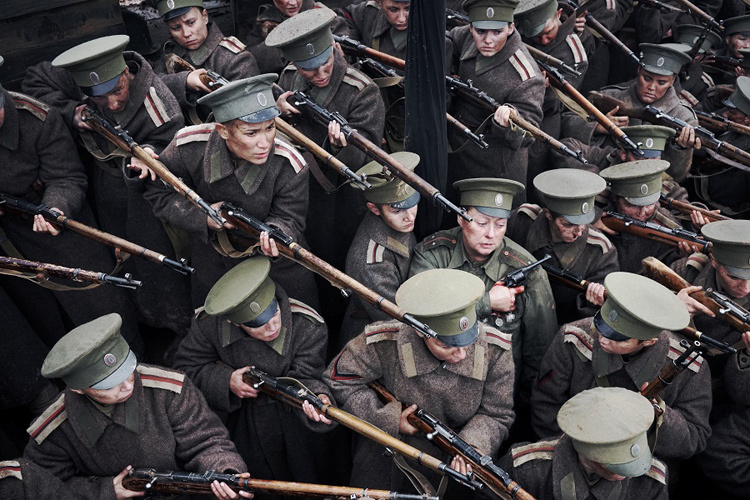
In an endless trench is an endless string of women. In his hands, each of them holds on a lit candle. Each outline is in great and bears the form of the time of the First World War. Around is very quiet, and therefore you can hear that these women are praying. The camera smoothly glides over their heads without malls. In addition to the goals, the viewer sees the setting sun and the field somewhere under the Smorgona.
It is very difficult to write about films. Especially if you did not watch them. The “Death Battalion” directed by Dmitry Meskhiev, produced by Igor Zakulnikov and created with the support of a military-historical society, Channel One, the Ministry of Channel and, it seems, Gazprombank, refers to such films. All that is known about him is the two reports of Channel One, in which the announcer touchingly talks about the forgotten heroes of the forgotten war, and several scenes shown to journalists during the presentation of the film held as part of the XXXVI MMKF.
However, the shown several scenes are enough to judge the whole film in general terms. Perhaps these assumptions will be erroneous. If so, the better.
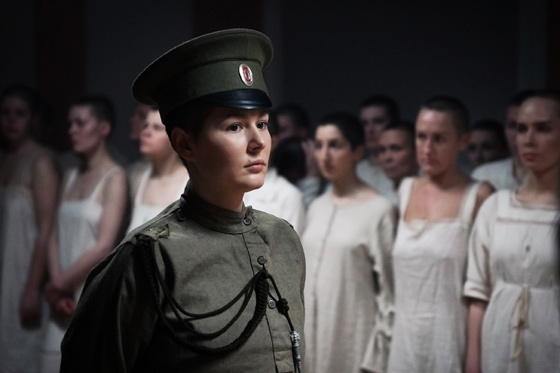
The scenes shown are few. We see how some hero goes to the station in Petrograd. Passengers scream around, but the scene does not seem too crowded. The hero hires a cab. After February, the cabs became roads. We see how Maria Aronova, an actress with a kind face and a big comic talent, plays Maria Bochkarev, who leads the shock female death battalion. She seems harsh, even cruel, but this is the cruelty of the motherland. We also see how beautiful girls are overwhelmed by hair (actresses talked a lot about how hard it was for them to go to it). Then beautiful girls in hysteria beat each other in the face - they need to be prepared for real battle with the enemy. Then - endless scenes of fighting near Smorgona. They are removed well, they look exciting. Someone is hurt, someone begins to pray loudly, the enemies surround the battalion from all sides.
 © MMKF
This film has not yet been shown, but it seems that we have already seen it. Only then was it called the “Admiral”, and then he walked in the form of a series along the first channel. It also seems to be called “Chapaev” and also walked along the same channel. Next year, he will probably be called Denikin. Either “Wrangel”, or “Miller”, or “Yudenich”, or “Kappel”, or “Ungern”, or “Old Man Makhno” (the military-historical society reported that 80 applications and scenarios dedicated to military events from the history of Russia were submitted to society, so there should be enough places for everyone). The simple and human history of people who love their homeland. There is nothing bad in the idea itself, but in realization - nothing revolutionary. The implementation can not be loved, but we do not have another yet.
All this fits completely into the current cultural policy, you will not surprise anyone now. Within the framework of this policy, really interesting works are sometimes created - it is enough to recall the Brest Fortress. Maybe the “death battalion” will be from interesting ones, it’s too early to judge. But now, in excerpts from the "battalion", two important details are attracted to the attention on which you need to stop.
Although everyone, from the Minister of Medinsky to the rank from the military-historical society, is repeated about forgotten heroes and unknown facts, the shock battalion of death has already appeared in the cinema. In one of the most important paintings by Soviet cinema - “October” by Sergei Eisenstein. Eisenstein depicted one of the companies of the 1st Petrograd women's battalion, which guarded the Winter Palace during an event, which is now commonly called the "October Revolution".
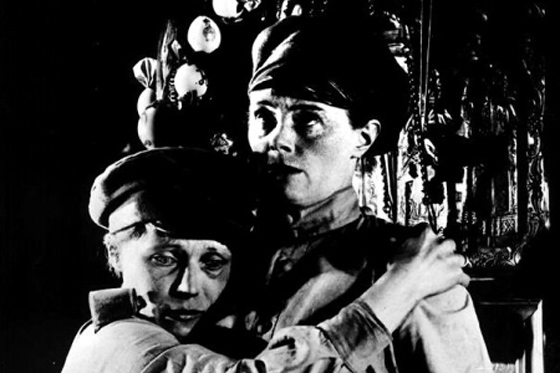 Frame from the movie "October", dir. S. Eisenstein
Meskhiev was hardly taken to review October (although this will become known for certain only after the film released on the screens), however, looking at the smooth movements of his cameras, at the neat traditional installation, you involuntarily catch yourself thinking that this film is completely opposition to Eisenstein. Eisenstein, who was often reproached with inhumanity, takes a mass, Meshiye - tells a simple personal story against the backdrop of great events. Eisenstein abuses caricature, Meskhiev creates human images. Eisenstein hysterically mounts, turning his picture into an incredibly rich intellectual comic, Meskhiev gives a wide canvas of pre -revolutionary life. Eisenstein is sarcastic, ironic, jokes and commented a lot, even his voice is heard in the dumb cinema, Meskhiev fully belongs to tradition, he makes patriotic cinema, and what more comments are needed for patriotic cinema?
It would seem that in terms of human intonations the advantage on the side of Meskhiev. Even the scenes at our disposal are enough to understand how not a dialectic it is. But here something amazing happens.
Through the dialectical calculations of Eisenstein, warm, human notes very often appear. His cinema should be inhuman, but the drummer leaned against Rodin's “spring”, and we see all the sadness in her eyes. She wants love, she is tired of a military uniform, tired of the surrounding nonsense, she is a person first of all, and only then a soldier. Or a few shockers are practicing guns. In the background, the sculpture of Kamensky "First Step". And when the pose of the drummers accidentally coincide with the mother’s pose from the sculpture, all the horror, all the unnaturalness of their classes immediately cast the viewer into the eyes.
It would be a mistake to say that Eisenstein shot class cinema. For him, the incoming revolution is not a class, but universal event, an event that will lead to the liberation of each person, and therefore he looks at cadets and shocks without hatred, sympathy often appears through his irony. Since all people are released in the film, the defenders of the old government will also become free. Only they did not understand this yet (this, of course, is about the truth of art). And therefore, Eisenstein’s intonations are often very human.
 © MMKF
But what about Meskhiev? In all the fragments of his film, through the tragic fate and human stories, something large and anxious, a huge charge of inhuman, which is contained everywhere, despite all the prayers, women of sighs and Babier Woe, peels out. In every battle, in every battal scene, the camera admires the war. We see the joy of the battle and the delight of the battle, the real war of the heroes, the war on which to die so glorious, the war, for which the boys are recorded in volunteers. This war is cruel, but also beautiful, even seductive. And it is important to pay attention to this.
Although Meskhiev and Ugulnikov say that they shot a patriotic movie, the scenes shown by them look like an apology of war in general. After them, stories about 80 scenarios sent to a military-historical society begin to seem very sinister. Have we forgotten that countless military parades and prolonged conversations about the glorious battles of the ancestors are needed only by society, which is preparing for a large, good war?
Of course, there is nothing more worthy of the return of forgotten names and unknown heroes. But what should be the form of this return? The First World War was a cruel and meaningless massacre that destroyed the old world. Starting formidable speeches about duty to the homeland, faith and civilization, it ended in universal disappointment. And hardly an attempt to expose her in the vigorous and heroic spirit of central television is the best form of reverence for the memory of its participants. Horace once wrote: “Dulce et decorum est pro-Patria more” , “Sweet and beautiful death for the Fatherland”-and almost any military film is an illustration of this line. But the drama of the First World War was refuted by Horace. Talking about this war, Ezra Pound wrote: “Died Soem Pro Patria, Non Dulce Non et Decor” , “And the Pro Patria , neither Dulce , nor et decor ,”. The suicide of civilization is the main impression of contemporaries from Somma and Verden. The situation with the show of fragments from the “Death battalion” becomes more ridiculous that through the street from the press center of the film festival, in October, a retrospective of films dedicated to the First World War passed. In the program-“On the Western Front without Changes” by Milestone, “Western Front 1918” Pabsta and “The Great Illusion” by Renoir-conducting films, films-accusations, demonstrating the meaninglessness of the First World War. All of them were shot by direct witnesses and participants in those events.