
Translated material
The troubled territory of freedom
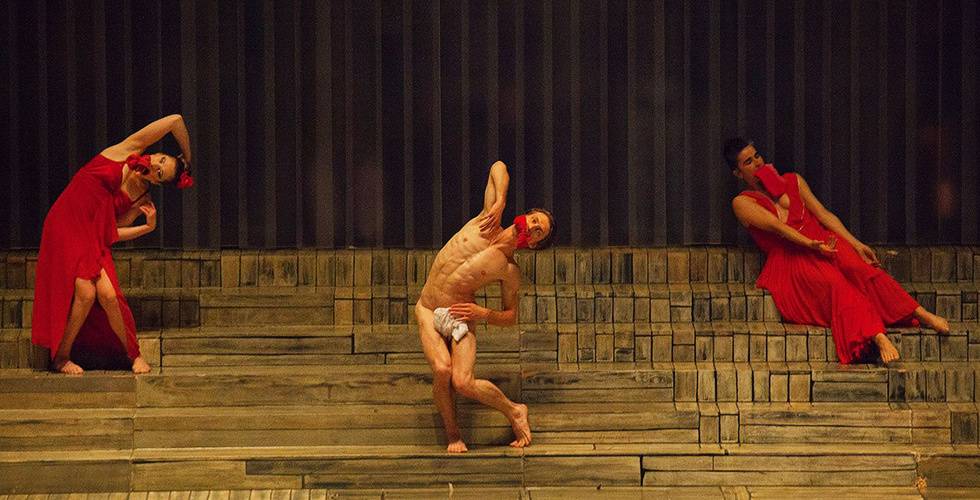
Today, in Perm, the Third Symphony of Mahler performed by the festival orchestra, in which the most enviable tops gather, ends the Diaghilev festival, the third during the local reign of Theodore Krentzis. There is nothing similar in the country, and in the current frightened times it looks quite an alien phenomenon. This is not a holiday - because you will not relax. Not a laboratory - because almost everything is completed and honed. This, probably, can be compared with the club of extreme sports lovers. Only at the Diaghilev festival, extremes of the musical and theater world gather. They recognize each other by the specific gloss of the eyes. Madrid, Berlin, Moscow, Peter, Greece, Finland, Belgium, Moldova, Tuva are being pulled out from everywhere-Madland,-making up some parallel map of the world, where Perm is not the end of the earth at all, it is worth it to be a stone's throw, it is worthwhile.
One of these was Gerard Mortier , who was posthumously at the current festival awarded Diaghilev award for the producing of the Perm-Madrid “Queen of the Indians” . Of course, Sergey Pavlovich Diaghilev was also one of them.
At the festival, fun and restless. Every day sucks under a spoon and adrenaline is expelled. Every now and then a step away from the usual, verified and permitted. And if you try here? And if here? Foothing borders. Intelligence of pain thresholds.
The point is not even the number of naked asses on the stage of the opera Theater. Although, of course, it’s scary to think about what would happen to our deputies, they, say,, say, an exemplary-provocative Madrid performance of Alena Payers “ C ( H ) OEURS ” , where they painfully pull their underpants to Wagner’s music, not forgetting to talk with the hall about democracy and tolerance. What a payer; In the charming musical and ziro "baroque carnival" French from LE Poeme Harmonique sings a counterattacent in a women's dress! Although, probably, not every deputy will guess that this is a man.
But the value and attractiveness of the festival is still different. In that common area, the shaky freedom, where the sounds ended, and the music by some miracle remained, where the integrity of the author’s opus finally lost its sacred status, where the facets between the opera, ballet, theater, circus, psychotherapeutic practice and social activity are dissolved in front of the composer and the performer. And in the formulation of new questions, to which only very subjective answers are possible, not necessarily coinciding even with the participants of the festival themselves.
The festival itchs from the distinction of opinions. Need Alla Demidova Opera Kurlandsky or not? Why did Anton Batagov dismember the Moon Sonata, shifting each part of Schubert's miniature? Why is her Aleksey Lyubimov with a kind of salon chic playing Hammer Clavir? Who is ready to endure the extravagance of the bosom of Patricia Kopachinskaya? And who is the inflated pianist Ollie Mustonen? And who - both at once, enthusiastically grabbing each other's musical phrases and scraps that once former Beethoven’s “cruiser sonata”? Or is it a "sonata" is still? Does the existence have the right to exist (let's call it so) the Trash-Video during the performance of the “Winter Way” or is there enough luxurious hooliganism that Hans Center has already created with the Schuberto masterpiece? (The Russian premiere of this very famous thing in 1993 was held at the festival, the genre of which is designated as “composed interpretation for Tenor and the Chamber Orchestra”; soloist - Steve Devisim, behind the remote control, Permyaki will bring her to Moscow to the “Territory” festival.)
The public issues begin in the morning and end late at night. This year, a festival tent was built in front of the Chaikov Opera and Ballet Theater with its huge free discussion and broadcasting program, where you can see, for example, the Berlin production of Chernyakov (who also goes around-came to the Dyagilevsky Prize ceremony), directly from the composer of Courlandsky to find out in his score of breathing. choral voices, and having already survived his “Nosferata”, go in again and try to speak out.
Despite a single taste vector, which, of course, is set by Kurentzis art, the festival program still leaves space for maneuvers. Therefore, the festival has a lot of different public, it is alive and motley. There is such an audience that claps between parts. There is one that does not clap between the parts. There are young people who lie in the dark under the piano during the night gala in the Diaghilev gymnasium-an extremely successful festival know-how, where participants change each other several times, and programs with performed works are not issued at the entrance to the hall, but at the exit. By the way, the leading workers of the Ruhr Tiennale or the Madrid opera are easily lie there. And there is such an audience that leaves the hall ahead of time, unable to withstand the test with unusual art. And it is precisely this audience that the Perm Greek Custezis calls its own-in three or four years he is waiting for her rebirth.