
Translated material
A text that should not be written?
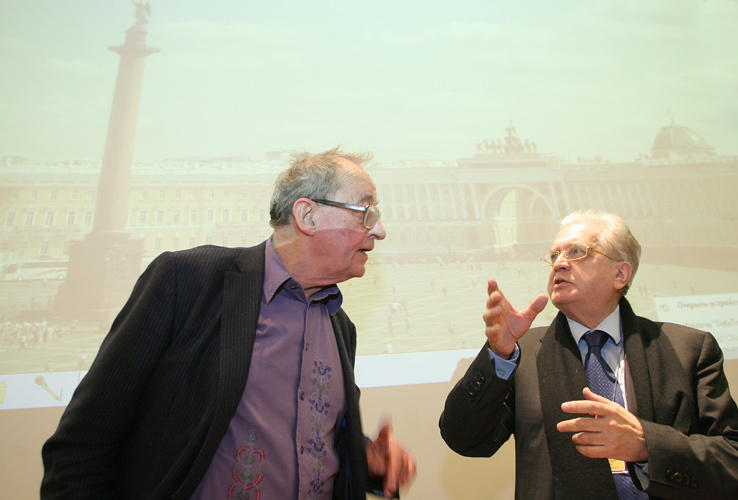
COLTA . RU represents the original versionof the article by Ekaterina Dygot, published in the journal E - Flux .
The time of action is very important.
The text for this book - about the political significance of Russian art - was ordered when Russia was already adopted in Russia against the “propaganda of homosexuality”, but Crimea was not yet annexed.
When he was annexed, it became finally clear that it was impossible to write such a text as if the “manifesto” in St. Petersburg was a regular exhibition in the usual (albeit with shortcomings) country, and I decided to eliminate this project.
When, in response to the public demands of the Boycott of “Manifesto”, the curator Kasper König said that he would not like if the manifesto “would not have been used by political activists as a platform for utterances” , it became clear to me that it was necessary to use this platform. But you need to talk not so much about the political significance of Russian art as about the political significance of the manifesto-10 in St. Petersburg.
Whether the decision was correct to write this text at the time of its writing is unclear. The subversive position is fragile and depends on the context - it always risks turning into legitimation. When and if this text is released, the situation may change. The time of action is very important.
At that moment, when I write these lines, in the east of Ukraine the Crimean script of the Russian annexation “at the request of the inhabitants” began, but the Third World War has not yet begun. The concepts of “foreign agent”, “fifth column” and “national traitor” used in the rhetoric of the Russian authorities have not yet been included. My close friends have not yet been arrested. Purely Russian analogue of Wikipedia and an alternative to VISA payment systems And MasterCard has not yet been created. The Ministry of Culture of Russia proposed supporting only those phenomena of contemporary art that implement a state order for patriotism and non-European identity, but the funding of the “manifestos” has not yet been discontinued. "Manifesto" should take place, but whether it will be subjected to censorship or self -censorship, is unclear.
The situation slides into the abyss with every second, the future is vague. One thing is clear: everything is very bad.
Is it so bad that Manifesto-10, whatever it becomes, could be considered an unambiguous, “civilizing” event in Russia, which moves into the abyss of militaristic aggressiveness, obscurantist obscurantism and fascist nationalism? Perhaps the rapid conservative revolution in Russia is equally rapidly saving not just a reputation, but the very identity of contemporary art? Or is this not so and the representation of contemporary art in an authoritarian context-what art in the 2000s goes more and more often-rather calls into question the whole foundation of this discipline? The glory of Zizhek has long claimed that “the eternal marriage between capitalism and democracy has ended”, but should not be said the same about the eternal, as it is believed, marriage of contemporary art and progressive thinking?
You need to talk not so much about the political significance of Russian art as about the political significance of the manifesto itself in St. Petersburg.
Since the 1990s, visual arts, with which (not least, for material reasons, for money rotating in this area of money), a critical theory concluded, as an exclusive zone of opposition thinking, where after 1989 the idea of communism (at the same time losing the contours of reality) has a “presumption of criticality”, and criticality, and criticality, and criticality on the left. At the same time, the main know-how of recent art institutions-developed in the 1990s in the system of large international exhibitions, which are usually paid from the city budget, and the “manifesto” here is a paradigmatic phenomenon-it is that the activities of critical agents of opportunist is carried out for money and with the consent of those who are criticized.
Although the “manifesto” only once passed in the country of the former communist camp, it is a brainchild of 1989, when new markets and new deposits of a diverse, including cultural and human, raw materials were opened at the same time. “Manifesto” usually works with “developing” artists and “developing” regions (Eastern Europe, as well as politically problem areas and depressed deindustrated regions of old Europe). Both of them and others develop somewhere, then towards the global market and post-industrial capitalism. This is clear with the countries, but the same applies to artists, for many of which critical, insofar, “biennal” art-“ephemeral” or activist, but in any question, questioning artistic autonomy-is a stage (although usually long) for the transition to a private-market gallery practice by years by years, when they are ceased to invite them to the Biennal. Critical art corresponds to a certain “stage of the career” in the artist’s life and in art in general, to which media attention is now focused. A “stage of capitalization” comes behind it, it unfolds already in galleries and fairs, and not at the biennal, curators are not interested in it little, and critics almost cease to write about it.
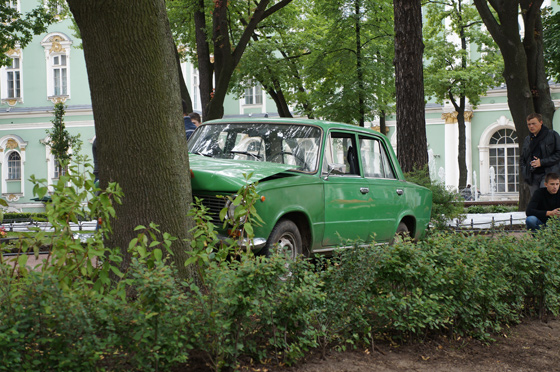 © colta.ru Francis Alus. Lada "Kopeika". 2014
In recent years, Manifesto has become the main station of this stage of a career for artists and curators, an indicative phenomenon of a new defet -shaped art market, where the buyer is not a collector, but an idle viewer, where state, city and corporate money, where a work is not sold as a unique object, but most often made to order and as part of a series or a circulation and where, instead Self -conference is a thematic and didactic principle that ensures the image of a socially useful phenomenon, which is necessary, in particular, to obtain urban financing. It is also, as it is believed, the zone of overcome (or at least critically meaningful) autonomy of art, since most Biennale represent the art of context. This is a strange market, which integrated the autonomy of art and even the market as such-under the indirect influence of Soviet experiments of the 1920s, perceived through European neo-Avangard after 1968.
Despite the non -profit status, the market and its ideology are located in the center of the Biennale system. It is not the goods who are fetishized here, but the central self -characteristics of the market are freedom, understood as the freedom of choice from the rich assortment of the existing one. That is why all the Biennale always represent something by the definition of a variety (different media, different artists, the variety of countries and continents, and never a monographic exhibition, for example). Multipulturalism is a purely market ideology. Such exhibitions also give work to independent (free) curators, which, as a rule, start by choosing a room, name, staff of employees - all that in other institutions is usually stable and more or less in advance data, and in the Biennale system refers to the authorship of the curator. Free curators personify the sacred cow of personal choice and carefully follow this as the highest ethics of their profession.
Critical art corresponds to a certain “stage of the career” in the artist’s life and in art in general, to which media attention is now focused.
This dominant of ideology and rhetoric of freedom in the “manifesto” and similar Biennale raises the question of how such freedom begins to manifest itself in non -free or not enough free contexts. The bureaucrat, who does not give the curator himself to solve creative issues, of course, does not understand the rules of contemporary art and is condemned; Even in the early stages of the preparation of “Manifesto”, the Fund specially emphasized in a special statement that the Hermitage “understandable” the idea of the creative freedom of the curator. At the same time, in the idea of free choice, the process itself is checked, and not the result: if the curator made an original choice, but then, as a result of a censorship act, what he chose is not given to him, this does not defeat the curator at all and, moreover, makes this choice (which it is possible to communicate in the press) as if even more significant.
This whole system of mutually beneficial relations of several social and political groups is based on understanding by all aspects of the rules of the game. Initially, it was assumed that the machine of the opportunistic subversion would work in St. Petersburg, and this would happen if the Russian government agreed to endure harmless criticism in exchange for economic benefits. So, in many ways, until recently, it was, Russia seemed to be one of the territories of contemporary art. In fact, as it turned out, this inclusion was very fragile and barely existing - in the described “career global”, represented by the “manifesto”, Russia was even more included in the international art market, represented, say, the Art Basel fair. Until recently, there was a gallery from Russia and in some places Russian artists were pointed, but absolutely no curatorial or museum careers in Russia were and are still not convertible abroad-even with the loss of several steps of the career ladder.
In post -Soviet Russia, contemporary art was legitimized differently, not by its critical function, not by social rhetoric, but in a more traditional way, as an exclusive product that strengthens this country the logic of inequality: in a naive version - expensive goods for rich collectors in the literal sense of the word, exclusive knowledge for the intellectual elite (In order to evaluate a socially oriented work of contemporary art, you need to be a member of the sophisticated international community).
Despite the non -profit status, the market and its ideology are located in the center of the Biennale system.
The Hermitage with its installation on the "high art" and the precious collection plays a special role here. This museum, whose identity has always been based on gold (Scythians or kings), has always been a special and in a sense of the classroom opposed the typical Soviet museum with documents and ideological paintings, the didactic and antifothyshist museum in nature. In Soviet culture, the Hermitage, together with other St. Petersburg palaces, was a rare zone of “rhetoric of wealth”, which, according to conservative logic, was linked in the public consciousness with the “high art” zone. It was as the “Museum of Wealth” that the Hermitage could afford - and allows you to still look down at uneducated, including uneducated officials.
Initially, it was assumed that the “manifesto” in St. Petersburg would be held in such an enclave of autonomy, which was found by real and symbolic wealth, and this was the political calculation - the authority of the Hermitage will serve as a protection from attacks on contemporary art, which did not come from the state a year ago, but from individual fanatics associated with the Russian Orthodox Church and the Cossacks. This calculation is fundamentally different from all previous editions of “Manifesto”, which rather worked with “interesting poverty” than with “interesting wealth” (despite the fact that in Russia and St. Petersburg there is enough poverty). However, it is possible, initially, the choice of St. Petersburg for the anniversary tenth "manifestos" outlined an attempt to break out of the paradigm of the "career" young art, which is too compromised. Already in Manifest-9 in Genka, held in a typical industrial hangar, there was a museum and historical part, subordinate to the post-industrial theme of the exhibition. The context of the Hermitage with its legendary wealth could provide an even more interesting challenge, similar to the one that was radically formulated by the left-wing artists and theorists in the USSR in the 1930s, feeling the exhaustion of the militant paradigm: the search for humanistic foundations of classical art, the search for universal and true, in the opposite of the momentary political political tasks. This risky conservative turn for the sake of approaching the true foundations of contemporary art, not yet instrumentalized by creative capitalism, probably lies on the agenda of curator Kasper König. His creative biography makes it an important figure of the period of contemporary art “before the manifesto”, the period of the heroic “Western” autonomy of the art of the Cold War.
This was the political calculation - the authority of the Hermitage will serve as a protection from attacks on contemporary art, which a year ago came not from the state, but from individual fanatics related to the Russian Orthodox Church and the Cossacks.
Such a reading of the conservatism of “old masters” through the conservatism of the modernist practice of artistic autonomy could become the productive self -criticism of “manifestos” and its routine “progressism”. However, unfortunately for everyone, the real policy of the Russian state in recent months has published its own version of ultramilitarian conservatism in foreign and domestic policy, which discredited the artistic measurement of transgression in this direction, creating a serious danger of instrumentalization of right -wing forces. The study of the underestimated liberation and humanistic potential of the classical museum heritage could be a bold gesture in a situation where a certain type of black and white and conceptual documentary art is recognized as mainstream, but In a country where the rigid authority of classical painting is used as an argument and a tool in the struggle against everything modern, even against the once modern political significance of this very painting, this requires much greater courage and political virtuosity.
Rutino-progressive “manifesto” by silent consent of all sides is always part of neoliberal city projects, and curators are well able to maneuver and protect both their interests and the interests of artists. But is the “manifesto” ready for the mirror reflection of this situation, when an experimentally “conservative” exhibition can be included in a too harmonious resonance with the ultra-right state cultural project? Did the technique have developed here, as Soviet artists said in the 1970s, “Neolipani”?
In recent months, Putin Russia suddenly began to implement the project of perverse decolonization and exemption from Western influence, including the influence of the art of modernism and, especially postmodern (the last term in the rhetoric of the Russian authorities is a charge). This is an art in the official documents of the Russian Ministry of Culture, where the author of the term “degenerative art” of Max Nordau is sympathetically cited, now it seems to be a mixture of “chernukha, mother, pornography and mediocre shamanism under the sign of innovation” .
Previous publications “Manifesto” declared their social engagement, but in fact did not come into contact with a truly wide local audience, imagining it as a hypothetical potential audience of critical art, a new premarit of the post-industrial era. In fact, the “career” art of “manifestos” is addressed to the instances of this career, influential curators and institutions. The “Manifesto” in the Hermitage, apparently, departs from this model, but the audience that she will turn to-tourists from the province and passengers-foreigners of the Baltic cruises, usually visiting the Hermitage-can only be mobilized to critical thought or even more resistance, it is too much in the register of enlightened nationalism and admiring wealth, which is inclined to be bent, to which it is inclined. Hermitage. In the new political configuration, the turn towards this public can threaten not only getting into a populist context, but also with a fatal “clipping” into the victorious aesthetics of the opening of the Olympics in Sochi. The anniversary "manifesto", conceived as a transgressive aesthetic gesture, can be very risky and politically.
Rutino-progressive “manifesto” by silent consent of all sides is always part of neoliberal city projects, and curators are well able to maneuver and protect both their interests and the interests of artists.
When modern Russia, represented by its president, proclaims its disagreement with “Western values”, this can be mistakenly read in the West as a radical criticism of capitalism and even find a sympathetic attitude. The fact, however, is that the denial of the West in this case includes the criticism of the West as part, that is, critical thinking, like post -classical art, is outside the law and we are dealing with the fundamentalist cultural revolution. В таком случае не выступит ли апелляция к старым мастерам и классическому музейному контексту опасным «шагом навстречу» российской власти, которая уже требует от художников соблюдения стандартов и приличий «высокого искусства» в противоположность «современному»? С перверсивной, хотя и довольно проницательной точки зрения этого нового российского ультраправого консерватизма, современное искусство самим критическим характером своих жестов воплощает «пропаганду» (однополых сексуальных отношений, западного образа жизни, толерантности и мультикультурализма), тогда как классическое искусство «эстетизирует». «Эстетизированные» клише ЛГБТ (например, в поп-музыке) и тем более клише «западности» в дизайне или моде вполне допускаются. Русский авангард также был успешно приручен — и инструментализован как символ вечной славы России — на церемонии открытия Олимпиады в Сочи. С другой стороны, разве сегодняшнее вроде бы «прогрессивное» искусство не говорит на языке слишком формалистском (даже если это критический язык, использующий левый вокабуляр) для того, чтобы быть защищенным от инструментализации? Сегодняшние «мягкие» диктаторы носят костюмы от Армани, смотрят американские сериалы, терпимы к некоторым образцам неплохого современного искусства и даже — почему бы и нет? — читают и ассимилируют критические тексты Славоя Жижека (или как минимум их подчиненные это делают).
В некоторой степени российские культурные руководители, которые внезапно стали до смешного архаичными антимодернистами и сделали «Манифесту», как бы она ни выглядела, героическим деянием, способствовали тому, что ситуация выглядит проще, чем является на самом деле. Раз Владимир Путин пошел дальше запрета на вождение иномарок и отдых за рубежом для госработников, то почему бы ему просто сразу не запретить любое иностранное искусство? Ведь в ситуации эстетической цензуры (которая предполагает некоторое послабление для «экспортных» историй) международное современное искусство по определению протестно. Но в более широком контексте это не так, и десятилетиями ничего подобного не было. Мир, в котором мы живем, намного сложнее. Нет никакой гарантии, что современное искусство содержит освободительный потенциал, как нет и специфических форм, благодаря которым мы бы могли быть уверены в правильности политического поведения их создателей, не говоря уже о владельцах. Все чаще мы слышим о таком явлении, как левая риторика (может быть, не только риторика) правых, а также мы видим современно выглядящее (и, может, даже современно мыслящее) искусство, которое принимает национализм и диктатуру. На «Манифесте» будут примеры такого искусства, порожденные российским контекстом, хотя, кажется, скорее по недосмотру, чем программно. Правил больше нет, и каждый случай нужно рассматривать отдельно. Относительно безопасная территория современного искусства изменяется. И эта невероятная запутанность — единственная надежда, которая нам осталась.