
Translated material
So the steel was tempered
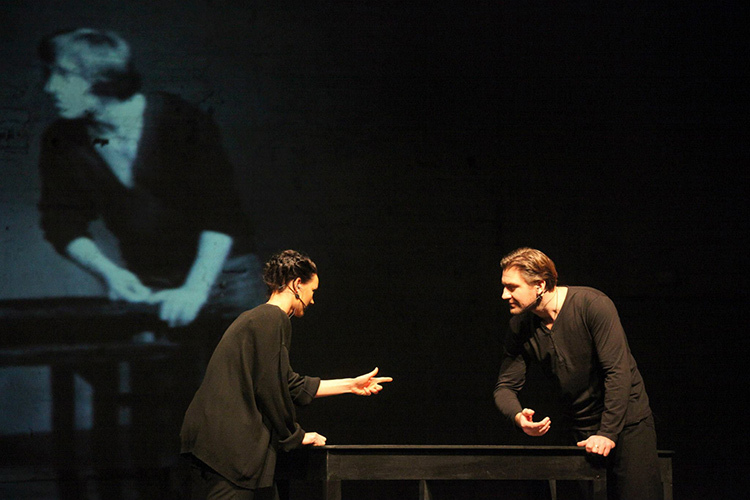
Colta.ru begins to publish a series of materials on the results of the theater season 2013/2014. Today is an interview with Anton Khitrova with the participants of the Yubileny Year Group, a team of young directors, artists, theater experts and managers, who literally exploded the artistic life of the Taganka theater and essentially returned his own identity in the last season.
Projects of the “Jubilee Group” - performances of directors Dmitry Volkostroelov ( “1968. New World” ), Andrei Stadnikov ( “Rehearsal of the Orchestra” ) and Semyon Aleksandrovsky (“Presence” and “ Radio Tagank” ), exhibitions of the artist Ksenia Peretrukhina ( “Alternative attempt” , “Archive of the Bowden family” and “Parallel. Curved ”), dramatic festivals supervised by theaters Anna Banasyukevich and Elizaveta Spivakovskaya, not only developed in the conceptually integral and artistically substantial Ommage Taganka, but also became unique for the domestic theater process by the experience of analytical understanding of the fate and ideas of the legendary theater. The results of their work are commented on by the teams of the team of Dmitry Volkostroelov and Ksenia Potrukhina, as well as the leaders of the school leader’s school , in the bowels of which the project of the “Yubilee year group”, the artist of the Meyerhold, Viktor Ryzhakov, and the art director of TsIMA Elena Kovalskaya, who matured.
Anton Khitrov: Developing the program of the “Jubilee Group”, have you focused on other similar art projects related to working with history, with memory-did you have, in other words, some sample, a standard?
Dmitry Volkostrelov: Honestly, I had nothing like that. I simply do not recall examples of this kind of projects. This is not to say that we focused on something specific.
Semen Aleksandrovsky: I really like how the German group Rimini Protokoll works - they are engaged in what can be called the “Witness Theater”. And here, on Taganka, to some extent, I also have a witness-that is, the theater itself. Radio Taganka is inspired by the play Rimini Protokoll " Remote X " . True, the participants of the Taganka Radio, the actors who participated in the records are not direct witnesses of events (Benjamin Smekhov is the only one who voices themselves), but these are people who had direct contact with the heroes of history. But the actors in the “presence” are direct witnesses, participants in the play in question - “a good person from the Sezuan”, the legends of the Taganka theater. They work with their personal experience and offer the viewer to observe this process.
Ksenia Peretrukhina: the school of the theater leader, in the walls of which our plan was born, declared and consistently affirmed the idea of absolute freedom - so that the project of the "Group of the anniversary year" was composed without regard to anything. Now I am returning to this moment I started and I think how wonderful we were. We just invented without restraining ourselves. I rarely can think so freely: as a rule, you are forced to set yourself some complex frames and act in this way, and not otherwise, based on a billion of conventions. Today it is even strange for me to think that the project of the “Group of the anniversary year” still managed to implement-with so many difficulties we had to encounter.
Volkostrelov: Yes, analyzing all this now, you understand how far we were from reality initially - maybe it was for the better. At some point, we complained that we were developing the project, not really representing many of the intricacies of the device of today's Taganka-but if we came to the theater and met his real life, then, perhaps, we would not agree to work in it.
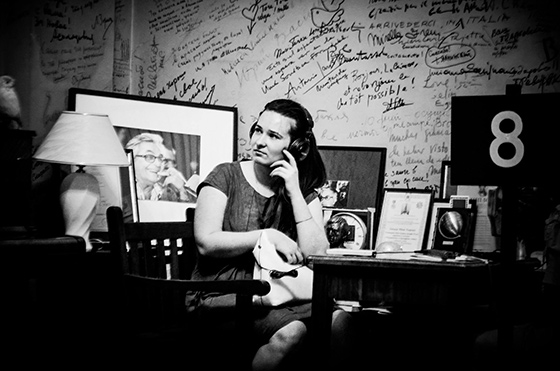 © Julia Lustarnova Scene from the play "Radio Taganka"
Khitrov: What work do you consider the most important in the project?
Volkostrelov: I would not distinguish. It seems to me important the whole project as a whole is a single organism, parts of which could not exist separately, without each other.
Anna Banasyukevich: It is also difficult for me to highlight a specific performance or some specific exhibition. And the point here is not even ethics. I would prefer that our project be evaluated as a whole: spectators or critics can distinguish certain individual work, but it seems to me that they all fuel each other and are so interconnected that it will be a mechanical separation.
Peretrukhina: Initially, engaged in a kind of urban planning, we agreed that each of the projects of the “Jubilee Year Group” will develop one or another plot for us, clarifying the plan of the whole. Yes, the project changed in time - but with all his global changes, he retained the general philosophy to the end.
Khitrov: Positioning your project as a research, reflecting over the past and present the Taganka Theater, have you not taken to the territory of theatrical studies, history, and sociology? Can work with scientists compete with a theater practice document?
Volkostrelov: I think that they just have different tasks. In the theater, exploring the past, you will still talk about today - we cannot look at 1968 through the prism of 1968.
Peretrukhina: Andrei Stadnikov’s performance “The rehearsal of the orchestra” is certainly a kind of blind and today's Taganka, just like the play “1968. New World ”is a cast of 2014, not the 1960s.
Banasyukevich: At the last discussion of the New World, we had a dispute about the principles of historicism - they are observed in the performance or not. For history, for humanitarian science, it is important to make an amendment to the attitude of a person of this or that time, but in the performance this is not and cannot be - we, of course, look from the perspective of people today. This is another position, a different distance, another optics.
Khitrov: Your project speaks of art by means of art, right? But you held two documentary exhibitions: “The Bowden Family Archive”, which exhibited theatrical programs and tickets with hand marks, and “parallel curves”, where articles from “Evening Moscow” were collected, accompanied by the life of the Taganka Theater. Both exhibitions could well have been represented both in the art gallery and in the Museum of the History of the theater. Have you drawn for yourself a border between the territories of historical and art - or was this division not too relevant for you?
Peretrukhina: We were not puzzled by this issue in our project: somewhere we, of course, theorized, but everything was done rather according to a hunch. In general, in order to be an exhibition of contemporary art, you must first show such.
Khitrov: Exactly. But you, meanwhile, were not declared.
Peretrukhina: I would not do this: “The group of the anniversary year”, in my opinion, from the very beginning took a very fruitful position - unbalanced, as if balancing on the verge. It was especially effective for solving the practical problem of destabilization, violations of conventions facing us.
Taganka sleeps and sees strong power - the group abandons power; Taganka does not think of himself without a leader - and the group does not put forward a leader from his ranks and makes decisions together; Taganka hisses and spits under the feet of the group - the group greets at the meeting.
Khitrov: What do you think, in the intra-therapy scandals that invariably accompanied the project, there was some content except hysteria?
Volkostrelov: The struggle for power. Nothing else.
Banasyukevich: repertoire theaters - like schools: closed hermetic institutions in which painful processes begin from any external invasion.
Obetrukhina: I would share, on the one hand, so typical of all repertoire theaters inertia and ossive, and on the other, the aggression of the struggle for power in the case of a particular theater on Taganka. One is not equal to the other. A scandal is, in principle, not a question of the majority, in our case the scandals were the work of the hands of four specific persons.
Khitrov: It seemed to me that there was a purely ideological conflict, only from the protesters he was not formulated, but with yours, on the contrary, was formulated from the very beginning. It’s all about history - you defended the right of every witness and participant to an individual vision of history, your antagonists, like all our society as a whole, stood in the positions of a single ceremonial canon. I remember the indicative episode at the festival of documentary plays “The Unit of Storage”, when Renata Sotiriadi gave the poet Andrei Rodionov a book of the theater ella Mikhaleva about the history of the theater on the Taganka and told me to read: here, they say, it is written correctly, and in his play is incorrect.
Wolferships: This is the same as when people say that, relatively speaking, Pushkin cannot be put “like”. How do you need it? Over and over again, we are faced with the situation of usurpation of understanding, knowledge of history.
Banasyukevich: It seems to me that the people you ask about whom you have such a naive heditarian conviction that involvement in one or another historical events gives them the exclusive right to dispose of this story. Each time at the discussion of the play “1968. New World ”are spectators who sincerely say: you do not know, you did not live, but I lived in 1968 and I remember what was wrong. They are convinced that there are no other people who lived at this time - and who remember him completely different.
Peretrukhina: Yes, but the point is not at all that we somehow specially contradict the generally accepted picture of the history of the theater on Taganka, to which our opponents appeal. All this aggression was caused not by what we say, but to those who we are. But, perhaps, it was thanks to the scandals that accompanied us that we wanted to launch artistic means that began to occur inside the theater much faster. In fact, the troupe polarization occurred: the artists understood a lot for themselves - and crashed into groups. At the beginning of the season, we often heard: we have such a difficult, path situation, we are neither here nor here, there are a lot of us and we all want different, we would have a good artistic boom, a strong hand. And now the situation has changed radically. It would still happen sooner or later - but the explosions that shook Taganka over the past season, all only accelerated.
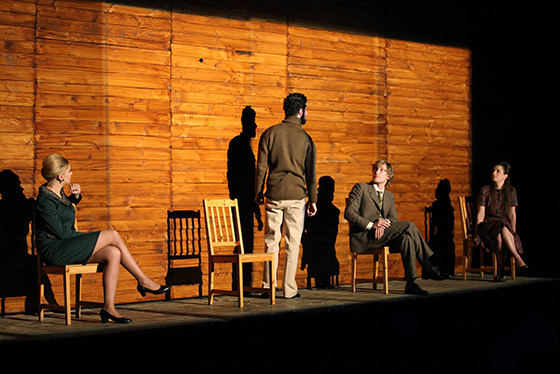 © Inara Ibragimova Scene from the play “1968. New World "
Khitrov: The Group of the Jubilee Year has finished its season, in the fall, the theater, they say, should close for major repairs. How do you see the future of Taganka? Should a new story begin - or should an old be revived in a new form?
Volkostrelov: You, in fact, want to ask us about whether the theater on Taganka inherit itself can inherit?
Khitrov: And most importantly - does he need it himself?
Peretrukhina: The question always arises: what is the theater? Building, people, traditions or something else? In my opinion, if the building, obviously, is and there are specific people who make up the troupe today, then this resource needs to work. There is another resource - the story of the legendary Taganka Theater. You can not use it and say: we, they say, will make a theater about another. And you can use these wealth. Dima (Volkostrolov. - Ed. ) At one time I talked a lot about this, and I agree with him in the sense that the Taganka is not the theater that can be closed and about which everyone will forget about in a matter of days. No, it will be a giant loss. It must develop. In the half-century his biography, fifty years of Soviet-Russian history were compressed.
We tried all year to figure out, for example, in the relationship of Taganka and Lyubimov. Someone will tell you that this theater ended with the departure of Lyubimov-and the point. We, being inside, initially proceeded from the assumption that this is not entirely so that the theater on Taganka is something more than Yuri Petrovich, and that after his departure, the theater is quite capable of developing further. Nevertheless, the present is always cut off from the past. People working today on Taganka - are these people who worked with Lyubimov? The theater is no longer included in this river: the names are the same, but people are already different. The new theater should be born from the former Taganka - but that former, Taganka, he will not be a priori.
Khitrov: What personal discoveries did you encounter for this season?
Volkostrelov: I do not know whether it is a discovery or not, but I have destroyed some myths with which we come to life after theatrical institutions. Myths about the 1960s, myths about Taganka ... Everything is much worse. And this is normal. And something good against this background is “worse” much better.
Aleksandrovsky: I, as a director, have been moving towards the documentary theater for a long time, trying in any work one way or another to rely on the document: even when I put the play “Bookmaker” based on the original play by Vyacheslav Durnenkov, I still reacted to the material as a document. And on Taganka, we were in direct contact with the source, with the material - and engaged in different ways to work with a documentary theater. I happened even more to make sure that only a documentary theater is able to give the maximum approach to the true today.
Peretrukhina: My personal discovery is "do not generalize." I thought a lot about it. The theater is not one person. For example, Renata Sotiriadi all the time speaks on behalf of the theater, as if appropriating the right to speak from the entire theater. We also thought the theater on Taganka as a single person at the school leader in the school leader. My personal revelation is that in any theater there is a huge and heterogeneous team. Do not generalize, because the initiative, both negative and positive, often belongs to one, two, three people.
Banasyukevich: I do not have a discovery, but rather confirmation of assumptions that in principle it is possible to build horizontal structures where vertical is familiar. The repertoire theater is arranged as a vertical and totalitarian structure. Everything that we did was built to a large degree of freedom and non -violence and with regard to the participation or non -participation of actors in performances or reading, and with regard to decision -making within our team. And such a scheme is much more complicated than someone where someone makes a decision and everyone obeys him. Yes, it is effective at a short distance, but in the future, the horizontal structure is much more effective. You just need to have patience to wait for these results.
Volkostrelov: Yes, there was a situation of a voluntary refusal of the participants of the “Jubilee Group” to take power. Including because it was such a reflex story, we were in the theater where one person took power. And he held her. And we saw what this led to.
Khitrov: Are you talking about Lyubimov now?
Volkostrelov: Yes, about Lyubimov.
***
Victor Ryzhakov
Artistic Director of the Meyerhold Center
The creative proposal of the development strategy of the legendary theater still at the stage of virtual development was distinguished by artistic non -standard, courage and ambition. An intelligently guessed an ambitious challenge not only to professional practice that has developed within the framework of theatrical Moscow, but also to the authors and “creators”, that is, to themselves. The project was designed for as many as five years and suggested a practical “rethinking” of the entire life of the theater. The program not only looked talented and beautiful, but also seemed to be kind of alive, human-it already revealed great respect and has been raising to the history of the Taganka itself and boldly united a specific company of completely different talented young artists.
The daring plan was not from the category of children's pranks, but the so -called application for growth. An attempt to turn not just to the “history”, to “memory”, but for the fifty -year -old unique, contradictory and tragic biography of the theater itself, even then suggested an incredible professional and human “adventure”. All this was terribly bribing: the very form of a secretly declared conditional research laboratory, a creative collegium, which included representatives of various theatrical workshops-directors, playwrights, theaters and artists; and the plan of joint immersion in the interesting historical context of the Taganka; And a hidden desire to find your new, unlike any biography - all this caused respect and desire not only to support, but also to promote.
However, history ordered otherwise, and the project of the “Group of the anniversary of the year” was adopted for implementation in edited and incomplete copyright. Further, the “psychology of the theater” itself intervened, having designated a lot and adjusting, including the circumstances of our “great history”. But even in this, distorted by time and circumstances, many of my expectations met the paths. Each of the projects presented by the “Group of the anniversary year” was the small discovery of the “worldview” of theatrical history and today's reality. All that the “Group of the Yubilee year” did is, starting from the first “liberation”, which fought with all the extra and alloy exhibition and ending with the performance of the stopped time “1968. New World ” - has its own special, important sound. An attempt to comprehend time and itself through the history of a particular theater, a specific place, a specific human being, perhaps, is the only possible way to find something that has long been lost-our present.
Elena Kovalskaya
театральный критик, заместитель художественного руководителя Центра имени Мейерхольда по творческим вопросам
«Группа юбилейного года» сложилась еще в Школе театрального лидера, где студенты пишут программы развития для реальных государственных театров, но исходят из собственных идеальных устремлений. И поскольку работа выполняется не индивидуально, а в группе, то складывается она, как правило, по совпадению сфер идеального. Так было и здесь. У тех, кто писал учебную дипломную работу про Таганку, была красивая и стройная стратегия. Но в театр их пригласили исполнить только первую, музейную, часть.
Планы изменились, когда они столкнулись с реальностью, не описываемой госзаданием, штатным расписанием и справкой 9-НК. Группу порицали за то, что она продолжает работать вопреки сопротивлению части труппы — людей, полагающих, что Театр на Таганке — это актеры, которые в нем служат сегодня, и что театр — это их дом. Я-то считаю, что частный театр может быть хоть домом, хоть храмом, а государственный — это общественный ресурс, на который у Ренаты Сотириади те же права, что и у Андрея Стадникова.
Но ядро идеи «Группы юбилейного года» сохранилось в целости: делать проект в театре, не растворяясь в нем. Форма существования, поведение, художественная программа — попытка альтернативы. Такое название было у выставки Ксении Перетрухиной, которой программа открылась. «Группа юбилейного года» была театром в театре. Таганка спит и видит крепкую власть — группа отказывается от власти; Таганка не мыслит себя без лидера — а группа не выдвигает лидера из своих рядов и решения принимает сообща; Таганка шипит и плюется под ноги группе — группа здоровается при встрече. Ксения Перетрухина дорожит мыслью, что у них появились в театре товарищи и даже друзья, что их программа что-то изменила внутри театра. Мне самым важным кажется именно то, что альтернатива осуществилась. Сегодня, когда в стране реставрируется тоталитаризм и мало надежды на разум, память, совесть, опыт «Группы юбилейного года» — то редкое, что обнадеживает. Это опыт достоинства, кропотливой работы, настойчивости и единства.