
Translated material
“Everyone should compose. Here to sit and compose! You can then throw it away "
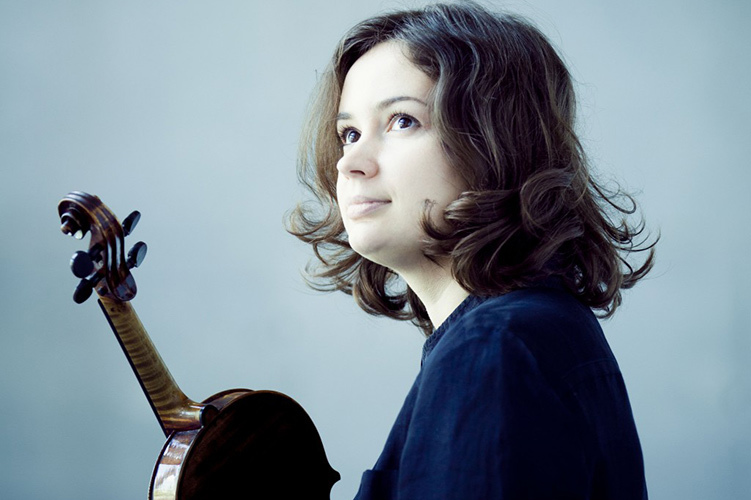
The new vivid acquisition of the recently ended Diaghilev festival in Perm was the Patricia of Kopachinskaya, the violinist of Moldavian origin, European training, with a brilliant career, emphasized by non -standard thinking and an incredibly wide repertoire in which new music occupies a very noticeable part. In Perm, she played a solo concert with pianist Ollie Mustonen, took part in the night violin Gala, and also performed the third symphony of Malera as part of the festival orchestra. During festival rehearsals with Patricia Kopachinskaya, Ekaterina Biryukova spoke.
- In your schedule of performances between solo concerts in Hong Kong and the Menukhinsky festival in Gstada - participation in the execution of the third symphony of Mahler in Perm as an accompanist ...
- ... Not even an accompanist even. I will sit next to the accompanist - we now decided so at rehearsals ...
- And how do your agents react to such extravagant behavior?
- Well, this is an exception. And most of all I am worried about this exit on the stage in Perm. Can I? And then, you know, being a soloist is also sometimes bored. It is interesting to sit in the orchestra. But just in any orchestra you can’t sit down. Sometimes I do it all the same. For example, when I play with Herreveg, I always sit in the orchestra after the intermission-but somewhere behind, I hide. Recently, Ashkenazi conducted London Philharmonic, played Manfred - also sat down. But so in order to sit ahead, to take some responsibility on yourself-this is the first time.
- And who came up with you to play a solo concert with Ollie Mustonen at the festival? Theodore?
- Yes, Theodore. And hit the point. I have long wanted to play with Ollie Mustonen. But it did not work. It’s a great pleasure to play with him. This is not just a pianist. This is a person.
- He still composes music himself ...
- That's why he is a person. It seems to me that the musician cannot only play something. This is so antimusic! Something else should come out of it. This is immediately audible from the game when the performer composes. He then says that he knows that he himself felt, tried.
- Do you continue to compose?
- Well, yes, I compose. Recently I tried to write a violin concert, but it turned out some kind of requiem. I need this - otherwise the brain will crimp. It is interesting to see how difficult it is to compose really, how difficult it is to merge with what you want to say. After that, it is immediately clear what good music is. Everyone should compose. Here is to sit and compose. You can then throw it away. It is not necessary to play. Maybe you don’t even have to play. But you must compose! It’s like people go to a restaurant, eat and do not understand how it is done. And when you start cooking yourself, you feel all the seasonings.
So you are going somewhere in the moon, take Beethoven, Purotin, Schubert and Voskli in your small baggage.
- But the performer - sorry - often composes, as they say, hands. Not a head ...
- Not always. Beethoven was also a performer, an improviser. But he did not write with his hands. He wrote in his soul. Many good composers were also excellent performers-Bach, Vivaldi, Handel, Mozart, Mendelsson, Saint-Sans, Rachmaninov ...
- Nevertheless, there is a division as if into two modern music. One is for famous performers, status groups, large halls, to open prestigious festivals. The other is laboratory work inside the composer workshop. Does everything need to be considered modern music? Sometimes it is just a quarrel of what already exists.
- Well, it probably always was so. It is not necessary that there were only geniuses. There was always something nearby that lived and ate their ideas. But they also helped to develop.
“But still, at least there was a recognizable style of the era.” And from what is written now, can everything be dedicated to 2014 later?
- It seems to me, yes. It is all today. Something looks back, something looks forward, something does not look anywhere. It is simply written on its own. But the fact that modern music is everywhere played is very good. Even if she is not all good, she holds us in motion.
Another thing is that now the most important thing is the premiere. Fashionable word. And what will happen to this work later? Will it still be played? You know, I always had an allergy to something that becomes fashionable. For example, when religion was prohibited in the Soviet Union, my grandmother took me to church. And the significance of this was felt ...
- Did it happen in Moldova?
- Yes. I was very small. But it was completely different than now. You came to church and knew that no one would show you on television. And now, when politicians are shown in the church all the time, this is a fashion ...
- Tell me about the music program Galina Ustvolskaya, who has now been on Wiener Festwochen .
- We recorded Utvulskaya with Marcus Haquirer (pianist and curator Wiener Festwochen . - Ed. ) whom Galina Utvulskaya personally knew, she wrote to him a letter where she thanks him. It is very difficult to convince the organizers to play her music in the concert. But both me and Marcus always had a dream to play it. Even when I was a student, Ivan Sokolov showed me this music. And I saw Ustvolskaya when she came to Bern ...
This was for me the discovery of something absolute new and more than what I could imagine. This music was part of eternity, real eternity. Which looked in all directions. Both forward and back, it was both the future and the past. She connected all this energy into one fist. Such a force has little music. After that, it was already ridiculous to play Schlenberg of some. And since then it was one of my big projects in life - to write down what Vostinoi has for a violin. In London, in SouthBank Center , we talked with the organizers about playing Ustvulskaya. They know her, but they say that collecting the audience is very difficult. But at the Vienna festival, a concert was sold in a few months!
- And why, with all the breadth of your repertoire, cooperation with Theodore in Perm did you start with the Tchaikovsky concert?
- (Laughs.) Yes, I wonder, right? I did not want to play Tchaikovsky before. And suddenly - I fell in love with him! I found him. Or he found me. And a constant conversation began between us. It has been going on for many years. He ceased to push me back, and it seemed to me that he could need. At some points in this concert you can tell something else. But for this you need the right partner. And the orchestra. And this is very difficult to find. In general, being a soloist, it is very difficult to find a conductor and an orchestra with whom you can play as if you are playing chamber music. For me, it is comparable to love. After all, it is very difficult to find a partner with whom you can live, communicate, quarrel. Music is very fragile, just like love. Strong and fragile at the same time. If something is wrong somewhere, it breaks down immediately.
In the Tchaikovsky concert, we found a common language and we have a common language - and in a very short time. We met once in Paris, discussed everything, then we talked a lot on Mail. Then I first came to Perm - it was a month ago, began to play, and from the first note it became clear that we understood each other.
I do not play as used to play. I have always been repelled by the standard, rule. I never trusted the rules. And she always asked: what will happen if I play differently? What does this music mean to me personally? Not for tradition, but for me and now. So I open the score, and what is happening between this party and me? How does this music pass through me and how does it come out of me? What becomes with her?
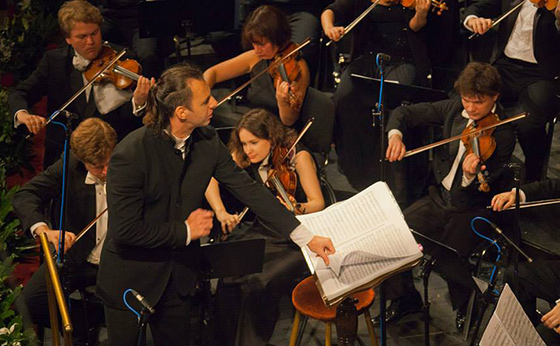 © Diaghilev festival
-Well, actually, any performer should ask himself like that, no?
- And why then there are so many similar executions?! Are we really so similar to each other? It seems to me that you need to give yourself freedom more, allow yourself to be it. But everyone has their own freedom. When I play with someone, I want us to think the same. And then a miracle happens. This is exactly the miracle I am looking for. But it can happen only if no one interferes with each other, no one hurts each other when we speak the same language and try to hear each other. What is the other telling? What else is adding? And it turns out a story that is told together. Then the energy is correct. And if one in its own way, the other in its own way-is it all wrong ... I probably say badly in Russian?
-No, no, everything is perfectly clear. This is what I want to ask. Now there is a tendency to encounter a work (or even part of the works) of different styles and eras in one program. For example, with the cellist Sol Gabetta, you are soon playing a program where Bach’s two -headed investments alternate with xenakis, Vasks, codes and Rales. That is, the integrity of the masterpiece is becoming more and more blurry.
- The fact is that all classical music becomes blurry. She does not touch us anymore. Because we have heard all this ten thousand times. And now we need to figure out how to present it, in what context, so that it becomes yours. And how to take the audience with you on this journey. So you are going somewhere in the moon, take Beethoven, Purotin, Schubert and Voskli in your small baggage. And you arrange them, and sit, communicate with them there. Like a galleryman who will hang one picture, another is nearby - and thinks how to look at them better. You can turn off the light. You can even look through the magnifier-it seems to be something old in front of you, but you suddenly see such an avant-garde! There are many opportunities. It seems to me that we need to excite new sensations, otherwise we do not feel music, do not hear it. And even more so when all the time is played not just the same thing, but also the same. It becomes ... I don't know what ...
- A supermarket, maybe?
- That's right, a supermarket. And it should grow in your garden. The seeds are the same, but the tree will grow its own. Because each has its own land, its own bacteria, its own past, its own worldview. For example, I'm from Moldova. There will always be something folklore in my game. Always. I don't even want to redo it. Why? I am. I am not shy about this. On the contrary, I believe that I enrich music, give her some new life in my garden, with my sun, with my seasonings. God made us as we are. And our task is not to pretend to be others. Although it is difficult to be yourself. Sometimes I want to escape from myself.
- Are you in Moldova?
- Rarely. My grandfather died. My homeland is already in me.
“Do you play barefoot in Perm too?”
- I do not answer this question. Journalists have already tortured me with this.
- Do you play on the baroque violin?
- Trying. This is also terribly interesting. Recently, Mozart with Rene Jacobs played. How fun we had fun! I always thought that I was just playing somehow wrong, that conductors were looking at me so obliquely. As on a mentally ill. And Jacobs, on the contrary, gave me the courage to go even further and further! Suddenly, at a general rehearsal, he stopped and began to laugh. And he said to the orchestra: "If I stop at the concert and laugh, do not pay attention, this is normal, it should be." It was so joyful and vital! I realized that I, it turns out, play Mozart correctly. So it is necessary!
- I want to ask about the game on notes. Here, at the Diaghilev festival, all the soloists - Mustonen, Batags, Lyubimov - play not by heart, as habitually, but looking at the Pupiter.
- And I play only by notes. I think this is very, very useful. At least in my case. I give myself the will to improvise. Well, improvised - of course, not quite the correct word, I play all the notes that are written, but ... if you think about it, I do not bring the finished cake on the stage. I have an approximate recipe, like a jazz musician, but what really turns out at the end-I do not know. And I like it. I do not want perfection. Because when you want perfection, you sacrifice the main point when some change happens to you. You do not let him happen. Instead, you make sure that everything is done correctly.
When I was a student, I earned a living by the performance of modern music. It was in Vienna. In the ensemble "XX century". We put notes to us, and we played from the sheet. That is, of course, we were given notes in advance, but I never did this, there was no time. I played from the sheet. And so it was interesting! It was like a book you read. And when I played by heart-the feeling that I would concrete something. And there was a very strong fear-but will I forget something, but will everything be correct? I do not want to give this fear to live in myself!
- That is, even solo concerts with a large orchestra do you play notes?
- Yes, I always put notes for myself and look in them. I even try not to remember by heart. And then the work opens to me each time in a new way. As if it is modern music. Here is Tchaikovsky’s concert - for me it is now written. I am playing it now. And each time something can change-both the application and the structure, and suddenly some new paintings arise. And such a conductor as Krentzis feels it in advance.
- So far you only played Tchaikovsky with him?
- So far, yes. But I have the feeling that I played the whole repertoire with him. I know for sure - we will play all our lives. This is something special: you meet a person and you feel-you know him. How, when? It is incomprehensible. A whisper from another world. I hope I don't look like some kind of esoteric aunt?