
Translated material
Visiting a fairy tale
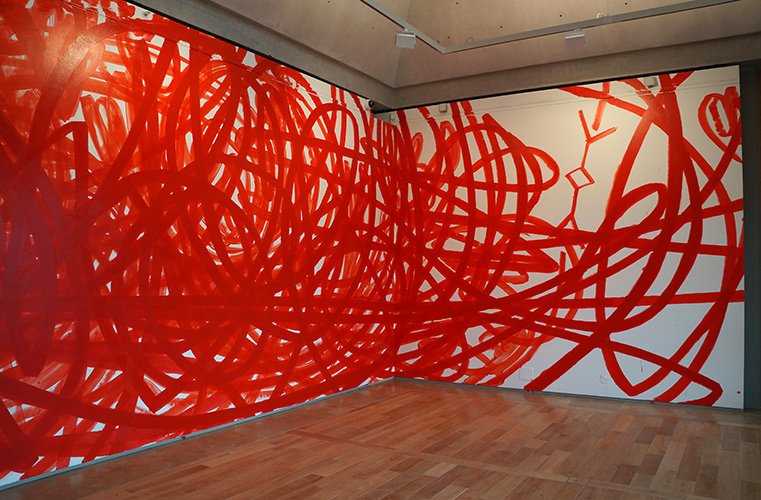
The tenth "manifesto" started. Now, if something extraordinary does not happen, for another four months it will be possible to see the works of Gerhard Richter, Louise Bourgeois, Joseph Boyce, Marlene Dumas, Wolfgang Tilmans, Elena Kovylina, other stars and not very in the main headquarters, the Winter Palace and throughout St. Petersburg. But this is so, in general.
Ekaterina Dyzhot told in sufficient detail about the context in which the organizers and participants of the European Biennale. In short, the situation is as follows: “Manifesto” can easily be instrumentalized by the current regime-just as the Olympics or any similar event moving from place to place like football cups and championships, EXPO or Eurovision. This is an expensive, but effective way to convince the world community and ourselves that everything is fine - about the same in the Stalinist USSR, they called the then stars of literature, and in Berlin in 1936 they arranged the Olympics. However, the “manifesto” was under suspicion of the authorities-after all, contemporary art, which, for example, complained about Mikhail Piotrovsky. Suddenly, artists Biennale will behave not like Henri Barbus, but as Andre Jew - and instead of the “beautiful facade” a scandal and an unpleasant story will be released. Until the last moment, these fears were preserved, but judging by the media response, they scattered. Contemporary art is not synonymous with criticism, does not mean the struggle for freedom and justice, the tar notes.
The officials were delighted, or at least not upset - naturally, with the exception of Vitaly Milonov . It's funny, as the dominant point of view spread through the media. This is the main consideration in connection with the Biennale, which was carried out on the cover of the official printed body of the St. Petersburg government: “Despite the actions of the provocateurs, St. Petersburg becomes the center of modern art. In the city, the Biennale “Manifesto 10” opens. ” And in other words, Kira Dolinin writes in the newspaper Kommersant: "Whatever the evil tongues predict, but the" manifesto "opened." And even in the article on the website of the German radio station Deutsche Welle The observer is so summarized, naturally, softening where, by European standards, it would not be comme il faut: “Getting back from the rules of neutral journalism, on the rights of the correspondent fascinated by the Biennale, I would like to say that this“ manifesto ”took place. And even better, that many do not agree with her. ” Amazing unanimous.
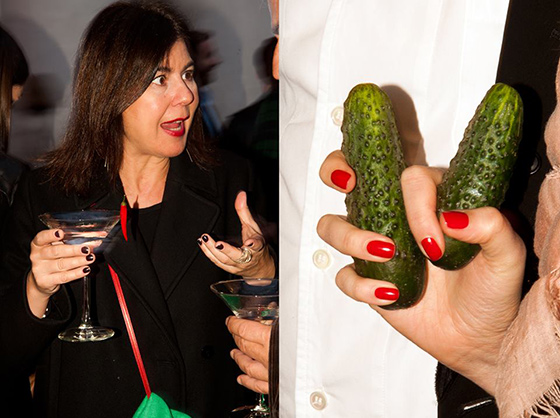 © Igor aircraft Igor aircraft. Opening "Manifesto 10" in the Great Courtyard of the Winter Palace, June 2014. Reporting sketch
In short, the Trotskyist-Zinoviev terrorist underground of saboteurs and killers is defeated. So what were these “provocateurs” and “evil tongues”?
One of the opposition strategies in this situation was a boycott. In fact, he was not supported by so many people: Ukrainian artists (Yuri Leiderman, Nikita Kadan, Larisa Venediktov, Lada Topi and others), some of the radical artists in St. Petersburg and Moscow.
Simultaneously with the calls to the boycott, a war of petitions began. The Irish curator Noel Kelly published a petition in which, in the light of the Law against LGBT, he called on, like Maria Alekhina a little later for another reason, to change the venue of Biennale. In the later petition of artists from Germany and Holland, which was already a reaction to Ukrainian events and the role of Russia in them, it was proposed to delay the holding of “manifestos” until better times. However, judging by the number of signatures and, most importantly, by the lack of active public support, these campaigns did not work, although they were reported in the press, large and small. But still they forced the leadership of the Hermitage and the “Manifesto” to make response statements, create retaliatory petitions, act and quote the name of the famous song “ Under Pressure " .
There was another strategy: the Russian group "What to do?" And the Polish artist Pavel Althamer refused to participate in projects associated with the “manifesto” (from the main project to a parallel program), while remaining opponents of the boycott as an instrument that covers any possibility of influencing the situation. That is, nevertheless, they considered Biennale as a platform for a critical statement possible, but with restrictions, and when the situation in the country acquired completely gloomy features, and the “manifesto” for a couple with the Hermitage showed their bureaucratic essence, they refused to participate. (And there were also those - like the Romanian artist Dan Perezovsky - who is just quiet, without any statements, left.)
Boycot and refusal to participate as a resistance strategy, of course, have long been rolled up. But do they give a positive result? Do they lead to any changes? Do they really make an art/activist community more conscious? At the moment, none of these questions have a definite answer. Some artists from year to year create a reality parallel to the Moscow Biennale , but neither this reality is developing in any way, nor Biennale fundamentally changes. The Lebanese artist Valid Rada and a huge number of those who are not indifferent have long come across the terrible working conditions of builders who are erecting Middle Eastern museums of contemporary art. The struggle includes an information campaign, and boycotts, and protest promotions for which Raad himself used to be arrested. However, the situation has not improved much since then. American artist Marta Rosler says he is actively involved in boycotts, but their effectiveness is in question: sometimes he works, sometimes not.
For comparison: recently, a scandal occurred in a slightly different field - the Ministry of Culture made it impossible to show two performances at the Moscow International Open Book Festival . Further, following the organizer of the canceled performances, our COLTA.RU website, many publications and organizations left Mokmokf - practically the situation of the boycott. However, did this lead to something positive? Yes, fortunately, all the “refuseniks” found platforms for their events, but it was leaving underground, not an active attack, as offered by some commentators of the scandal: the festival could become a platform for discussing censorship and protest, but instead of “creating two, three ... many Vietnam”, especially in the enemy territory, people dispersed in their corners.
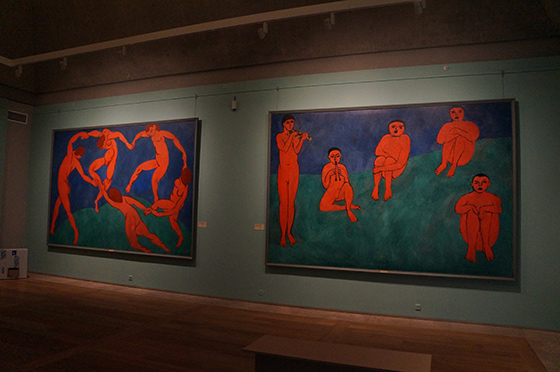 © colta.ru Henri Matisse, on the left - “Dance”, 1910, on the right - “Music”, 1910
In the case of "manifestos" there was an attempt to attack. Some-for example, John Warsha, Alevtina Kahidze, Ekaterina Grandty or students of the school of involved art, whom everyone perceives as an integral body with the group “What to do?”, Which is not entirely true, to put it mildly-they decided to take advantage of the chance to criticize the situation from the stands of the “Manifesto”. Then everyone turned out differently. The tar was preparing a text for the Manifesto catalog criticizing this very Biennale, but in the end the article was published in a completely different place. Warship headed the public program “Manifesto”, being between the hammer and the gravity: on the one hand, her position and statements did not cause sympathy for the leadership of Biennale, and in resources it turned out to be more limited than the rest; On the other hand, she was reproached with the supporters of the boycott, and simply criticism for the company with the rest of the "manifesto". In a similar situation, Kahidze was as a participant in this public program. Students of the School of involved art, many of whom were for participation in the “Manifesto”, in addition to holding absolutely “nemanifting” events in the bar next to New Holland, they decided to lure the audience of Biennale to their site: when they came to the Event in the apartment gallery on the Marat Street stated in the program, they expected the news that they had to go to another place, not to go to another place, not included in the Biennale program. And the artist from Donetsk Marusya Kulikovskaya, who refused to participate in the Manifesto, held an unanocanced action in the main headquarters: she lay down in the lobby on the stairs, now covered with the Ukrainian flag in Russia. Etc.
It is clear that this position (position) had its own shortcomings. First of all, artists and curators risked being instrumentalized and used as decorative elements of that very beautiful facade. This was most often reminded, speaking of John Warshe and Alevtina Kahidze.
It is completely incomprehensible which of all these strategies could be called the most appropriate moment. Probably, no, however, the unconditional participation in the “Manifesto”, and the detached observation of the “out of the outside” process. But to talk about this - now and in the future - it really would be worth it.
* * *
The exhibition itself also deserves a separate conversation, outside of contact with boycotts. Even if this is really a facade, what it looks like, which consists - also interesting. Each facade has its own characteristics.
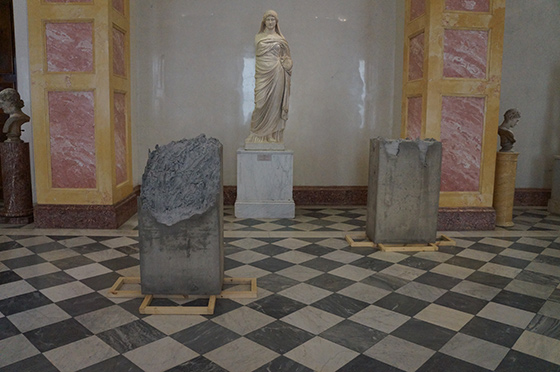 © colta.ru Concrete blocks of Lara Cuffo in New Hermitage
Judging by the professional history of the curator of the main project “Manifesto” Kasper König, one could understand that the nomadic European Biennale is not interesting to him, but the Hermitage is quite. He himself admits this: “I can’t say that I was capturing the idea to make an exhibition for Manifesta , but the proposal from the Hermitage - that was interesting.” Therefore, in the relatively empty main headquarters, the scope was the Hermitage: a lot of art, large -scale work, almost every artist is a separate hall, and some - two. Within the framework of the main project, even two mini-retrospects are held-Vladislav Mamyshev-Monro and Timur Novikov under the curator of Ekaterina Andreeva. In the Hermitage itself, the presence of contemporary art was specially reduced to a minimum-apparently, in order not to distract attention from what was really important for König: from the atmosphere, size and wealth of the museum itself. But, as many have already noticed, Koenig is a curator without a concept. He himself, in a program article in the Biennale catalog calls his brainchild “manifesto” without a manifesto. Someone considered this position bold, someone-on the contrary. And if it is true that, as they say (both John Warsha and Viktor Misiano emphasize this specially), König gives free rein to the artists (which, apparently, is partly true), then the issues for the most part - to artists.
The Hermitage (namely the old part of the museum, not the main headquarters) - and here we must agree with Piotrovsky - is really suitable for modern art. But not for the reason that the director of the museum calls ( “Catherine the Great bought contemporary art of her time, Alexander I bought contemporary art, even Alexander III bought an ultra -modern salon” , etc.), but because the Hermitage is a cast from Russian history, especially its imperial period. It is here, and not in the emasculated to the notorious “White Cub” the main headquarters can be said about “here and now”, which logically stem from “then” - because this usually consists in the script of “Manifesto”. But neither Coheniga, nor most artists do not need all this at all. The curator is fascinated by scale and variety, artists are immersed in their own fantasides, in fact they are not interested in the place where they got. The palace ensemble, now a large museum - how was it created? What is there? What is not and cannot be? How did the museum and its ideological role change? Why is he needed now? (To answer such questions, but in relation to all of St. Petersburg, John Warship tried to in her public program.)
Yes, several artists worked with the Hermitage, and this is undoubtedly good. The Japanese artist of Yasumas Morimura turned to the work of Vera Milyutina (1903-1987) and Vasily Kuchumov (1888-1959) - artists who documented the museum during the blockade. He literally got used to his heroes. The Italian artist Lara Favaretto installed concrete blocks among ancient statues, and Susan Philips placed an audio installation on the main ladder of the new Hermitage: numerous tourists stop, sit on the steps and listen to music. According to the Scottish artist, the work is inspired by the images of St. Petersburg floods and the influx of revolutionary masses that stormed the Winter Palace in 1917. However, these few works are a drop in the sea. There was practically no dialogue with the past and “our heritage”, which was repeatedly written about in connection with the tenth “manifesto”.
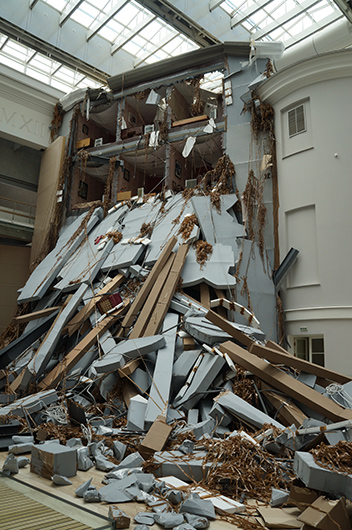 © colta.ru Thomas Hirshorn, "Cut", 2014
In fact, the same story happened in the main headquarters. All the observers were struck and even delighted with the “cut” of the Swiss artist Thomas Hirschorna - probably the largest of the work at the exhibition. Some considered it the central work on the Biennale. There seems to be just about the dialogue with the past. A house with a collapsed wall is built in the lobby of the main headquarters, rooms are opened in which the old environment and the legacy itself are visible - the painting of Kazimir Malevich, Olga Rozanova, Pavel Filonov taken from the Russian museum. As Hirschorn developed as an artist, he more and more monumentalized - he grew in breadth. This, in principle, is O'Kay, but in the Hermitage, his gigantomania reached some excessive scale. In fact, the “cut” is an appeal to the very beginning of the Khirshorn artistic career, when in the early 1990s he created “Suprematic” compositions from improvised garbage. That is, he finally reached out to those works that inspired him so much, could he not take advantage of the case? In general, exactly the same story as König with the Hermitage.
Many artists used participation in the Manifesto as a platform to talk about their own past. Belgian Francis Alus recalled his youthful dreams and drove from Brussels to Petersburg on an old Soviet car, finally crashing into a tree in the courtyard of the Hermitage. It is clear that artists often use personal history, the circumstances of their lives to talk about something important, but here-not only Alus-there was some kind of overkill of solipsism and narcissism (it is worth noting that alus often does completely different works in which he successfully balances between departure into his spiritual depths and a story about something important for everyone).
In the already mentioned text from the catalog, König writes: "Art is a parallel world that does not exclude politics, but in which political crushing is far from the main thing." In fact, I am inclined to agree with this, since the badly understood requirement to “talk about politics” is more harmful than the benefits of artists working with acute political and social topics. That is, of course, when they close the exhibition of Vasily Ilekunov , it is necessary to support the artist and condemn censorship, but you need to understand that his work is rather weak (the issues of censorship and aesthetics are generally different things, but we, alas, are often not distinguished). Discussion of deep topics is what is really important. And in the Hermitage this is possible: for example, to show through this muse the genealogy of imperial consciousness in Russia. However, just in a strange way on the “manifesto” there are precisely references to the topicality, so condemned by König, and not more subtle and convincing work with the situation in which we all found ourselves.
It seemed that at the “manifesto” they turn to the present, as they say, for reporting - it is required according to a certain canon of modern art. Is it possible, for example, to take the gesture of Alus seriously, which at one of the stands, which told the story of a trip from Belgium to Petersburg in a car crashed into a tree in the courtyard of the Hermitage, placed magazine pages? Headings: about the annexation of Crimea, about Putin in connection with Ukrainian events and so on. This is some kind of supplement at the last moment, neither to the village or to the city.
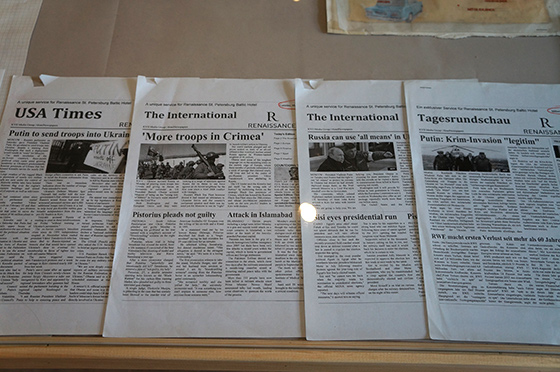 © colta.ru A small “Crimean” addition to installation with the details of the Francis Alus project, “Lada Kopeika”, 2014
It was this circumstance that made a ambiguous photo sear of Boris Mikhailov from the Kyiv Maidan. Mikhailov’s gaze is absolutely suspended, which is probably good for the photographer-director (present, not from RIA), but Mikhailov seems to be a little from another area. As a result, there is no narrative, there is no mood, there is no atmosphere - personnel that differ little from everything that went on the Internet with a plentiful stream when the Maidan fought with the “golden eagle” or just lived. The essence of this series is that the organizers can say (and they did it): “Here, we have about the Maidan; See how good? "
A pleasant exception could be the work of the Dutchman Eric van Lishaut, who erected a model of the basement corridors of the Hermitage, where the legendary museum cats live. The artist beat the English word “cat” - “ pussy ” in an ironic manner, and disputes around “manifestos”. In the video and on the “corridor” sheets, there is a Piotrovsky interrupted at a glance, the mention of the group “What to do?”, Photo of a cat with the signature “ Riot ” , Putin portraits. The work causes a smile, but at the same time it is clear that this is such a contextual irony: so many things have happened around the “manifestos”, but what exactly Lishaut is so amusing - it is unclear. Funny, but no more.
На третьем этаже Эрмитажа, откуда забрали и перенесли в Главный штаб картины Анри Матисса (его работы — тоже часть «Манифесты»), можно увидеть работы Николь Айзенман и Марлен Дюма, а в соседнем зале среди живописи XIX века — инсталляцию Йозефа Бойса, которую из-за сильного запаха смотрительницы окрестили «диверсией», о чем и сообщают посетителям. Художница из Южной Африки Марлен Дюма создала «портреты знаменитых геев», переименованные в «Великих людей». Тут есть и Михаил Кузмин, и Петр Чайковский, и Алан Тьюринг, и Антон Красовский. Это, как и показанные здесь же живописные полотна Дюма, действительно важная работа, хоть и утопающая в общем контексте «Манифесты», а потому в ней усмотрели конъюнктурность и заказной характер. Как пишет художница, «современное искусство — это деятельность, нетрадиционная по природе», далее выстраивается вполне понятная параллель, которая в России, где публичная атака на современное искусство явно превосходит любые цензурные скандалы на Западе, довольно актуальна. Работа эта оказывается больше про искусство, чем про геев, что нисколько ее не умаляет. И сама ситуация загончика, где что-то еще разрешено, в которой оказалась Дюма, да и все остальные художники, только подтверждает это.
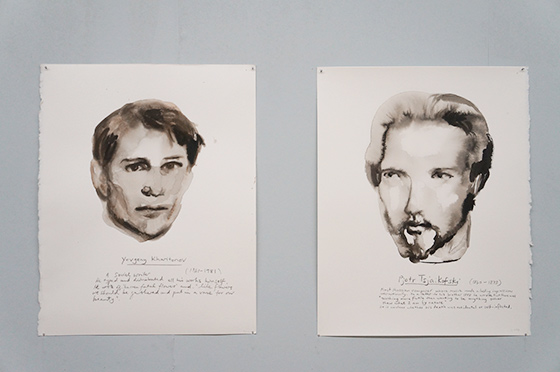 © Colta.ru Марлен Дюма, из серии «Великие люди», 2014