
Translated material
Moses and Phoenix
We continue the story of some reports that sounded at the conference "Indo -European linguistics and classical philology" conducted by the Institute of Linguistic Research of the Russian Academy of Sciences. A completely collection of materials of this conference is available on the institute’s website.
The report of Tatyana Aleksandrovna Mikhailova (Department of Ancient Languages of the Institute of Linguistics of the RSUSU) was dedicated to the Alexandria author of the II century BC, Yezekiyl-Tagika, who outlined the plot of the Old Testament book Exodus in the form of Greek tragedy. No other information about this author, including the exact years of his life, has been preserved.
The tragedy is called "Exodus" (ἐăγωγή). Her full text has not reached us. Fragments of the tragedy “Exodus” have reached us thanks to two other authors. The tragedy was quoted by the Greek intellectual of the 1st century BC. Alexander Polygistor in his non -preserving works, while the work of Alexande Polygistor was used by the father of church history, Eusebius Caesarean (c. 263–340) in the treatise "Preparation of the Gospel". It is there that all the fragments of the tragedy “Exodus” are found to us. In total, 17 fragments have reached our time, in the aggregate of the constituent 269 lines.
Ezekiel-Tagik talks about the origin of Moses and the events of the outcome of Jews from Egypt. The last of the Old Testament events, the mention of which was found in preserved fragments - the arrival of Jews in Elim (chapter 15 of the book Exodus).
Even such an incomplete text of the tragedy allows you to see what methods was used by Ezekiel-Tagik to adapt the Old Testament narrative for the new genre and for the new addressee-Alexandria spectators and readers. The tragedy begins with a prologue in which Moses himself tells the story of his birth and upbringing in the house of the pharaoh. Often such a standard technique is used as the appearance of a messenger telling about events that cannot be shown on the stage. The surviving fragments do not make it possible to determine whether there was a choir in this tragedy, but one of the lines says: “I see seven some girls”, which makes it possible to suggest the presence of a choir. Ezekiel used the iambic trimete - a poetic size that is most characteristic of the dialogues of heroes in the ancient Greek tragedy.
The presentation compared to the Old Testament text becomes much more emotional. The episode entered the tragedy, where Moses doubts that the fellow tribesmen would believe him, and the Lord, into evidence, turns his staff into a snake. In the book, the outcome (4: 3) is described as follows: “[Lord] said: Throw it to the earth. He threw him to the ground, and the rod turned into a snake, and Moses ran from him. " And so this is presented by the words of Moses himself in the tragedy: “Here it is abandoned, be merciful, Lord! // What a huge! Scary! Pity me. // Seeing, I'm horrified. The body shakes everything. ”
In the surviving parts of the text there is a story about how Moses in his youth, escaping from Egypt to the land of Madiam, married Sepfor, daughter Raguil. The Old Testament text tells about these events quite sparingly, while fragments of the tragedy suggest that there this story was deployed into a special plot. A new character appears named Hum, who is considered either a fan or even the bridegroom of Sepfora. Sepfor herself may be alarmed by her father’s plans to marry her as a stranger.
Moses. Fresco from a fool. II V.N.E.
There are episodes in the work of Ezekiel-tragic, which are completely absent in the Old Testament text. For example, he talks about the prophetic dream that Moses saw. He dreamed of a huge throne on top of Mount Sinai and a noble husband sitting on the throne. In his left hand, the sitting held a scepter. He beckoned to Moses with his right hand, handed him his crown and scepter and allowed him to sit on the throne. Getting off the throne, Moses saw the whole earth around. Many stars fell at Moses's feet, he counted them all. Then the stars went in front of him, like the construction of people. Then Moses woke up in fear. The viewer recognizes all this from the story of Moses to his father -in -law Raguil. Raguil interprets the dream, saying that this is a good sign. Moses should become a judge and leader of the people, as well as see what happened, what is and what will happen.
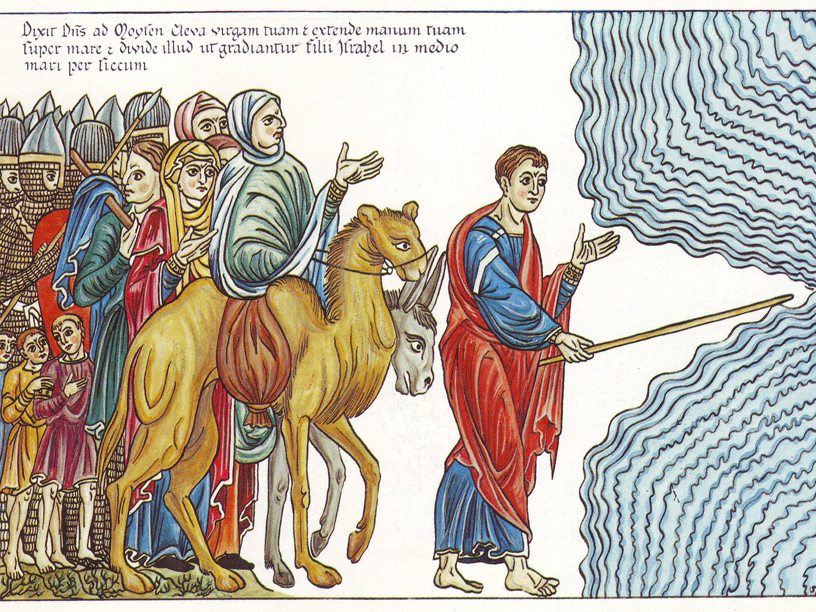
In the tragedy there is a story about the transition of Jews under the leadership of Moses through the Red Sea and the death of the Egyptian troops that had begun behind them. It is interesting that the Egyptian acts as a messenger from whom the audience learn about this event. In other fragments, there is a description of the phenomenon of God to Moses in the form of a burning and non -combustible bush. “What a sign from the bush! - exclaims Moses - wonderful, which is difficult to believe in. The bush suddenly flashed with a strong flame. But all his foliage remained green and fresh. What's happening? I’ll approach a great miracle. ” This is followed by the dialogue of Moses with the Lord, which describes the upcoming executions of the Egyptian executions, in a slightly modified manner compared to the Old Testament text, and also set the establishment of Easter celebration.
In the story of Easter's establishments, Ezekiel-Tagik does not mention an indication of the mandatory circumcision of men (Exodus 12: 43-49). Apparently, this has been done so as not to provoke anti -Jewish moods from the Alexandrian public once again. Cutting was one of the frequent topics that the ancient critics of Judaism paid attention to. Moreover, since among the famous Greeks of peoples it was practiced only by Jews and Egyptians, Greek authors believed that the Jews borrowed this “barbaric” custom from the Egyptians. Diodorus Sicilian in the “Historical Library” wrote: “... such an ancient institution is observed among these two peoples as circumcision of boys - this is a custom brought from Egypt” (I, 28, 3).
The changes made by Ezekiyle-tragic in the story about the arrival of the Jewish people in Elim are interesting (most often it believes that Elim is Vadi-Garanel oasis 100 kilometers southeast of Suez). In the book, the outcome of this is said briefly: “And they came to Elim; There was [it] twelve sources of water and seventy finite trees, and settled there with a village in the waters ”(15:27). In the tragedy, the landscape is shown in more detail: “They found a shady and sources meadow there. // rich earth and abundant // Rucheevs twelve from one mountain flow, // There are palm trees of beautiful fertile seventy // and meadow, feed on all sides, // gives rise to greens - for animals food. "
Moreover, in Elima there was an unusual creature that Ezekiel just calls the “animal” (ζῷον): “By the same time, we saw the strange animal, // Amazing, which no one has ever seen. // Two times more in height than an eagle, approximately. // with variegated wings. // His chest was purple. // Reds are red, and on his neck // there was saffron wool. // with the head of the manual rooster is similar, // and looked with a yellow pupil // around. The pupil looked like a seed, // as it seemed. Nevertheless, birds // behind him the frightened followed, // He is ahead, like a proud bull, // walked rapidly walking. ” Already ancient commentators saw in this animal the famous Phoenix, a wonderful golden-purple bird, which, according to the ancient legend, arrives in Egypt from Arabia every five hundred years to burn and revive again. The mention in Phoenix in the tragedy “Exodus” is considered a symbol of the revival of the Jewish people, freed from Egyptian slavery.
Phoenix. Mosaic from Antioch.
As T. A. Mikhailov suggests, Ezekiel-Tagik could not directly name Phoenix in his tragedy. She gives an example of the appearance of Phoenix in one of the midrash, which describes the episode with the daughter of Jacob Dina, whose daughter, born after rape, was left in the desert. The girl saved the wonderful eagle, which carried her to Egypt, to the city of Heliopol. Later, she, who received the name of Asenf in Egypt, became the wife of Joseph Egyptians. Thus, the author of Midrash got rid of the need to recognize the marriage of Jew Joseph for a representative of another people. The mention of Heliopol is given in the wonderful eagle of the Phoenix, but the author did not want to mention the creature from pagan mythology. Similar motifs could be moved by Ezekiyle-tragic.
However, according to the researcher, Ezekiel left a hint in his tragedy, allowing you to find out that the Jews met with the Phoenix. It is contained in the lines preceding the description of an amazing animal: “στελέχη δ'εὐεὐερνὰ ποιλὰ φοινικων πέλει ἔγκαρπα ...”, in the literal translation: “There are many strong Phoenician / fertile trees there ...”. The fact is that the ancient Greek word φοῖνι clim “Phoenician” could have the meanings of “Finnish palm” and “bird of Phoenix”.