
Translated material
Not only about the "deadline"
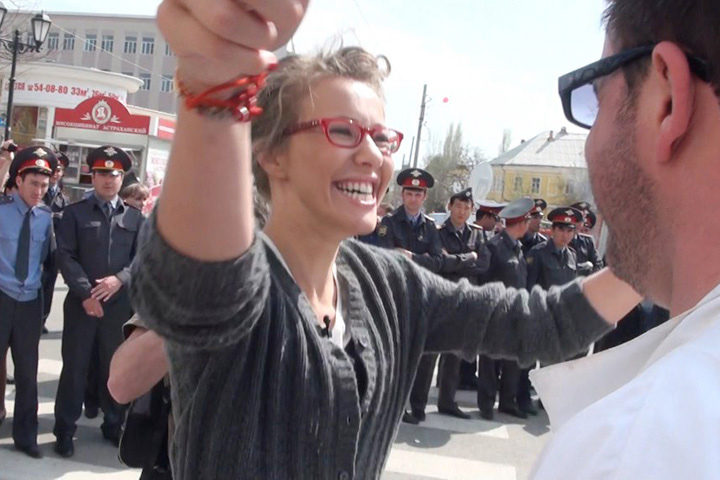
The film of Rastorguev -Kostomarov - Pivovarova "Term" caused general disappointment. Dmitry Bykov, even without hesitation, called him "inadequate abomination." The directors worked for a long time on the film about the protest movement of 2011-2012, released many episodes and eventually made a film in the center of which it turned out to be ... Ksenia Sobchak. Sobchak has never been a politician, and her nomination looked strange. In his review, Oleg Kashin irritably remarked that the “term” is the film “About Love”: “In fact, and what else - not about the protest movement? The story of Ksenia Sobchak from Ilya Yashin to Maxim Vitorgan-from everything that happened in the rally Moscow of 2012, this is the only storyline in which at least something (wedding) happened, which can be recalled without obligatory in all the other storylines “eh, protected”. And even Sobchak itself, it seems, was a little surprised by the central role that she was assigned: “term”, of course, speculates a little on media characters, and sincere people remain behind the frame, freezing for abstract values, their nobleness and fearlessness, which later led to the bars. ”
Meanwhile, the film is just interesting in that the center is not placed in politicians, but a prosperous, successful young woman who enthusiastically enters the protest movement with enthusiasm, and then leaves it. Sobchak is interesting in that she is better than others expresses the evolution of the “middle class” attitude towards protest. This attitude is fought by a special experience of freedom, internal emancipation, which the first rallies and processions brought with them. In his response to the film, his heroine emphasizes that participation in the movement was more existential experience for her than a manifestation of political beliefs: “That winter was an incredible concentration of nobility and human dignity - this is infrequently in life. And this is most valuable for me. But the film cannot fix this magical state. ”
The middle class, which was crushed by fear and inertia, experienced unexpected intoxication of an unknown experience that, by the way, is indirectly connected with the culture of prosperity and consumption, built around the set of consumer choice. Rastorguev, Kostomarov and Pivovarov realized that this feeling of intoxication was directly connected in the case of Sobchak with the novel she experienced. Her relationship with Ilya Yashin at the beginning of the film is full of the same fun romance and freedom as protest demarches. The authors emphasize parallelism in the development of love relationships and social experience. The advantage of the “deadline”, in my opinion, is that he is the first reflection of protest in Moscow, in which the role of politics is minimized. The protest is shown almost exclusively as a drunk existential experience of freedom. And I think this diagnosis is smart and accurate.
Without paying attention to politics, the “term” gives a clear picture of the reasons for the degeneration of movement. As the authorities begin to use systematic violence and prohibitions, the gatherings of the protesters naturally lose touch with freedom and gradually degenerate in contrast: the experience of lack of free. The heroine is searched, they seize money from her, she is put in a car carrier. And the reason to participate in the movement disappears. What is the point of persistent when the main incentive disappeared?
The central episode here is a stray Maidan, invented by Navalny and Udaltsov. This walking along the streets of Moscow is an exhausting movement from one police barrier to another. There is no more choice. It is at the time of these wandering that freedom finally discovers its fundamental metamorphosis - in coercion. At the same time, a gradual change in relations between Xenia and Ilya also occurs, lightness disappears from them. The authors were inserted into the film, it would seem, a worthless episode in which Sobchak makes Yashin buy lipstick to relieve irritation that appeared on the lip. This "empty episode" is an indicator of romantic evaporation.
Perhaps the main metaphor of the film is the contrast of the free fluidity of the implicity of obstacles, repaired by power. Some modern sociologists distinguish in society manifestations of morphostasis and morphogenesis - interconnected phenomena of crystallization of form and its continuous variability. Sigmund Bauman wrote the famous book “The flowing modernity”, in which he proclaimed the variability of social forms the main feature of today. However, there is, however, fluidity without forms taking it to the shores.
The changing attitude of the flowing to the static in the film is represented not only in the opposition of the protesters and riot police. This attitude is fundamentally and for a couple of Sobchak - Naval. Navalny occupies a significant place in the film, which is becoming more and more important as repression increases. Navalny’s police possession contrasts his own petrification. The more they put pressure on him, the more he is his fearlessness and principledness. Navalny is shown as a bold person of beliefs, the bearer of the idea, and therefore, a person of politics. The more decisively he is opposed by the authorities, the more delighted the eyes of his wife Julia turned to him. Navalny turns into a heroic figure of political protest. And it is at that moment that Sobchak expresses his complete rejection. In a conversation with Venediktov, she calls him Putin 2.0. For free fluidity, the stasis of political confrontation is absolutely unacceptable. From this episode it is especially clear that in the center of the film and the personal project Sobchak is not a politician, but exclusively existence, a form of existence.
It is curious that in the film as an episodic character arises a firing leader of radical nationalists Belov-Potkin, expressing admiration for the bulk precisely as the embodiment of a petrified force.
The film ends with the exhaustion of the protest movement and - ironically - the unexpected marriage of Ksenia with Maxim Vitorgan. The romantic freedom of relations with Yashin is completely exhausted, and the heroine’s integration into the social institution of the family occurs. Personal morphogenesis ends with morphostasis.
Of course, the metaphor of fluidity and immobility has not been invented by the authors of the "deadline". But she successfully falls on the dynamics of Russian events, allowing them to comprehend them not in the political plane, but in the plane of transformation of social forms. This approach to the events of the recent past can be productive beyond the scope of cinema. If from this point of view to look at what is happening, then the curious dynamics of these forms becomes obvious. Initially, we have a dynamic, fluid and chaotic process, concentrated in the protest movement, and opposing it of a repressive apparatus that blocks any possibility of movement. The state in this situation looks like power, whose rigidity in the fight against protest increases sharply. Meanwhile, everything unfolds as if the dynamism of protest in a paradoxical form was transmitted to the state apparatus, which begins to behave more unstable and unpredictably . The fluidity goes from protest to the state. Recently, we have observed the through destabilization of many social forms - from a gross violation of international treaties to the war. We observe the destabilization of the economy, cultural policy, a chaotic change in rhetoric at the level of international relations, etc. The forces of morphostasis begin to mutate in their opposite. The radical sociologist from England Margaret Archer showed that the dynamics increases as a result of the lack of adaptation and pile of obstacles. By building obstacles, the system itself produces its own destabilization. The result of this mutation is difficult to predict, because the country is included in the zone of uncertainty and turbulence. Once the wonderful English biologist Konrad Hal Waddington introduced the concept of homeorezis, which he defined as a dynamic form of homeostasis. It was about the ability of organisms to maintain a stable form through a continuous dynamic movement that arises in response to the external and internal noise of the information and termodynamic system. In itself, this movement produces a powerful informational noise, reflecting chaotic reigning inside it. The form and its meaning are drowned out by this noise, which can only be suppressed when moving to another system, when changing points of view. The French philosopher Michelle Cherr claims that only for the view from the inside of a different system the chaos ceases to dominate and the outlines of Stasis, that is, forms that have meaning, arise behind him.
What is happening in Russian reality and in the film "Term", similar to the processes of homeorezis. From the inside of the Sobchak and Navalny movement, they seem to be elements of the general dynamics, but from another system, their confrontation, opposition, crystallizing meanings and forms are found from another system. Being part of the movement, Navalny becomes an element of immobility. From an external point of view, the policies of the authorities look like a pure increase in immobility (everything around is clamped and under petty control), but when he enters a different perspective, this stasis turns out to be a chaotic and selfless noise of the system that has lost all sorts of support points.