
Translated material
Putin's "Airszhabas"
The publishing house “Time” has just been published “The most complete collection of poems and poems” by Alexei Parshchikov, who had gone in 2009, entitled by his last poem “Airships”. As a poet, Parshchikov has long taken a strong position in the Russian canon: the role of the leading head of “Hydra of Metrealism”, the early (1986) prize of Andrei Bely. At the same time, as it became clear lately, throughout his life he remained at the tip of Russian poetic thought, although not always in its first echelon. In criticism, it is customary to see Parshchikov with a poet with a hermetic, inheriting mastic tradition of philosophical and “academic” poetry of the 18th century, one of the central moments of his work - including the poems “Airships” - is considered a reflection on the perception of history, the aesthetic experience of the fragmentation of a large history. In the preface to the collection, Ilya Kukulin writes that "the airships ... were such a detailed metaphor of memory of the hope of technological progress." The remark is undoubtedly significant, however, it seems to me, it describes only one of the motives of this poem, completely losing sight of its semantic rod.
The text of the “Airships”, in the comments on the collection, characterized as “an incomplete cycle or poem with relatively autonomous parts”, in fact, is formed in an amazingly holistic work both in choosing words and in the picking of one, very accurate experience. This becomes visible if it is reacted to the poem as a single text that is built around a particular and easily recognizable script. In fact, what does he celestial peace have heavenly peace ? Behind this peace there is an extremely clear series of words: a limousine, pompous cottage, a puppeteer, spotted fur coats, a banquet and musicians, fingers whispering in a thimot darkness or a pack of bills with a strain will hide the finger-and a lite-clutch ... The character of the poem leaves the house, with a huge kitchen, with the courts and a labyrinth of the bedrooms , and next to it-his colleagues, nervous Scarecrow , gloomy monkeys . What kind of “colleagues” could be called gloomy monkeys in the middle of the zero, it is unlikely that it is necessary to explain: these are security forces. In the focus of the poetic telescope Parshchikov is the ideology of the Russian authorities of the Middle Putin era. Before us is the top of the elite ( “Airszhabas, you are the sky in the sky!” ): The oligarchs mired into luxury and corruption, who are served by gloomy monkeys . The semantic frame is surprisingly homogeneous, and its traces are scattered in the text in such abundance that my “reading” loses the last chance to become stripping reductionism. Heavenly peace is the aphoristic formula of the neopetin social ideal “strong”, “strong” political power, economic stability guaranteed by militaristic structures. “Hope for Progress” was just in the middle of the zero were marked by the explosion of the popularity of “nanotechnologies” in official rhetoric - by the end of the decade we will find this at the stage of degeneration in anecdotal “nanovsuli”, which must be “knocked down by nanolaser”. "New technologies, heavenly peace!" -ironically exclaims Parshchikov already in the fifth line of the poem, thereby introducing the motive of scientific and technological progress, to which he is really extremely critical. However, it is important that the idea of progress acquires a specific socio-political marking in its text, being an integral part of the ideology of power.
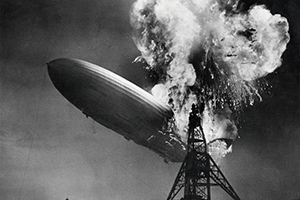
In a nutshell about the quasi of the "airships". The mafia Tykun T. is refueling by the security forces here - the figure is either an oligarch or a “bloody gabist”, personifying the total continuity of the Putin regime in relation to Soviet Russia (“succession of fault”). In the very first line, we are informed that Taykun served the entire World War I / in the Zeppelin division : it is unlikely that it can be argued here that the airships by Parkhchikov is an exclusively symbol of “Hoping for Progress”. In the First World Airships “distinguished” with destructive bombing (London’s bombardment in 1915 is known, there is a reference to these events in the poem: “And the pilots were wrapped on decks, / throwing bombs to London” ). In Hitler Germany, the famous “Hindenburg” was a symbol of all the achievements of the Reich (the collapse of this apparatus is also described in the poem: Black Hyndenburgs Black Black Poleni ).
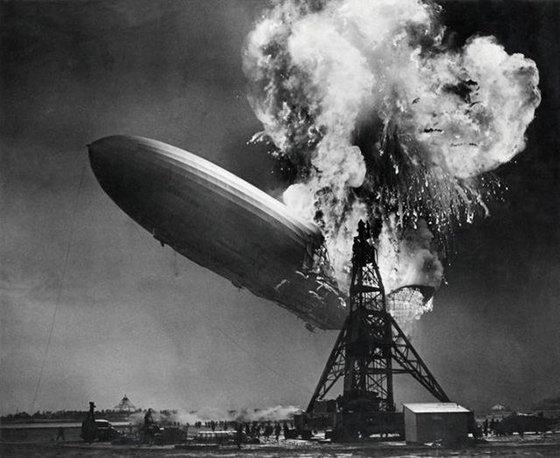 The crash of "Hindenburg"
About the same there was an airship for socialist realism - you can recall the mosaic of Deineki “Airship over the Spasskaya Tower of the Night” at Art. m. "Mayakovskaya" in Moscow; The halo of destructive power remains around the airship as an archetype.
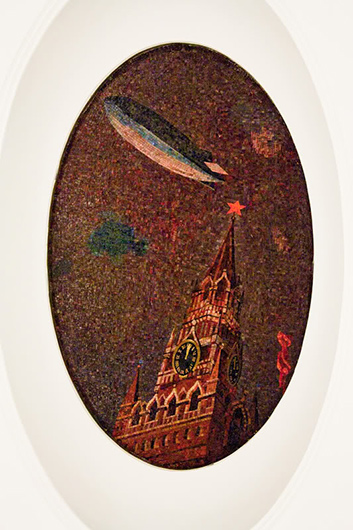 Mosaic Deineki on Art. m. Mayakovskaya - "airship over the Spasskaya Tower at night"
At the end of the twentieth century / [Tykun T. -] the owner of their production : the figure of this quasi -poses is a sign of an inextricable connection between the bloodthirsty desire to profit by Putin oligarchs and the violence of totalitarian regimes of the 20th century. Taikun T. invests in the construction of a new airship - on a sunny battery ( sunny power of authoritarian power, which brings heavenly peace ); This airship will become a communication server . Here, the airship motif is transformed into a clear figure of communication between the authorities and the population. However, the pilot L. , to whom we kind of sympathetic, hugs it, wants to disrupt the bank for himself. This pilot, however, is the same smashed as his “colleagues”, only “from young, and the early” - everything imagines that he is not at the mistake / at this wedding with D., the daughter of Taikun T., like his dad, he throws, and then his competitor rolled up to his dad, P. provider (well, here, probably, there is no need to explain, who lies for the initial. Puppeteer, grandfather, hypnotist, sticking into the forehead of L. Matovaya cane ). Putin seems to offer help to the first oligarch, puts binoculars to his eyes - and strikes behind . Typical techniques replicated in mass culture are to take any domestic series about NKVD dungeons. It is important, however, to note that the observed fan of the characters is a deliberate convention, both warring sides (Provider-Putin vs. Silovik-pilot with the oligarch T.)- it seems that the same-polar , they were taken out of one suitcase .
Already at the level of this quasi -bustle, a semantic frame - heavenly peace , where he smashed everything in power - begins to undermine from the inside. Having stolen the airship, L. tries to participate in a certain lottery , which is counted on by his enemies, but he, choosing numbers for lottery codes , wins for the time being (until everything completely collapses, like “Hindenburg”). The lottery motif introduces the experience of complete unpredictability, absolute arbitrariness reigning in Putin’s proposed stability: “I plucked the bank on the casino website, and the markets were strained” ; "The lottery won, getting down from the course and freezing." L. security security officer guesses along the shadows , and the general sense of life of the whole country is aptly described in the phrase , the Universe sorting out the intentions of his hand - complete uncertainty, meaninglessness, and ephemeral of control. What can be “stability” when the executive branch guesses along the shadows , and in which case he sticks a matte cane in your forehead ? Here we draw attention to another phrase from the Putin's media language - “vertical power”: the vertical is pierced by the accordion - the power is scattered from the inside, and the whole country is experiencing metastases (Is the Parshchikov topical? Yes, but in the highest sense). The problem, however, is that the horizontal opposed vertical does not give deliverance: "We are lighter than air, and horizontally / we fall freely." Perhaps this is the main feeling in Parshchikov’s poem from Sredne Putin’s Russia: everyone is clamped, everywhere is uncomfortable , everywhere he has some ribs, bones, claws : “And the lottery drum increases the momentum / squeezing time with ribs” . The power of arbitrariness is a rigid, inhuman cream in which all bodies dangle, but their freedom is imaginary (this is the only way they say that the bodies are freely cut ) - they are doomed: a great airship rushes towards a catastrophe. Solid Western meaning .
The most capacious Putin government reflects the quasi-poses, given by Parshchikov almost dotted line: manual owl bubo-bubo . It is manual manual, even like homemade , but for some reason he does not give in to the calculations, nor the name-we will get down , and even mutter. The power is unarmed and unarmed. The worst thing that his image is fulfilled: looks at both, where it is darker, and attacks the mouse tribes . Here, in the motive of these tinted mice , we are all represented. The airship of the authorities flows nowhere over them, but the connection with him is lost, violence ( throwing bombs ) comes from him. Not necessarily mice , it is possible: "And lizards with a tongue in the lips on the shore are soldered to the wall." Or like this: "And robots, numb, support rolled bags." The people are a bunch of demented and blind who build these airships for their deaths, and power in the face of gloomy monkeys is represented exclusively as a punitive instance. These thugs are equipped with all arsenal of the NKVD dungeons:
Picks, files, cerebral knives, and the azure bends on the blades with a hunchback,
Coloralists, holes for nails, screwdrivers and hooks ...
All these “charms” are used by complete arbitrariness, and those who cannot stand it are sent to voluntary flour to the gulag:
who did not pass natural selection, he pulls the wire on the way
Around him, and a sticky current is visible so that the fences do not climb .
Everyone here was stuck in the labyrinths : the people - literally, in field prisons , in basements , and power - in the maze of their own projects ( “Projects, permutations!” ). The people are zombie to the state of monsters ( “Low inflaces to the heels, but they can’t find their eyes in them” ), and while the authorized authorities joyfully hap oil ( “The boys stretched out the fuel oil” ), the country bends from hunger ( “The hollow loss of the skeletons stared from the hangar” ).
It remains to say about two significant points in the "airships". Firstly, what does the central text with the loud name “rural cemetery” do there, which all obediently after the author is erected to the famous elegy of Zhukovsky and Gray of the same name. So: with these texts the "rural cemetery" of Parshchikov does not correlate in any way. Well, almost nothing. In the poem, behind this poem, a prosaic “comment” immediately follows, where the author with a huge language in the cheek tells us about his connections with romanticism and about the passion for the history of the airship (understand: the structure of the instruments of power and violence). And this, apparently, is the same red herring that so easily confuses all researchers. The intersections between Parshchikov and Gray-Zhukovsky-a little. The name, the motive of the "cemetery", the motive of the "towers" - that's it. However, where the grave hills are covered in Zhukovsky in green sod , in Parshchikov- in the cemetery with a chemically green I, I erected a hiking, shaky monument . Pushkin, not Zhukovsky! Rather, the distortion, the impossibility of this Pushkin: a poetic statement in a planted Putin society is almost powerless. And the "rural cemetery" turns into a chemical burial ground, which gives almost a battle under the IPRE of 1915. The “tower” is approximately the same: Gray from yonder Ivy-Mantled Tower / The Moping Owl does to the Moon Complain , from Zhukovsky, from the top of that magnificently sprinkled decorated tower / mournful cry of Owl, before Gray, uninvited by Gray, uninocated. visitors who violated her peace. In Parshchikov, in the last line of a multi -page poem, we finally read: in the tower with the phone disconnected, I listen to the desert owl through ivy . Parshchikov’s airships, I recall, should have been used as a communication server, but the country is collapsing from this, so Tykun T. is sitting in a tower with a shutty phone - this is another “tower”! This is an ice tower , this is airship, this is about the lack of feedback from the government with the people. Parshchikov skillfully pulls us by the leg, but, by the way, constantly speaks: "True, I missed a common theme of property equality in the face of death." We will not find fault with the wording, but-mercy, “missed”-the main meaning of these texts turned out to be. The only thing Gray and Zhukovsky are needed here is the reminiscence of the genre: Parshchikov’s poem is a real elegy. The lyrical “I” is acutely experiencing the loss of all control over life, the Western of meaning , erosion of creative principle under the influence of circumstances - and this sensation is entirely ascending to the classical elegy.
And yet - about the experience of faith in Putin's Russia, as shown in the "airships". In the sixth chapter, “Schedule (Stop Sun)”, the very name refers to the biblical legend of Jesus Navin, the Gromille colleagues turn into surveyors- and then into the commanders-Navin , who seems to be easy to throw out their hand forward and stop the sun. In the Old Testament, according to the prayer of Navin Yahweh, the sun stops so that the Israelites manage to break the enemy in daylight.
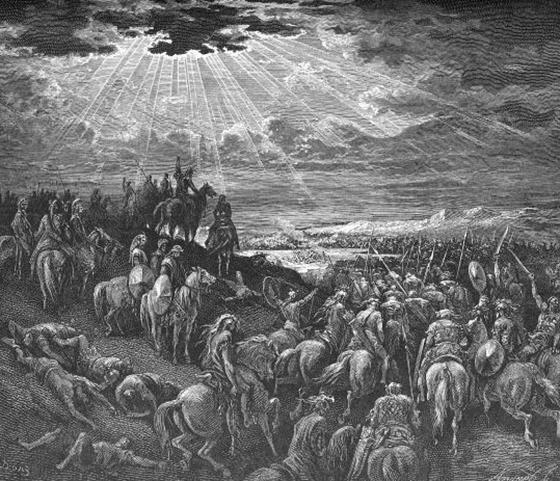 Gustav Dore's engraving - "Jesus Navin stops the sun"
But the Putin gloomy monkeys stop the sun before it rises above the horizon, the motive turns over, and darkness reigns everywhere. In this darkness, all the demented and blind will be cut, like the inhabitants of Jericho, but Navin’s commanders would not see victory. The daughter of the oligarch says:
I dreamed that they gave me bread easier than air (an object in the form of round bread),
In it, the stadium inside and is in full swing - a millimeter of bitter grain .
There is no faith in Putin’s Russians, even “with mustard grain”, and the participation of participle is experienced as a meaningless object . Pretense of religiosity is convincingly shown as a phantom, sleep, cold indifference ( “blows through a fresh baguette” ).
Returning to the image of the country of camps, I would finally want to clarify how Parshchikov has a story. He really reflects a lot on her, leaving about two hundred years back ( “My strict apparatus has surfaced in a fault, / between two centuries in an ellipse lumen” ) and mainly concentrating in wars and disasters. The whole beautiful -hearted history of the aeronautics, about which critics are enthusiastically subject to, is completely subordinated in the poem “Kidigabia” to the destructive use of these devices as instruments or direct violence (First World War), or propaganda (“Hindenburg”, streets in leaflets and instantly reminding us of the photo chronicle of Gagarin or pilots - rescuers of Chelyuskintsy, i.e. media socialist realism).
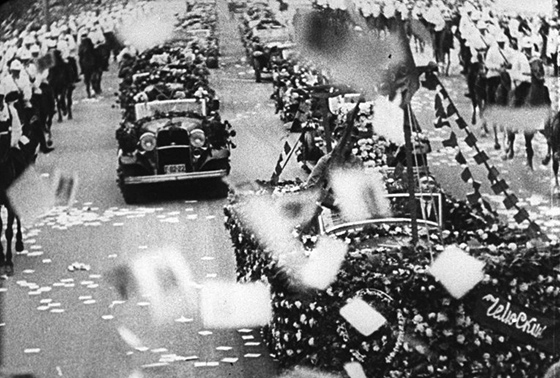 Moscow meets pilots from the expedition to save the crew of the ship "Chelyuskin"
The War of 1812 is also available to Parshchikov’s gaze, but it is not a glorious milestone of domestic victories (here is another aspect of the official pathos of the zero), but the figure of violence ( will deliver Napoleon's head ). At the same time, the view of history is subordinated to the general semantic frame: the experience of the situation of the present. Parshchikov-poet accurately and balancedly (without losing the height of the flight of poetic thought) analyzes the origins of the self-awareness of the middle of the zero and does this sometimes more insight than any historian due to the courage of his comparisons.
It is necessary to make a reservation that this is not the first time in the "airships". In another poem, with the speaking name “Oil”, written at the very beginning of the zero, Parshchikov also aptly outlines the ambivalence of public ideals at the dawn of Putin's rule:
The killers are hidden, but their ribbed sticks, like neones, shade the sinks.
Tulip's fingers roam the morgue, poke in the sky and find oil there.
So is his other poem, one of the earliest, “I lived on the field of Poltava’s battle,” written in 1985 and received, in fact, Andrei Bely award in 1986, we cannot perceive even today outside the semantic context of the Brezhnev era. In Poltava, everything is as obvious as in the “airships”, to take at least the last, third, chapter, which is called “the king rewards” - these are already almost anecdotal orders of Brezhnev. Parshchikov-Saltykov-Shchedrin?
In a certain sense - yes, at least, his attitude to official Russian/Soviet culture was more than critical. But at the same time, unlike Shchedrinsky, the Psshchikovsky experience is the experience of the lyrics: we recall his textbook eight -style, where American culture (phantom) and Russian ( man ... upside down / dragged along the stairs to the spire of Moscow State University ), - A poem with the mocking name "Everything is so."
Aesopov language Parshchikov is exceptionally intelligible and does not allow many interpretations. At the same time, the presented picture is not a flat political pamphlet, because The "airships" do not come down to a number of references to well -known historical events. The motives associated with specific socio-political realities are not important in themselves, but as a factor in the existence of the lyrical “I”. The adhesive current of wire and a chemically green cemetery is not literally a gulag and a battle of IPRA, but the non-freedom of mice in this gulag and the horror of the “I” from the presence of IPRO in the present. The architectonics of the poem also represent a constant poetic work, “artistic assumption”: the provider-Putin can turn into Androggin , Taikun T.-it is not necessarily Yeltsin/Khodorkovsky, the motive of the airships also acquires different sounds depending on the context: this is the connection of the people with the authorities, and the power in general, and all of Russia, which rushes, like a rageous, to suffer a crash and turn into a crash and turn into a crash and turning into a crash and turning into a crash and turning into a crash and turning into a crash and turning into a crash and turning into a crash and turning into a collapse Air snake with a round -up tail along all of China . The quasi -jacket itself is reset in the poem, there is no narrative here as such. Переживание поэтом среднепутинской России есть ужас вечной погони провайдера за пилотом через трупы мышей. Здесь нет изменений в структуре персонажей, но важно, что они все внеположны лирическому «я» и олицетворяют те обстоятельства, в которых творческое начало постоянно подавляется. Начало поэмы точно совпадает с концом, что в принципе отменяет нарратив: в первом фрагменте, «Завязка», мы находим невесту, которая — мел , а в последней главе, «Ветер, Сан-Ремо», перед нами юноша в нише… — известняк во плоти . Даже первая и последняя строчки поэмы эквивалентны: начиналось все с тайкуна в дивизии цеппелинов , а заканчивается аллюзией на полотно «Апофеоз войны» Василия Верещагина (1871):
Мимо вокзала с горы верещагинских черепов слетела тысяча шляп .
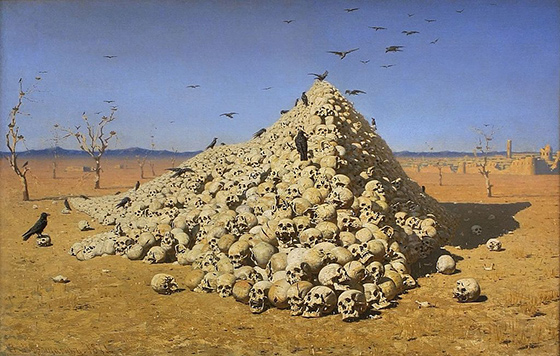 Василий Верещагин, «Апофеоз войны»