
Translated material
"We ourselves are quite exotic"
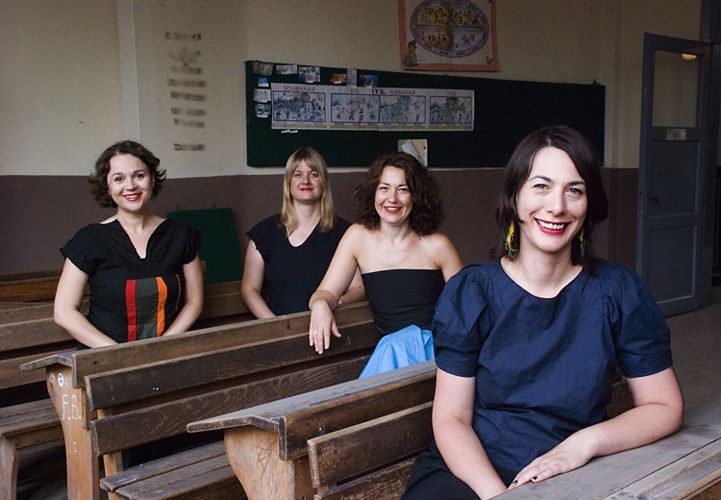
The curatorial team from the Croatia Whw (What How & For Whom) shows in Moscow, in the building of the Institute of Africa, the exhibition “Ten thousand tricks and one hundred thousand tricks”, which is the final part of the long -term nomadic project Meeting Points 7 . Participants in the collective Ana Devich, Natasha Ilich, Sabina Sabolovich and Ivet Churlin talked about the project.
- The Moscow part of your project “Ten thousand tricks and one hundred thousand tricks” has three levels. The first is the nomadic project Meeting Points . The second level applies to a narrower social and political context of Russia. And finally, the third is the microcontext of the Institute of Africa. How do you characterize and correlate these levels with each other?
- We were invited to oversee Meeting Points shortly after the beginning of the Arab Spring, or the “Arab Revolution”. It was a moment when optimism about these events began to gradually decrease. Initially, we thought that it could be an exhibition or festival that will unite artists from the Arab world, introduce them to each other outside their region. Then it seemed to us important to contrast it with cultural stereotypes about the Middle East in the West. Often in such situations we are faced with the following problem: the unexpected popularity of a particular region in the field of art means mainly only temporary and superficial interest. A similar story happened in the 1990s with Eastern Europe, especially with the Balkans.
We wanted to give Meeting Points a new form - the Arab world was supposed to be the reference point. However, given the then political stress, it was also a way to express international solidarity. Therefore, it was interesting for us to investigate how a certain chain of events in North Africa and in the Middle East inspired other protest movements around the world, including a new wave of capitalism that gave rise to a crisis. For this reason, we turned to the book of Franz Fanon “The curse of the branded” (1961). This book analyzes a liberation war against the French colonialists in Algeria and contains many interesting ideas on which we would like to focus on today. Fanon speaks of the violence and roles of the middle class in the revolutionary process - an extremely important topic for the Arab world, as it turned out. Another topical question that protest movements in all corners of the world encountered is a political organization.
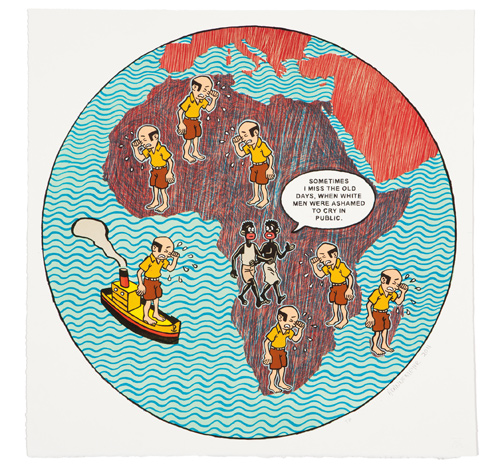 Anton Cannemier. Tears in public. 2011. Courtesy of the Stevenson Gallery, Johannesburg
And, of course, the question of decolonization. We were interested in seeing how the colonial process was arranged today, how it correlates with different forms of imperialism and how globalization affects it. But what was especially interesting to us in the analysis of the fanon is how and in which society the process of overcoming the colonial past achieves success, a new system and a new society are established, and how at the same time it retains the remnants of the previous period, which can lead to the restoration of previous orders. This is especially important for us, this is a matter of responsibility that we, as cultural workers, share that we are also discussing with invited artists.
- Why did you choose the chapter “Ten thousand tricks and one hundred thousand tricks” as the name of the exhibition?
-We borrowed this fragment and used the headline, because it refers to some extent to the various difficulties that liberating movements face, and at the same time we wanted to make a project strengthening these movements, discuss different strategies of struggle. We decided, as far as possible, to avoid turning our project into a certain “representation”. And this position was reflected in the choice of artists and cities in which the project was held (it was already shown in Zagreb, Antwerp, Cairo, Hong Kong, Beirut and Vienna. - Ed .). We really cooperate with a number of artists from the Arab region, but the idea was still in the creation of an international project, where participants are judged by their work, and not by ethnicity. For us, the book of Fanon was a guide that helps to analyze the modern revolution. Later, we had the idea to go to China and Russia to explore the history of the largest revolutions of the twentieth century. From the very beginning, we hoped for the continuation of the project in Moscow, because then there was also an active wave of protest movements. And we managed to organize an exhibition in Hong Kong, in China.
- Partly in China ...
- Yes, it is partly China, but very specific. For example, in Hong Kong, we focused on the question of the middle class, which today turned out to be a significant force requiring democratic reforms in the region. As we have already said, Moscow was included in the Meeting Points plan, but the decision to hold an exhibition at the African Institute was made much later. And we thought that there was a really suitable context: we can talk about colonialism and its consequences, about the anti -colonial confrontation in which the Soviet Union played both a positive and negative role.
In recent months, the situation has changed dramatically in connection with the Ukrainian crisis. We see a conflict that resembles a civil war rather and testifying to the beginning of the next Cold War. It is clear that it is necessary to talk about all this, to critically analyze the current events (on the first day of the project in Moscow, a joint Russian-Ukrainian assembly was held, which discussed the current situation.- Ed .), To understand how the current imperialism implements its robbery policy. As curators, we did not want the exhibition to be nostalgic, because even the building of the Institute of Africa, monumental and majestic, can cause nostalgia. In fact, the building functions as a storage of history. But visually we sought to distance ourselves from this past. This is not what can be blindly used as a background on which the events of the present are developing. There are certain gaps, we would like to minimize them. Therefore, the viewer will not have any particular difficulties in reading contemporary art, since work does not dissolve in the surrounding space. We do not have a Site-Specific installations, we initially wanted work to clearly stand out.
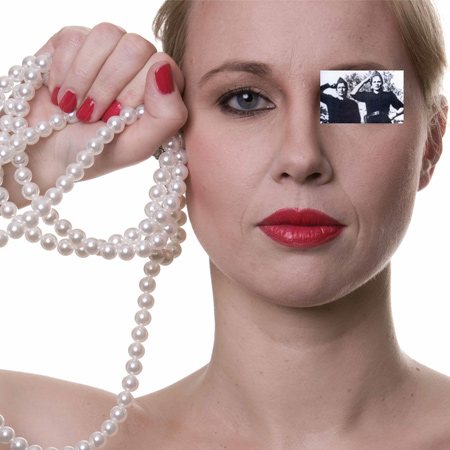 Sanya Iveokovich. From the series "Correct: the pearls of the revolution." 2010
- You involuntarily pay attention to the fact that in your project there are a number of artists who make up the “basis” of the project, passing from one part of the project to another. There is also a “superstructure” in the form of artists who join the exhibition in every city. How do these two elements function inside the project?
- Each stage of the project creates a collective body that develops in itself. This is a kind of meeting place, not a traveling exhibition in its usual sense. We perfectly understood that it is impossible to make a universal project that would suit all sites. And this becomes clear at the level of practical implementation. For example, all spaces differ in size: it is impossible to make the same exhibition in such a large museum as M HKA in Antwerp, or in a small non-profile space like Para SITE in Hong Kong. But even if you do not take into account physical parameters, it is extremely important that our project is developing in time, which allows us to re -revise the initial ideas, put forward at the beginning, and develop them in the future, thinking over new optics for a new place.
And therefore, for example, we again invite artists who joined the project in his first editions, but not always with the same work. In addition, in every city we call local artists. But we do not have a hierarchy. Together with artists, we are changing the project. This approach is fully correlated with the name of our curatorial team - What How & For Whom , "What, how and for whom." Of course, we are greatly dependent on working and material conditions, on logistics. For example, with the budgets with which we usually deal with, it is simply impossible to transport large sculptures from Europe to Hong Kong or Russia. This is reality. We have to correlate our ideas with existing capabilities, although as curators we always try to expand these boundaries with artists and always do more than we are required, and better than we were asked, because this is the only true way to do anything. In fact, if you just follow the rules, then nothing will happen.
In general, the project is flexible and built as a dialogue. Often we add something at the very last moment and try to react to the surrounding situation. I would like to believe that our “meetings” create a coherent chain: individual chapters of the project can be correlated with each other or, conversely, contradict each other. In addition, we had suppetors at exhibitions in Cairo, Hong Kong and Vienna. In Moscow, we have been helped by people with whom we have been cooperating for many years. This was a kind of continuation of the long relations that arose back in Yugoslavia, especially in Ljubljana, in the 1980-1990s and allowed us to start work on the project. At the same time, Meeting P Oints was an attempt to establish connections in those places that we know little. We would have summarized our experience with great interest, unless, of course, we manage to publish a book about all the stages of the project.
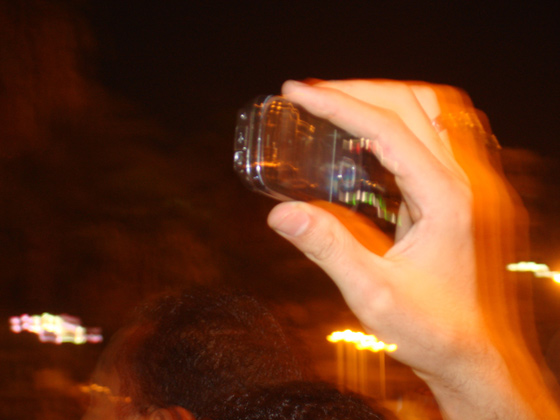 Maha Maamun. Night Guest: the night of the counting years. 2011
Once a long time ago, the Slovenian psychoanalyst Renata Salev said that the exhibitions are being made so that the curators enjoy themselves. To some extent, this is characteristic of our project, since we are the only ones who know all the nuances of each exhibition and, therefore, the project as a whole. But in fact, it fascinates how the same things work differently in each specific context. When you demonstrate the work of the Palestinian artist in Antwerp, it is perceived as a certificate of the next place, where there are many problems. But the show of the same work in Vienna goes into a conversation about Israel. And in Beirut, of course, there will be a completely different reading. And this is what is important to us as for researchers.
Therefore, these meetings can be strange, cause awkwardness. Some works directly turn to the topic of colonialism and anti -colonial struggle, while others do not. Does something happen at the time of the collision of these works with the context? Especially when you refer to the fanon and concern the questions that he raised, and then put all this in certain conditions of a particular city. For example, what does it mean to show work from the province in such a large city as Moscow? How does this correlate with the colonial ideology and the fight against it? What is the role of the national bourgeoisie? When did the revolution lose its impulse? And so on. This is the task of our meetings is not just friendly communication, but at the same time a clash. We do not take the idea of multicultural dialogue seriously, which would lead us to utopia when everyone is talking with each other, and we completely recognize that we can also make mistakes, because the project develops in time, and each exhibition is a kind of rehearsal.
- You are always talking about these meetings as an attempt to initiate a dialogue. But the rhetoric of the fanon is extremely directive and radical, especially when it comes to the struggle for freedom from colonial oppression. To what extent do you associate yourself with this line, while maintaining a discursive and dialectical position?
- “Curse of branded” is a very strong book. She really clearly expresses a set point of view and is very important today, and yes, it is directive. But the exhibition is still a different form of expression, you still do not expect it to clearly follow a certain position. We used fanons in order to, for example, demonstrate how to analyze the formation of national states in Africa in the 1960s in the 1960s, allows you to understand the process of formation of national states in the Balkans, as well as the problems that nationalism gives rise to in this situation.
Although, when we had just begun to engage in this project at the end of the “Arab Spring”, we perceived the fanon to a greater extent literally. We focused on his warnings in connection with the role of lumpen testis and middle class, with the alignment of forces and unions of various social groups, which are so easily created and disintegrated, with the organizational structure and its capabilities. These ideas were important at that time regarding not only the Arab Spring, but also the movements of OCCUPY , Indignados and others. However, now all this is perceived as yesterday’s story, because all these are the events of 2011, and now it is already 2014. That is why the book of Fanon is becoming an increasingly important source - precisely as a classic of political thought, and not as an actual revolutionary textbook.
Our 2012 exhibition in Antwerp was more about the revolution. In a sense, we managed to convey the physical sensation at the same time joy and fear. Over time, our opinion about Fanon has also changed, and now we perceive it as part of an intellectual heritage, which it always makes sense to turn to, but which at some point can be exhausted, which may make someone think about our position regarding the current situation. How could the happened two or three years ago could become obsolete? Why has our perception of the world have changed with such ease? Was it a kind of "normalization"?
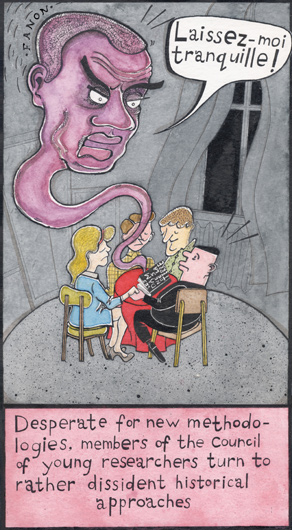 Vlad Kruchinsky. The spirit of Fanon. 2014
- How deep are you immersed in an existing post -colonial theory?
“We hold a little away from her.” Not any fanon is important for us, but only the book "Curse of the Bracks." The wider context of post -colonial research, of course, has its value. But this is not necessarily what we would like to dive deeply. We were more occupied by elements of class analysis. However, as we have already said, at our exhibitions there were a lot of works that included post -colonial problems. The fanon for us is an example of the classics of political literature, which can exist regardless of the context in which it was created, and lead to other areas - for example, to Marxist theory or classical German philosophy, which causes us greater interest.
- Working in such various situations as you manage to avoid the danger to reproduce cliches and exotic your object of research?
- On the one hand, we ourselves are quite exotic: four women from Eastern Europe, a curatorial team. The idea that we should always be represented by something and make up for some gender or national quota or that we are perceived as archaeologists and immigrants from “what is happening in this terrible place, which used to be considered Yugoslavia”, etc. We try to trust our feelings and artists, who are also very sensitive to such things. In addition, we take into account the fact that financing of projects such as Meeting P Oints comes from Europe. Therefore, you always have to negotiate. For example, how to avoid an exoting representation of Arab artists in the West, if you need to make a project in Europe (since the money came from there)? One of our tactics was the expansion of the geography of Meeting P Oints . We tried to strengthen the “International” element, without exploiting the whole variety of geopolitical background. And, of course, we are always attentive to each specific work in order to avoid various kinds of cliches. That is why Meeting P Oints is not friendly meetings, but conflict, tension, mistakes and productive misunderstanding.