
Translated material
Prodigal son
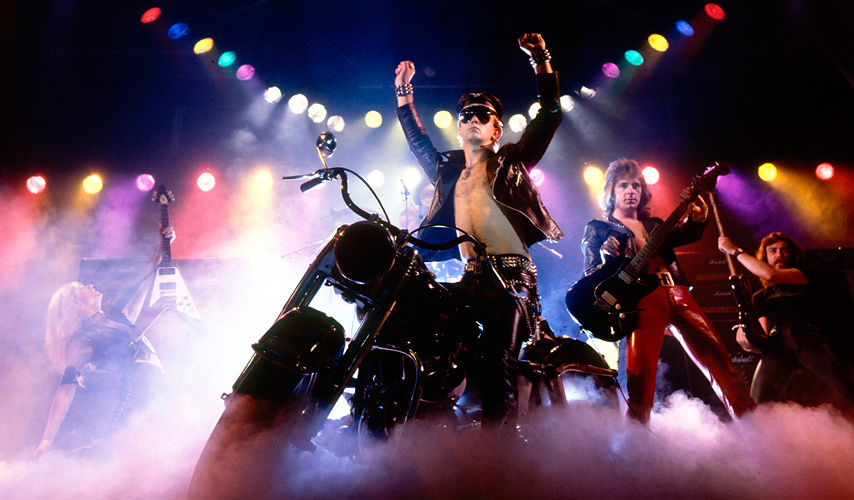
A musical journalist and Meloman with great experience Andrei Bukharin continues to revise the established opinions about famous musicians and musical cults.
Above Hevi-Metal, among intelligent people, it is customary to mock, so it happened from the very beginning. Here I am, in the 80s-a fashionable guy in the manner of the current hipsters (only we were hundreds of times less for the soul of the Soviet population), who then listened to the most progressive music in the range from Talking Heads to David Silvian, despised him as stupid and proletarian music. So much so that even Saxon and Manowar heard, it seems, only in our time. However, the covers of their records remembered by heart, they became so confused on illegal vinyl push.
The only group from the so-called new wave of the British Hevi-Metal ( New Wave of British Heavy Metal) , which I listened and loved against desire, was Judas Priest . Firstly, because he knew them from the previous, classic rock epoch. Judas Priest began before the rest, but later Black Sabbath - the foundations of the foundations of all heavy music. Actually, they were from the same industrial Birmingham of those times when the local working class was strong there, until it was replaced by migrants from India and Pakistan at the factories. Yes, and their name was clearly taken with an eye on the “Black Shabbat”, although it is formally believed that from the song of Bob Dylan.
At first, Judas Priest was played by an ordinary student hard rock, then gradually felt for their own unique style, and in the late 70s they found themselves in the thicker of this wave (in many ways forming its imagery, themes and cliches). In the 80s, they released a whole clip of interesting records, in which they made excursions unusual for conservative metallists into neighboring regions, from synthesizer New Weiva to major American rock.
And Judas Priest also had a special vocalist Rob Halford, who stood out not only with an extraordinary ultra-high voice, but also with his appearance. Like a punk, briefly cut in the kingdom of ideological hairs, he wore a cap with a high tulle, black skin in metal rivets, went on stage on a motorcycle and with a whip in his hand - in general, only Freddie Mercury must not be enough. Then we somehow did not realize that all this arsenal came straight from the underground gay culture (the same can be said about our perception of the image of the same Freddy or, say, George’s fight). The image of Halford quite correlated with the heroes of both Punk and New Weswa with his cult of decadence and androgynia. When, finally in 1996, advertising his own album in the style of the then-fashionable industrial rock, he “left the closet”, as the British say, and publicly announced his non-traditional orientation-in the camp of his brutal fans there was a pretty pry. But it was too late: Halford's leather-metal clothing has already become the uniform of the Hevi-Metal adherents legions.
A contemptuous attitude towards Hevi-Metal is nothing more than ordinary intellectual and snobs prejudices and prejudices.
The term “Hevi-Metal” itself flashed earlier (for example, with William Burrose) and was sometimes used in relation to the most difficult groups of the 70s like Black Sabbath , Led Zeppelin , Budgie . But the hard rock that they played was an integral part of the rock music as a whole, how the stormy 60s formed it. As a special phenomenon with its own scale of values, canons, the imagery of Hevi-Metal arose only by the end of the decade, becoming a parallel line of development of rock music. Other styles were later busted from him, which eventually made up a separate metal universe, very little in contact with the mainstream.
At the beginning of the 2000s, when the corporate pop was filled in music in music, I remembered about Judas Priest and began, replenishing the gaps in education, getting to know another metal music, which was helped by children's love besides Black Sabbath . And he found that all this contemptuous attitude to metal is nothing more than ordinary intellectual (and snob) prejudices and prejudices. Gradually, I had a small, but representative collection of heavy music, in which the early Heve-Metal took a special place.
This genre, as, indeed, all in pop culture, did not last in its purest form: from the late 70s to the mid-80s (as, by the way, a parallel New Weev). Further, such styles began to grow from it like mushrooms and ascended as Trash, Dat, Dum, Black, Power, and so on to infinity. In the late 70s, it was a small revolution-leaving a long “Haer” from the past, our difficult teenager refused blues roots and began to play hard rock more difficult, quickly and loudly. In fact, Hevi-Metal was a consolidated brother of the same punk, he was the same aggressive reaction to the thrown rocks-billionaicles, to their claims to high art, about the emerging fashion and the bankrupt hippic ideals of universal love and the world. He was only focused on Velvet Underground , but on the same Black Sabbath . And if the punk, despite all his declared streetness, was the lot of children from art colleges (not without reason they literally later began to play a sophisticated, aesthetic post-pack), then Hevi-metal became the voice of real working youth, that is, Patyushniki in Soviet terminology. The best example of this fraternity is the first Motörhead albums. Counting for NWOBHM , they actually played-wildly, loudly, dirty-all the same TRACKORD ROK-N ROLL.
Such faces were at the pirates, sailors, soldiers who built the British empire.
Once in London, I ended up at the Motörhead concert-I was struck by the guys in kosukhs and their friends, “for whom you won’t give a ruble” (© Mike Naumenko), flowing to the concert hall from all the cracks of the capital “ C OL Britain”. I drank whiskey among this raging sea alone and thought that, probably, such faces had such faces, sailors, soldiers who built the British empire. Such is the XVII century in the yard.
By the 80th year, a wave of new, young, evil groups gained such force that she broke through all the dams. The senior rock heroes, having received an energy injection, ran after the youth- Black Sabbath , having expelled the poor lake, recorded with Ronnie James Dio Classics Hevi-Metal, the album Heaven and Hell . Even sorry, Lord, Uriah Heep after a few years ripened for the ABOMINOG Hebi -Metallic album with a cover that is steadily entering all lists of the most vile plate envelopes.
Listening today all these records with idiotic, usually covers, you understand that it still works. Compared to modern metal, which really has become very heavy and gloomy music, the early Hevi-Metal is perceived as a slightly funny, but very peppy, energetic and, most importantly, sincere boyish music. And you understand that there was no chance of a normal kid then. Special pleasure is to listen to the notes of forgotten groups that are not lucky like well -known stars of style: I mean groups like Tigers of Pan Tang , Diamond Head , Fist , Tank and others.
As for Judas Priest - after the release of a rather monotonous, monotonous threshold “ Painkiller” in 1990 (which, by the way, the new generation of “metal -headed” considered a masterpiece) for the group were difficult times. The ingenious vocalist Robert Halford left it for the sake of a solo career and, as it often happens, picked up for a long time without much success, the group was even worse-Halford replaced the singer from Caver Band, performing the Judas Priest's repertoire, and no one took them seriously. Finally, everyone got enough, and the prodigal son returned home - in 2003, Judas Priest released the album in the original composition. True, the next huge conceptual opus about Nostradamus did not like him, the group even almost committed suicide - she promised to self -dissolve. But she lied-on July 8, the light saw the new album “ Redeemer of Souls” , which Judas Priest tried to make in the best traditions of the good old Hevi-metal. I think so: all Black Sabbath is to blame - last year's grandiose success of their Cambecia inspired their faithful followers. Of course, as Sabbat is unlikely to succeed, but still nice.
10 hevy-metal records that need to be heard
Of course, the faithful metallist would have a similar list a little different - for example, there is no Iron Maiden textbook group here, but I admit, I could not understand what was so good about it. These are the recommendations of a person outside the cult to an ordinary listener.
1) Judas Priest - “British Steel” (1980)
2) Black Sabbath - “Heaven and Hell” (1980)
3) Ozzy Osbourne - “Blizzard of Ozz” (1980)
4) Dio - “Holy Diver” (1983)
5) Motörhead - “Overkill” (1979)
6) Saxon - “Wheels of Steel” (1980)
7) Manowar - "Hail to England" (1984)
8) Diamond Head - “Lighting to the Nations” (1981)
9) Tigers of Pan Tang - “Wild Cat” (1980)
10) Tank - “Filth Hounds of Hades” (1982)
Judas Priest album " Redeemer of Souls" is released in the USA on July 8, in Europe - July 14
Motörhead concert at Crocus City Hall - July 25