
Translated material
Thomas Hirshorn: Installation and Intuition
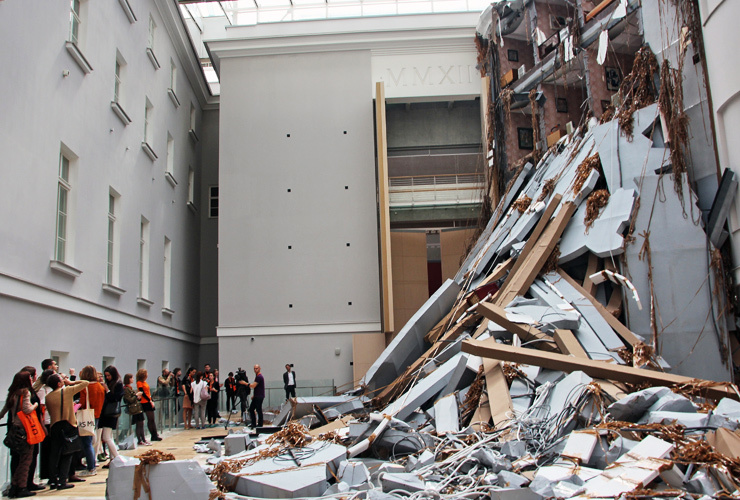
The most noticeable work of the European Biennale of Modern Art Manifesta 10, which is held in St. Petersburg, in the Hermitage, was Tomas Hirschorna's “cut”. A noticeable and literal sense of the word: cyclopic sizes, the installation, which occupied the largest of the largest courtyards of the main headquarters, is visible from almost all its internal windows, and a rare review of the “manifesto” is complete without mentioning the Swiss artist. The exhibition of the curator of the St. Petersburg “manifesto” of Kasper König for a good third consists of various kinds of Ommages and curtsies to the Hermitage: the Winter Palace, Palace Square, the Leophonian building of the Imperial Museum - the new Hermitage. Hirschorn is the only one who wore the bow to the main headquarters. Poof, more like a slap in the face.
The “cut” of Hirschorna literally is a cut of a five-story building, resting the roof into the glass ceiling of the attrium yard: either the house is bombed, or half demolished, its facade turned into a mountain of construction garbage, beams, panels and communications crawl out, like guts from a ripped abdomen, the interiors of the apartments of the upper floors were exposed, and on The surviving walls pasted with colorful wallpaper are visible paintings by Russian avant -garde. The house is built of branded Hirschornic materials, cheap, universal, any available and, as it were, anti -art: cardboard, plywood, foam, foil, adhesive tape. The genuine paintings: “October” and “Victory over the Eternity” by Pavel Filonov, the “carpenter” of Casimir Malevich and the two infinite compositions of Olga Rozanova were rented in the Russian Museum. “Cut” - in a sense, Ommage to the Russian avant -garde. “This is the art that I love the most,” writes Hirschorn in a commentary on his work. - The works of these artists are evidence of the struggle of utopia and anti -utopia in which they were involved. The struggle they immortalized serves as a measure of the authenticity of artistic achievements. This artistic authenticity goes beyond historical facts, beyond the framework of the conjuncture of aesthetic opinions and political dogmas. ” The cut of the building with the collapsed facade becomes a metaphor for the cut of history, allowing the forgotten past to break out. The metaphor is universal, but the installations of Hirschorna made here and now have an amazing ability to enter this “here and now” in unforeseen semantic alliances.
Looking at the “slice”, the viewer here and now can think a lot about. About the war - for example, the one that goes in the east of Ukraine. About the cultural reaction in Russia, where Malevich, even if included in school textbooks, is still an “ambiguous figure” for the majority, including the creative intelligentsia. About the ever -controversial issues of the history of one former country, where society was divided into two parts that are not able to agree on what the same Philo -School “October” is called - a revolution or a coup. Finally, how all this is interconnected. And, of course, the “cut” has become a plastic rhyme to the current building of the main headquarters - one of the best works by Carlo Rossi, disfigured by the Hermitage Reconstruction, expensive and, as it turned out, completely meaningless: after all, it is impossible to exhibit art, classical or modern.
The slice of the building with a collapsed facade becomes a metaphor for the cut of history, which allows a forgotten past to break out.
Of course, we are only talking about the very attentive eye of the artist, about the subtlest artistic intuition, although sometimes it seems that Hirschorne was closely monitored by the shameful history of the international architectural competition for the reconstruction of the General Staff. In that contest, Rem Kolkhas lost to one town in St. Petersburg workshop: Kolkhas, who had a reputation as a terrible avant -garde, proposed to leave everything as it is, adapting the Russian architecture to exhibits - a small -town workshop, shouting about his love of classical heritage, heated an enfilad, generously decorated with glass and toilet marble.
The Hirschorov rooms with the painting of the avant -garde seem to resurrect the project of Colhas. Moreover, the collapsed facade recalls hundreds of houses, for nothing about anything demolished in the historical center of St. Petersburg, destroyed by the historical center of Moscow, about many mutilated ancient cities throughout the country, about the battles lost by local historians and won by investors, about the defeat of the enlightenment project and the victory of primitive, robber's capitalism. This artistic intervention-sabotage helps the headquarters, who was previously the embodiment of the military spirit of the Russian Empire, turn into a symbol of the corruption union of capital and bureaucracy in today's Russia. In full accordance with the words of Hirshorn from his program article “What does“ do the art of politically ”mean”? ”:“ My work should be a door, a window or even a hole in the reality of today. ” And, perhaps, art completely happens - it happens, comes true - not at the moment, as the viewer looks at the “slice” in the museum, and then when he sees something similar on the street or on the screen of the TV and recognizes the image of history in all its artistic authenticity.
Installation is perhaps the most heterogeneous form of contemporary art. The fourth dimension of the picture, an expanded sculpture, spatial cinema, a performive space of drama or dance, an objective and staged book - the nature of the installation can be different. It seems that the installations of Thomas Hirshorn are originating from the poster. In the mid-1980s, having learned to schedules at the Zurich’s applied arts school, he left for Paris to work in the Grapus group, the famous team of postermunist posters, born on the 1968 barricades and considering graphics as a tool of social and educational work. In Grapus, Hirschorn spent only two years, remained in Paris forever, gradually moving from sculpture towards installation. But the poster clarity of the statement has been preserved in his art for a long time.
The actress bluched into the urn for voting, and the actor was urgently urging a photograph of the right populist.
So, the record holder for attendance and scandalous in the Swiss cultural center in Paris was the Hirschorna exhibition “ Swiss - Swiss Democra C Y ” , held in 2004. On it, visitors who received an invitation, at which the photograph of torture in the Abu-Graib prison was combined with the emblems of three cantons-the founders of the Swiss Union, could see the performance of the legend of Wilhelm Tele, where the actress blueped into the urn for voting, and the actor like a dog closed on the photograph of the Right Board of Christopher Blocher, the famous, in particular, by his anti -Semitic performances. The artist said indignant to the public and journalists that this is his protest against the "absurdity of direct democracy." To tell the truth, there was an almost exceptional case of an extremely concrete political statement, woven directly into the fabric of work, usually Hirschorn leaves political gestures for its interaction with institutions. Say, from 2003 to 2007, he refused to exhibit at home, protesting against the election of blocher to the Federal Council of Switzerland, and resumed the exhibition in the Confederation as soon as the blocher failed at the re -election. But in 2004, it was far from the Bloher from the government: the exhibition “ Swiss - Swiss Democra C Y ” Fund Pro financed Helvetia - after the scandal, inflated by the press, its budget was reduced by a million francs next year. However, all this bad policies did not prevent Hirschorn from representing Switzerland at the 54th Venetian Biennale in 2011.
The “Resistance Crystal”, shown in the Swiss pavilion, was a kind of artistic manifesto of Hirschorna: the form arises in a force field where love, philosophy, politics and aesthetics converge (just like that - with capital letters, with pathos). Making his way along the narrow paths of the labyrinth, composed of tons of broken glass, torn cellophane, neutralized plastic, waste paper, scrap metal, sold out office furniture and tabloid collages, each of all the senses felt that the world was unbearable and the revolution was inevitable. However, Hirschorna’s poster-collage installations never translate unequivocal messages-if the artist calls for a revolution, then this is more likely a revolution of spirit and consciousness. The heir to Russian constructivism and the situational international, he builds short -term utopias, where the desired form can be born as a result of a meeting of a completely random, non -vulnerable viewer with love, philosophy, politics and aesthetics that come to it in the form of a philosophical lecture, library, media texts and open artistic workshops, incorporated on the body of installation.
Such was the series of installations-monuments begun in 1999 to the beloved philosophers of Hirschorna: Baruhu Spinoz in Amsterdam, Zhil Deleze in Avignon, Georges Batai in Kassel, Antonio Gramsha in New York-all of them were “installed” in the poor, often immigrants, not so much attracting and captivating the local communities, but fascinating the local communities, but fascinating the local communities, but fascinating the local communities, but fascinating the local communities. Emphasizing the antelithic position of the artist. This is the last grandiose installation of Hirschorna's “Eternal Flame” in the Paris Palais de Tokyo. The museum contained an entire barricade, built of car tires, completely hung with slogans in the spirit of 1968 and as if the hello to Kyiv and the Maidan. Lectures of philosophers, discussions with intellectuals, poetic readings, concerts, library, workshop, printing house, Internet cafe, bar-intellectual life in this revolutionary city did not freeze for a minute, so that from the sparks of the eternal flame in the center, at a kind of forum, the flame of truth is flared up, which Thomas Hirshorn is not natural, naturally, not naturally, not Claims.