
Translated material
Labyrinths Leninka
From the author
In the spring of 2013, the Russian State Library for the first time in history launched outsiders in the bookstore. Young photographers and video artists of the Moscow School of Photography and Multimedia named after Rodchenko gained free access to any corners of Leninka, and everyone was invited to make their personal projects related to this peculiar place. I hit them.
After communicating with Leninka’s employees, I felt for the main semantic canvas, which I tried to reflect in my work. This is the conflict of the old and the new, people from the departed Soviet era and inevitably advancing new technologies.
The library has incredibly complex "analog" order processing systems that have not changed since the opening of the library. For example, technological atavisms such as pneumatic post and card catalogs.
Reading orders are packed in special flasks, which whistle with whistles along the pipe-channels laid throughout the building. When the bookstore workers receive a flask, they find the right books and, using a vertical transporter, deliver them to the second tier, from where they go directly to the reading rooms on the swing of the chain conveyor.
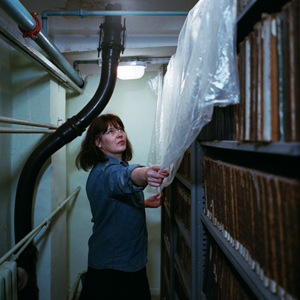
In total, the bookstore is 19 floors. The most valuable collections are on the upper tier, where you can only go up on foot, since the elevator does not reach there. Sometimes readers complain that books from the 19th tier can deliver several days instead of two hours.
Despite the fact that the service of such complex mechanical systems requires large labor costs, and the ordering speed is very low, the introduction of new, “digital”, information processing systems causes other kind problems associated with the age of employees and their adaptability to modern work methods.
I found confirmation of my observations in an interview with the general director of the library A.I. Visly:
“The library is a feminine word. So, the retirement age is 55 years. It turns out that the RSL will retire in seven to eight years, when the average age exceeds 55 years. There is a reduction in personnel, and where the staff is needed, in the maintenance of readers. The other side of the same problem is women who work in reading rooms, where computers are already everywhere. They are 50-60 years old, they saw this computer only three to five years ago. Accordingly, their level of ownership of technology is extremely low. And they come to them 18-20 years old, who have been sitting at the computer since childhood, on the Internet. And an absolutely obvious gap appears. ”
Of course, employees are also contributing to the interior decoration of working spaces. Despite strict prohibitions, women adorn their jobs with countless figurines, soft toys, icons and posters with kittens of all stripes. Some even manage to contain real cats, carefully hiding them in the distant corners of book labyrinths.
Legends saturated with mysticism are born in the walls of the library, the most popular of which tells about the spirit of bibliographer Nikolai Rubakin, who gave Lenin a huge collection of books among the racks with books. They say that one evening, when the employee took out a book from the Rubakinsky meeting, the door to the storage opened and closed by itself, as if someone had invisible. There are also rumors that part of the dust of Rubakin was transferred to the library - closer to the favorite collection of the deceased.
Among the visitors Leninka are a lot of elderly and very old people. There are very strange regulars and even local city crazy ones.
A common picture in Lenin is sleeping visitors, and not just dormant, but sleeping for hours. To sleep in the corridors on the sofas and just in the reading room right on the open book is a common thing. Apparently, this is due to the fact that books cannot be taken with you, and a quiet, cozy atmosphere, frankly, does not have many hours of wakefulness.