
Translated material
Cervantes as Tutankhamun
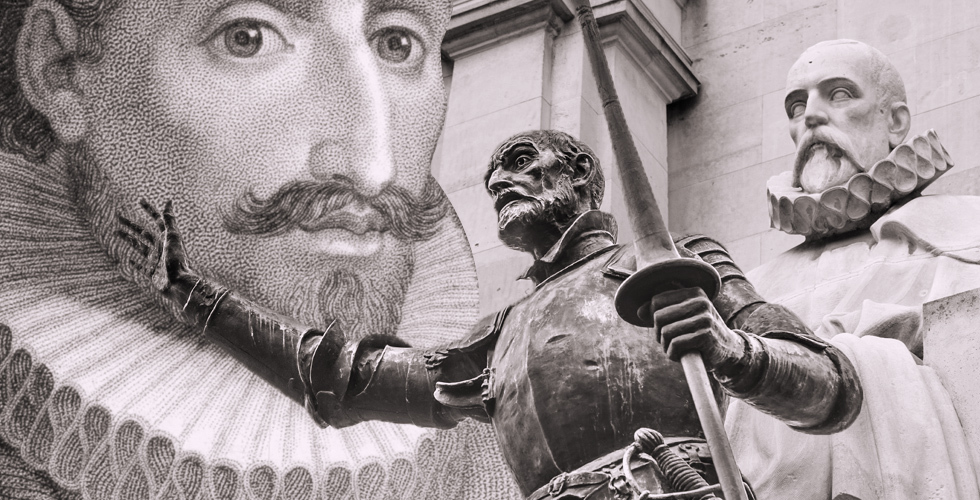
For several months now, Spain with a bated breath has been following the development of a historical thriller in the Madrid monastery of Trinitaria-Drykalsas. The brave trinity - historian Fernando de Prado, geophysicist Luis Avil and pathologist Francisco Echebarria - decided to find the remains of the main Spanish classic, Miguel de Cervantes Savedra. Moreover, two jubilee dates in a row are coming: the 400th anniversary of the publication of the second volume of Don Quixote (in 2015) and the death of its occupational author (in 2016). Newspaper leaders report more and more details.
It would seem that the formalities of the posthumous celebration were observed: on the wall of the Trinitaria-Drykalsas monastery, in the 19th century, a basic board with a bas-relief was installed in the 19th century, which confirms that “Miguel de Cervantes Saader, in its last will, rested in this monastery of the Trinitarians ...” But everything is not so smooth. He rested to rest, but where? ..
The Convent in the Madrid quarter of Wertas, nicknamed the “quarter of writers” - was founded at the beginning of the 17th century. Cervantes lived nearby (he died on a neighboring street now bearing his name), and the Trinitarians were especially connected with the Order of the Trinitaria: the trinitarians bought Cervantes-warriors from five-year-old Algerian captivity, and at the end of his life the Cervantes writer entered their order. The name of Cervantes defended the monastery from demolition in the 19th century. Justice of history: at first the monks saved a man, and then he is their abode. Only now, the old church was rebuilt in 1668, having lost the remains of a national genius in the process ...
For Madrid, such negligence is no exception, with the remains of the great there is a big problem there. Lope de Vega was buried with incredible pomp in the church of San Sebastian, but soon they lost, because (according to one version) the abbot freed a place for the rest of his sister. Most likely, the remains of the Spanish Shakespeare were transferred to a church cemetery, in the place of which a flower shop is now fragrant.
The grave of Velazquez was lost during the demolition of the Church of San Juan. However, the politicians went to Va-Bank, and on the 400th anniversary of the artist in 1999, excavations of crypts (and at the same time-the construction of underground parking) began on Ramales Square). They discovered the remains, started a noisy examination, but then in the church of San Plaxido there was a mummy with a sword and the Order of Santiago. A group of scientists said that this is the reburied Velazquez. The piquancy of the situation was that the excavations of the church financed the Madrid autonomous community (regional government), and the study of the mummy - the city hall. Two forever warring institutions turned Velazquez into an occasion for the attention of political accounts (accusations of a meaningless embezzlement of state funds, etc.). Everything found for a long time was studied, but the sensation did not happen. An old memorable cross and glazed ruins remained on Ramacles Square.
Calderon lasted longer, although his grave was moved along with the luxurious tombstone from the San Salvador church in the San Nicolas cemetery. The posthumous ordeals continued: with the orchestra and ceremonies, the remains of Calderon were taken to the church of San Francian-El Grande, reproduced by Napoleon’s brother in Pantheon of great people, but there was such a confusion that they decided to return to the cemeteries, and abandon the idea of the pantheon. At the beginning of the 20th century, Calderon was allocated a chapel in the new Los Dolores Church on San Bernardo Street. But during the Civil War, the remains were reliably hidden, and the watchman who remembered exactly where, he died, without opening a secret to anyone.
The failure of the Operation "Mummy of Velazquez" did not stop the historian Fernando de Prado in determination to encroach on the title of Spanish Howard Carter. Actually, everything began - as it usually happens in Spain - in the Madrid restaurant Manolo on Princesa 89 Street (perhaps a memorial plaque will soon appear here). In 2010, Prado dined there with a friend, geophysicist Luis Airlines, and it came to the use of a georadar in archeology. Here the historian dawned that such a study could be the first step in search of the grave of Cervantes. Since then, the main task of Fernando de Prado began to convince the powerful of this world of the need for an enterprise. And although several Spanish businessmen were ready to act as Lord Carnarwon, de Prado was convinced that such a matter should have gained a state scale. In April, the Madrid mayor Ana Botelia announced that the mayor's office was assuming financing the first stage of searches: a geo -radar examination in the amount of 12,000 euros. And the experts of the Madrid community gave permission to work in the cultural heritage object. This time, two rival Madrid power structures showed enviable unanimous.
The search for the grave of Cervantes has already become an economic phenomenon, bringing 16.4 million euros by early June.
A detailed study of the Louis team revealed the foundation of the old church and five sections of burials: a crypt in which there are about 30 remains, and four separate graves. The three -dimensional map of the dungeons - such accuracy gerandal research in Spain was conducted for the first time - replicated in all the media, caused a stir, as once a map of pirate treasures. Now scientists are analyzing the data to identify which of the inhabitants of the monastery dungeons is most like a man of 70 years with six teeth, an atrophied left hand and traces of two shots from an arquebus on the chest (memory of participation in the battle of Lepanto). The semi -writer was buried in a small coffin, in the Franciscan robe and with a wooden crucifix on his chest. The next stage of the search will be the extraction of the remains that are most responding to the description. Here the georadar cannot be dispensed with, excavations in the “object of cultural heritage” (with all the ensuing formalities), obtain the permission of the church and thirteen nuns, the monastery of the monastery. Since all experts work for minimal money, Fernando de Prado hopes to meet the budget no higher than 100,000 euros ( Oblight crisis), of which most of which will go to restore the monastery after excavations: “If we find the remains of Cervantes, this will be a fantastic success, if not, we don’t have to be ashamed that everything was not done.”
Cervantes did not have legal children, but his sister, Luis de Saadra, was buried in a monastery in Alkala de Enarez, the city where the writer was born. So DNA analysis is possible, although you still need to get to the final moment. Fernando de Prado selflessly believes in the success of the enterprise and dreams that in early 2015, Spain will gain the remains of its national genius and they will be buried properly - with honors and a tombstone.
Until recently, the Trinitaria-Drytariass monastery in Madrid knew few, and it was possible to visit the monastery church only on April 23, on the day of Cervantes’s death, announced by UNESCO by World Book and Copyright Day. However, the mystical coincidence of the days of the death of Cervantes and Shakespeare contains serious stretches. Cervantes died on April 22, and was buried on the 23rd, while Shakespeare died on the 23rd, but according to the Julian calendar (it would be on May 3 by Gregorian). But it was on April 23 - following the principle of “God loves the trinity” - Inca Garisilo de la Vega died. Later, they were joined by Vladimir Nabokov, Maurice Druyon, Zhuzep Pla (Catalonets), Manuel Mehia Valeho (Colombian) and Halldor Kilyan Laxes (the Icelander and Laureate of the Nobel Prize), whose days of death or birth are on April 23. Now at the church, albeit closed, tourists crowd daily. And at this place, literature develops into the economy.
The search for the grave of Cervantes has already become an economic phenomenon, bringing the city by early June ... 16.4 million euros. This is how the PR campaign score (3410 news in the press, on television and on the Internet, including BBC and The New York Times ) Madrid City Hall. The General Directorate of Roads of Spain spent 16.7 million euros in 2013 on a similar advertising campaign. And here the cemetery is the pasta, science, literature and tourism formed the perfect mixture, without additional costs, working for the benefit of the city.
Everything would be fine, only Fernando de Prado himself admits that 98% of the Spaniards Don Quixote did not read. In connection with the noise around the burial, the novel began to be bought more often (the phenomenon from the series “Anna Karenina” in the cinema ” - the circulation with Kira Knightley on the cover), but to sell, buy and read is not synonyms in any way. And to find living readers is no less important than the remains of the great dead man.
At the beginning of the twentieth century, the philosopher and writer Miguel de Unamuno published “The Life of Don Quixote and Sancho”, claiming that the characters of Roman Cervantes are much more real than his creator. He called for "taking a sacred crown campaign for the liberation of the coffin of Don Quixote from the power of bachelors, priests, barber, dukes and canonics ... in order to conquer the coffin of the knight of frenzy of the vassals of prudence." Find out the Don Miguel de Unamuno about such a profitable search for the relics of Cervantes (and not the innermost meaning of “Don Quixote”), he would have rolled over in his modest niche at number 339 at the cemetery in Salamanca.
Perhaps the posthumous fate of Cervantes is truly symbolic for a person who has experienced so much ingratitude, slander, blows of fate, mockery of brothers in the workshop, illness and deprivation, finding eternal peace in the nameless grave of a little -known monastery. And just such a grave of the author of “Don Quixote” - a novel who for a long time occupied second place in the world in circulations after the Bible - is a true metaphor for writing fate. The lush tombstone will restore justice, but will overshadow the truth.
The house where Cervantes died was demolished in 1833 by a stubborn bargain, who did not agree to sell him, despite the persuasion of King Fernando VII himself, and even on a new mansion, hastily erected in a historical place, refused to hang a memorial plaque. History has preserved the good arguments of the landowner: “I know that Don Quixote lived here, but something to me. And who is Cervantes, why hang him here? " Elias Kanetti, a big fan of the knight of a sad image, correctly remarked: "When we visit the graves of writers, they mock us, hiding in the bowels of their books." Will we hear in 2015 a caustic laugh of Cervantes at the time of his new funeral?