
Translated material
Emergency regime - political declaration
In the regions
 Emergency regime - political declaration
July 10, 2014 Svetlana Gannushkina
In the six Russian regions-Volgograd, Rostov, Astrakhan regions, in the Stavropol Territory, in Kalmykia, as well as in the Crimea and the city of Sevastopol-a state of emergency regime was introduced from Ukraine, said the deputy head of the Ministry of Emergencies Vladimir Artamonov. In the territory of the Belgorod and Voronezh regions, a regime of increased readiness has been introduced.
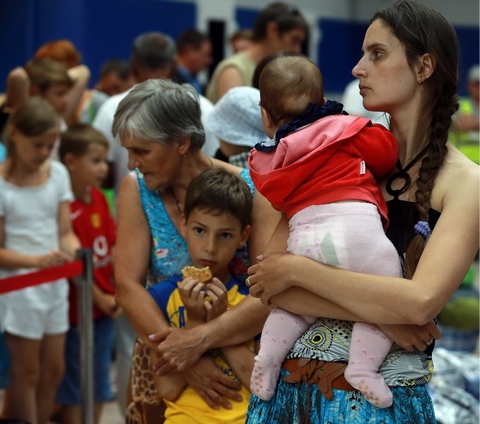
There is actually no emergency in these areas. In general, the country, which back in 1992 joined the UN Convention on the status of refugees, should be prepared for a similar situation. Refugees are from Ukraine, they speak the same language with us, many have relatives in Russia - all this greatly facilitates the task of the authorities in comparison with a similar situation caused, for example, by the war in Syria. There we are talking about millions of refugees who were accepted by the surrounding states, and about tens of thousands that came to Europe. One Germany opened borders for 40,000 and does not complain. And we are talking about a similar number - several tens of thousands of people, and our brothers. And what emergency are we talking about? You just need to activate, you need to be able to solve such issues. This is the first stream of refugees, which the state is ready to somehow equip.
So a state of emergency is, first of all, a declaration. All that needs to be done can be done so: invest money, efforts and everything else. This situation must be declared in the event of a great danger of some violations, violence, but in this case there is nothing of the kind. Peaceful people come, mostly women and children.
Just for Russia, any number of refugees is already a lot. At the end of 2012, it was announced that the number of refugees in our territory was 826, at the end of 13 - 632, and about 3,000 received a temporary asylum. At the same time, some Italy accepts 2000 a year and believes that this is not enough, but they are just a small country. Russia never did this, as a result of some of our efforts, the thesis about the need to develop the institution of shelters was inscribed in the concept of state migration policy, but no one did and did nothing. And therefore, we try to abandon everyone and do not fulfill our international obligations. And now we must once again emphasize, we accept people of our culture, who do not need translators from Arabic, as Syrians or Copts, people who know Moscow, know the Moscow metro, who themselves are arranged here. And what can be a humanitarian catastrophe here is completely incomprehensible.
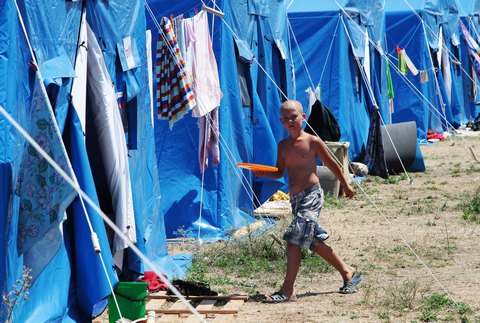
Many of these people live with relatives. Someone received places in hostels, in some areas they live in pioneering camps and boarding houses. There is no horror that Moscow experienced during the years of pogroms in Azerbaijan, when people went here in very large quantities. Then we were completely not ready for this, in the yard was the 90th year, the Convention was not signed by us yet. And then they coped with this, although 40,000 people were in Moscow. Until the end, the problem of Baku refugees was never eliminated, but “knit” in all problems - this is another property.
It would be better if people were met on the border and immediately said where to go, then everything would be fine. Do not create the EMERCOM camps. Or people there must be kept there for a very short time, because in such conditions, of course, you can’t live. We must invest - both in the organizational sense and in the material. Now the refusals have begun to provide temporary asylum, which can mean problems for people who have come before the start of hostilities and now cannot decide to return or do not live directly in the field of conflict. Such people are refused, they are thrown out. The country is not yet expelled, but they actually turn into illegal immigrants.
In the first photo: Russia. Ivanovo. July 7. Refugees from Ukraine at the Yuzhny airport, where they were delivered by the Il-76 EMERCOM aircraft. Photo by ITAR-TASS/ Vladimir Smirnov
In the second photo: Russia. Sevastopol. July 8. A child in a tent camp for Ukrainian refugees. Photo by ITAR-TASS/ Alexey Pavlishak