
Translated material
Smiley, cat and others
The Internet forms a special Russian language according to the laws of folklore
The most capacious and accurate definition of folklore is oral folk art. We pay attention to the adjective "oral", this is important. A researcher at the Institute of Art The Studies Tatyana Sukhanova is engaged in Internet folklore. But is the designation of the subject of research correctly, because on the Internet the language is mostly not oral, but written? Yes, technical means now allow everyone to place some kind of video on social networks and in many other places, but still the printed word prevails. And if only the word was a complex fabric of a folklore statement, there is, says Tatyana Sukhanova, and other components:
-One of the specific features of the language of the Internet folklore is the combination of picture and text. Moreover, the picture should not be considered as a simple illustration, because the combination of the visual and verbal side, as a rule, occurs in the game forms of Internet communication. True, sometimes it’s just a dialogue in the pictures, the exchange of them, which I do not really like, there is little creativity.
- Smiley and other graphic icons like them - in the same piggy bank?
- Certainly. Just the smiley is an almost mandatory element of communication. There are many of them, such symbols, not only the main “smile” and “sadness”. They are already from the so -called "virta" into the so -called "real" stepped, that is, beyond the limits of the monitor. I once caught myself
Smiley is a projection of living oral communication. Usually we do not just listen to the interlocutor, but after that, stiffly waited for the end of the speech message, we speak ourselves. We nod, shake our heads from side to side, giggled, grunt
Here's what: it was necessary to fill out some form with a pen, at the request of my cable television operator. It was required to report that everything is fine, I am satisfied with the quality of the services. And in the right column, I put a smiley, and they say to me: "Here! We conduct a study, now it is already completely and people on the letter are used by hand!" Because it is convenient.
- I think the reason is not only in convenience, that is, in saving funds, which is one of the basic laws of the language. And not because people use emoticons that they do not know how to describe emotion with words. Rather, this is a projection of living oral communication. How does it happen in real life? Usually we do not just listen to the interlocutor, but after that, stiffly waited for the end of the speech message, we speak ourselves. No, we nod, shake our heads from side to side, giggled, grunted and so on, in other words, do not interrupt, but still denote our reaction.
- We will also not forget about userpics and avatars that represent a person on the forums, in the game, in any chat, in the blogosphere, in social networks. It can be a photograph, there may be a picture. Suppose, in one of the networks - a photo of my dog, in the other - my photo aged 23 years. People very often row, which is generally characteristic of folklore.
- Is this a game moment?
- Game, and very active. The most boring people do not do this: Petya Ivanov - and here is his portrait from the passport. Boring!
-In addition to this combination of the verbal and fine series, what else can you characterize the Internet folklore, what is new in it today?
- First of all, of course, the language. A language that is very diverse and which would never be born if there were no Internet, because this environment allows you to experiment with the language. For example, "the language of the scum", these are all "the author ZHZHOT", "The topic is not disclosed" ...
- Yes, but this fashion, in general, has already passed.
- She passed, but she was learned and settled. This can be compared with how we sometimes include some English word-not because we flirt, but because it is already everyday.
Very often, people who perfectly speak the Russian language intentionally break the language system, write separate words with errors, for example, “Zviz” or “Nonos”. Everyone understands that this is a joke. Comedics in the language of folklore can also be attributed to the alleged spelling. "Rzhusimagu", for example. And if you write “Ring, I can’t”-this will be the wrong Internet director.
- Here, of course, I recall Krymnash along with the mirror answer “Namkhkh”. Assigned spelling of several words, turning them into a meme is a relatively new trend. But is this model productive?
- And what does it mean - productive or unproductive?
- Will this phenomenon grow further?
- Of course, it will be, and then it will not get out of itself. But, as a rule, outlining itself, not one such model finally dies, it still works. Many are afraid that our Russian language will finally spelling spelling, this is not true. I work quite a lot as an insider character in games online, among young animals, the so -called "shkolota". There, mostly, of course, young guys.
This language is very diverse, and it would never have been born if there were no Internet
15-year-old, 13-year-old, 10-year-old even. In general, up to 25 years. But besides them, there are 40-year-olds, 50-year-old and 60-year-old people who are engaged in young animals, including rule their language. And here is what is important: I did not expect that there would be such a good Russian language for such an abundance of people. They speak well and write well, know how to speak out, know how to defend their opinion, using a competent Russian speech, only with rare reservations and mistakes. Although, of course, there is terrible ignorance, but it is not total.
- For a long time I have the feeling that all these scenes about the damage and decline of the Russian language do not find confirmation.
-In any case, my almost 9 years of experience on the Internet proves that the opposite. There, really the pleasure of communication is largely determined by the fact that you speak in a full -fledged language, complex, with a bunch of all kinds of beauties and curls.
- Perhaps the whole point is that this is a written speech, you can, slowly, think through the text, build a phrase?
- Probably. Only oral speech may well be screwed there by elements, and it is necessarily screwed. I rarely have met such a stiff Russian language there.
Another important side is the composition of your own language. I wrote about this in my last article, which will be published in the next collection of the Institute of Art of Art. So, we are talking about game behavior in our national folklore and in its network modifications. I repeat, people invent their language, not only they can play with the already consisted subcultural languages, such as the language of scum and cashchentites. They themselves also want to play with the word. And this would never have happened if there were no network. Suppose I have two sisters among my research objects, the granddaughter of the writer of the famous and the actress. They perfectly write in normal Russian, but, having a huge number of Frends on Facebook, more than one and a half thousand for each, they introduced their own language. These girls, firstly, abandoned the category of the genus: I came, I did ... refused return particles. Not “I thought”, but “I conceived”, not “I had to”, but “I came” and so on. And at first it is annoying, and then it is so funny, so funny! In addition, they like to change syllables in words, say: not "Russia", but "Roiss". When I saw, I was just anger: they mock! "Rossyas ahead!" - "Russia forward!" Still, it is ridiculous, and therefore it was picked up by the Frends.
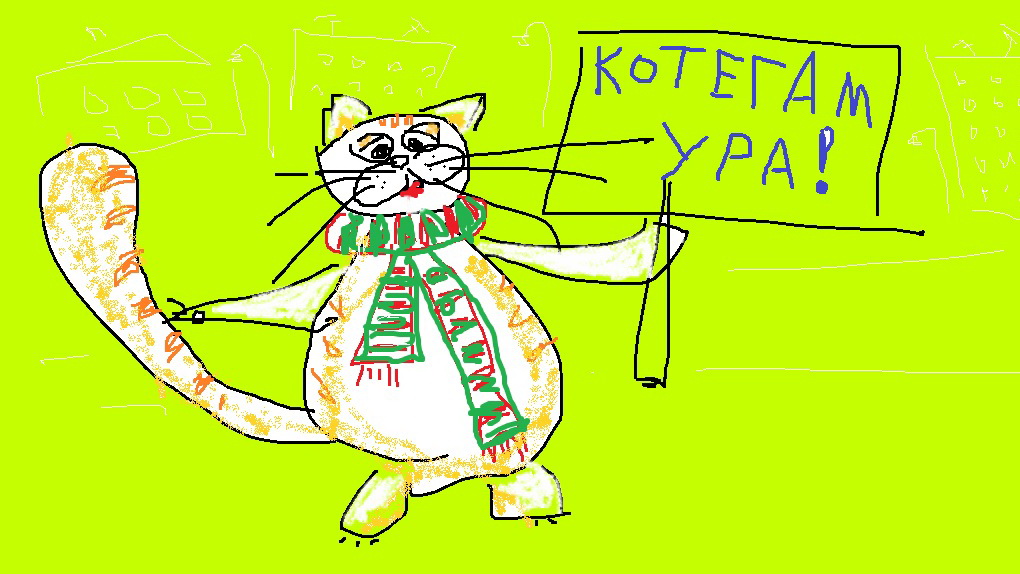
Another story. There is such a "Turkish cat", I also wrote an article about the author of this blog. He has a huge audience. This is a young man who has been writing a blog on behalf of his cat for many years, an absolutely invented language, charming. It's not even what language it is, but how he understands the complex relationship between the animal and the owner, so that, in fact, this is a blog as if on behalf of two, a very difficult story. From there, the lexicon of the people who read it penetrates with whole fragments of concepts. For example, the cat after separation with the owner: "Were you! And where were you? And where were you? And I lost!"
There, really the pleasure of communication is largely determined by the fact that you speak in a full -fledged language, complex, with a bunch of all kinds of beauties and curls
And he "lost" entered the asset of "cats": here my cat is sitting, losing. It is clear that I mean - offended, launched. True, at first I decided that I mean the Ostap Bender: "Give me the road, devious!" No, this is a much thinner story. "So yearned that he even ate." There is an insanely funny, delicate, touching tongue. And already, please, this spreads in the same way as in classic folklore, from one to another. Thus, the Internet environment is an oral environment. Written, but oral is such a paradox. There is also a colossally fast, fan distribution occurs. And you never know where your word will be tomorrow. It may go unnoticed, or may turn out to be one of the most used, says Tatyana Sukhanova.