
Translated material
Maidan: Aesthetics of protest
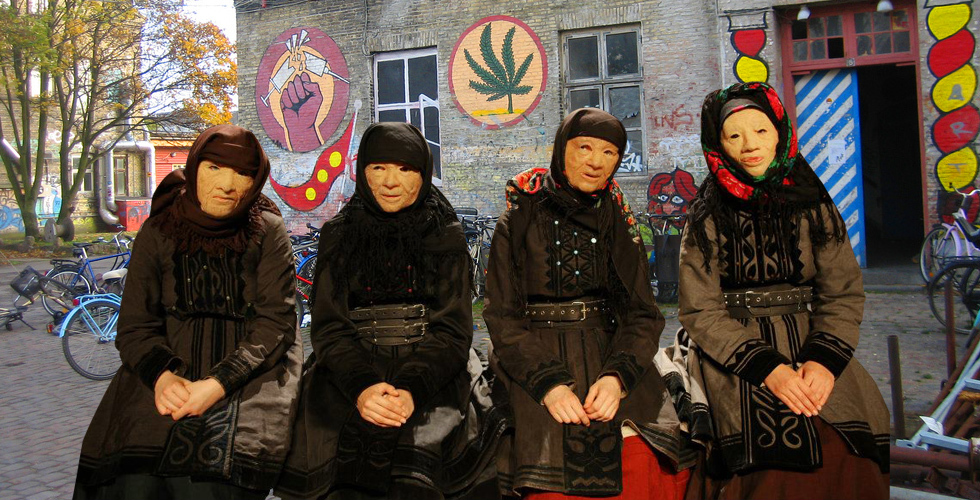
The next issue of the magazine " Theater. " , This time dedicated to Ukraine and the Ukrainian theater. Colta.ru publishes the column of the editor -in -chief preferred by him.
I was asked: why make a number about Ukraine, there is no good theater?
I replied: we want to know what is there. Do not exalt, do not humiliate, do not debunk, do not sing - just understand and figure out what happened in the culture of a geographically, ethnically, in every possible way in the last 25 years.
I was asked: why did you realize now? I thought.
I try to answer this question honestly.
Because Ukraine fell into the focus of history. Because we have been living nearby for so long that we have already learned to fight each other. Because it's time to get rid of the post -Persian complex: we are representatives of the great power here, and you are there, in fact, who?
But this is only part of the truth.
The truth is that the national features of a particular culture as a theatricalist are becoming less and less interesting to me. I do not believe that in contemporary art they, by and large, determine something. In some of his lower reaches, probably yes, but in the upper reaches-no longer. Even in such a collective art as a theater, they stopped playing a decisive role. Is it so, in the end, it is important to know that Robert Lepage is a Canadian, Robert Wilson is an American, Christophe Martall is a Swiss, and Ivo Van Hove is a Dutchman? And what such national traditions were embodied in their work? Do you know anything about Canadian theatrical traditions? I am not.
In the current cultural situation, the heirs of large cultures have no advantages over small heirs. Moreover, the apparent advantage often becomes a burden, the great traditions - Verigami, the consciousness of exceptional greatness enslaves stronger than any inferiority complexes. Read our project “The Fundamentals of State Cultural Policy” and make sure that we are directly crushed by our grandeur.
I cannot recall a single noticeable modern director, composer, writer, who would be the expert of the national spirit of his country. In the era of romanticism there were a majority. In the era of neo -romantism and symbolism, they met, and often. In the middle of the twentieth century, they also met, but already rarely. Now decisively no one comes to mind.
A modern artist is almost always a citizen of the world and almost always a rootless cosmopolitan. And this is not globalization: globalization is not related to art - it is related to mass cult. This is a completely different process, the reverse globalization. I would call it "individualization." Everything that used to determine the identity in general and the creative person in particular (the place of birth, nationality, race, belonging to one or another social strategic strategic strategic) ceases to play a decisive role. The world of modern culture is a world without borders. And the whole question is how much this or that artist is ready to exist in this world without borders, and this or that country is ready to endure such an artist.
The highest form of protest is when the protest itself manages to become part of the aesthetic space.
Until recently, it seemed that Ukraine in this matter did not go far from Russia. And the diseases of the Russian theater even occurred in our neighbors in an acute form with complications. The inheritance from the Soviet era with a clumsy and bulky theater system was even more clumsy and bulky than ours. Tolerance to their "rootless cosmopolitans" is no higher than ours. Conservative trends are even more conservative than ours. The bloated theatrical troupes are even more inflated (they say that 500 people are listed in the state of Ivan Franco - oh, mothers!). The most famous Ukrainian director Andriy Zholdak chose to move to Germany. The most famous director, who remained in Kyiv, - Vlad Troitsky was actually devoid of state support. Art-activism was subjected to approximately the same oppression as in Russia.
And then the Maidan happened. And we saw another Ukraine.
I ended up there when Yanukovych was already running and the protest naturally dried up, but the barricades were not yet dismantled, hiking kitchens were still smoking, the smell of burned rubber still hung over the giant, and the tents were still competing with his Stalin architecture. The city center turned into some total installation, in which the line between life and art was finally erased, and the slogans of the revolution easily coexisted with literally on each corner by quotes from the Old and New Testaments. I all tried to understand that what I saw reminded me. Then I realized: the free city of Christiania, located in the middle of Copenhagen, the commune Niderkaufungen in the German land of Hesse, the Lithuanian Zhuypy on the banks of the Vilenka River. Everything that is an alternative to the current world order. Both wild and civilized - everyone.
On the Maidan, as in Christianity, there was no strict social hierarchy, there were no bosses and fools. The society was not arranged vertically, but horizontally. The most implacable opponents were ready to exist side by side. Coateness and tolerance became almost synonyms. In this amazing combination of archaic and modernity - the paradox of the Kyiv revolution and the key to renewal of the country. I, I remember, was very impressed by the story of how the epic with which politicians broadcast and on which the Ocean Yelzy spoke, from time to time turned into the altar part of the invisible cathedral: a worship took place here. Representatives of various Christian denominations, who are with each other in difficult, to put it mildly, relations, divided the liturgy into parts - well, like a play to acts - and, replacing each other, served each of their part. But the main thing - it was here, on the Maidan, suddenly became clear that everyone can become an artist in the modern world.
Did you have a lot of various "Maidans" in the world? There, in Egypt, they also constantly rally and rebel. But the uprising of the uprising is different. And the difference, in the end, is how much this or that protest is able to aesthetically comprehend itself. And the highest form of protest is when the protest itself manages to become part of the aesthetic space.
So the Kyiv Maidan has become not just the most important political event of the latest European history. He became the main Ukrainian artifact. He expressed modern Ukraine more powerful than performances, films, poems and a diverse “Council”.
You can argue as much as you like about the rightness on the Maidan. You can talk as much as you like what political forces stood behind them. The debaters will never argue each other. But I don’t even remember such a creative upsurge that happened here last winter, in the winter of our anxiety during the “white movement”, but there was also a lot of different creativity. And, on the heart, it is difficult to imagine anything remotely reminiscent of the Kyiv campaign with the throwing of the policemen with soft toys or the performance with mirrors arranged by the residents of the Ukrainian capital, which they kept before the law enforcement officers, somewhere in Slavyansk or Kramatorsk. From the very beginning, the muses were silent there and grenade launchers spoke. The Maidan from the very beginning, in addition to the political, also aesthetic dimension. And this is its main difference and its excuse.
I don’t know if beauty will save the world, but politics is verified by aesthetics for me.
When you see how a simple Kiev pensioner, without suspecting it, turns into a situationalist, you understand: the confrontation between Russia and Ukraine, with all the desire, cannot be reduced to the confrontation of Russians and Ukrainians. Behind him stands (loom) a much more essential opposition. For nothing, or something, there were so many ethnic Russians among the Maidan activists (how many I met in Kyiv), and among the “Russian patriots” there are so many ethnic Ukrainians.
If you completely generalize it, a global confrontation between old and new forms of life unfolds in front of us. This is not always a confrontation between countries - much more often it is a confrontation within one country. Just at some point, Ukraine became a synonym for the renewal. The acquisition of national identity here coincided with an unprecedented hitherto breakthrough towards cosmopolitanism and individualism, to the concept of freedom that does not have and cannot have any national and confessional coloring, does not depend on the former greatness of a particular culture or on the amount of money in a particular treasury.
The spirit of free Christianity, the spirit of life creation blows, as you know, where he wants - it does not know borders. And now the whole question is only whether the new Ukraine will come to the aesthetic measurement of its transformations, whether it is hung up on its national pride, whether the idealistic impulse that has stupefied its revolution will preserve it.
This impulse was best recorded by articles from the Constitution of Lithuanian Zhuyups:
Everyone can be free.
Everyone is responsible for their freedom.
Everyone has the right to make mistakes.
Everyone has the right to be happy.
Everyone has the right to be unhappy.
Everyone has the right to believe.
Everyone has the right to realize their insignificance or their greatness.
Everyone has the right to be a person.
Everyone has the right to any nationality.
Everyone has the right to love.