
Translated material
"I will drive groups to learn to listen"
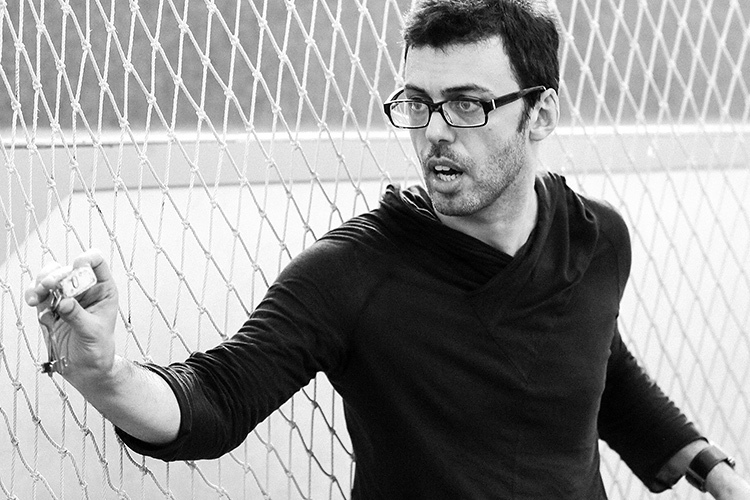
Recently, Dmitry Courland is not only one of the key characters of the modern Russian composer scene , not only the head of the International Academy in Tchaikovsky, but also the musical director of the Stanislavsky electric demonstration, which is more familiar to call the Moscow Drama Theater named after K.S. Stanislavsky. This fall, the renovated theater opens the first season of its dizzying new life led by Boris Yukhananov.
- So, the status of music rises in the theater, if you consider it necessary to take the composer to work?
- It was completely Borina (Yukhanova. - Ed. ) The initiative. He always showed interest in composers. At first there were Iraid Yusupov, Seryozha of the Polls, that is, our conceptualists - the batch as Borya himself. And a few years ago, he became interested in the music of a younger generation - well, from Filanovsky and younger. I would call her "postpostmodernist." When the game postmodern consciousness is already chewed and some new integrity of the statement and the integrity of the language are found.
Borya went to the contest “who will head the Stanislavsky Theater” with an already formed team, where I was declared as a musical leader. He immediately asked me if I was ready, in addition to making music for performances, to answer for ideology.
I want to stretch out the bridge between the current composer scene and the theater. We are ready to provide absolute freedom. We will also have concert programs. With Seryozha Krasin, there is a conversation about the regular festival project Fancymusic as part of the theater. But, of course, Bore is primarily interesting to the opera - as work at the same time musical and theatrical. And our opera start is the setting of the Roman-Opera "Ships". Actually, my part of the "Ships" has already debuted twice, now it will debut for the third time, because I am again making a new version. And so this is with mine - five new operas, from 70 to 120 minutes. Authors: Courland, Filanovsky, Syumak, Nevsky, Rannev. That is, in fact, it is Soma ( composer group “Material Resistance” ) - in the next variation of the composition. And so matches that in 2015 there will be 10 years of the formation of catfish. It was in the spring of 2005 that Gulyar Sadykh-Zade wrote a devastating article entitled “Croups, Slot and hiccups”, which turned out to be programmatic (laughs) . This was about our first program "Spelling".
Music for the "Ships" is now being written, in September-deadline, in October we begin to record it so that Borya can already develop production and scenography, and from mid-March we go into a 70-day rehearsal period. In closed mode, we release each opera in turn - about once every 12 days. And by June we will reach open shows. At first they will be in a day, and then in daily mode. And then we plan that this will regularly appear in the repertoire with such five -day blocks.
The composition of the performers in the "Shipyards": the Moscow ensemble of modern music, the conductor - Philip Chizhevsky, the Questa choir Musica , soloists - from the N'CAGED ensemble Arina Zvereva.
-Recently, such a movement of theatrical institutions towards modern composer music has already ceased to be something unique. But the set of composer names is painfully the same. They appeared on the “platform” for a couple of years, now everything is curled up there - we move to the Stanislavsky electric power engineer ...
- Not quite so. Bori has a course of young directors - in the workshop of individual directors - who do quite a lot on the basis of the theater: performances, laboratory work. I introduced them to young composers, still students at the conservatory. And they are trying to do something together. At the moment, these are 8 composers, quite different in aesthetically, but I think, 10-12. Some of them went through the "platform", of course. But part are completely new names. In the Great Hall will go the "Ships". And in the small, which is being built, this laboratory of young directors and young composers will go. We want to do this on an ongoing basis. And so that these works then enter the repertoire.
-And yet: here you say-Soma, as if it were such a single lump. But you are completely different people ...
- ... And every year everything is more spray and more different. Well, we can say that my name is for some time-I hope, a long one-connected with the Stanislavsky Theater. Rannev now rhymes with Alexandrinka-he regularly makes some projects there. Manotskov - with Serebrennikov. Nevsky - with a laboratory in Tsim that he leads.
- New music has already completely moved from the Philharmonic sites to theatrical ...
- That's right. Philharmonic sites sometimes simply openly refuse new music!
-And because of this, it is completely incomprehensible what the “prepared listener” means to her, about whom everyone moans. Because that listener, who, for example, goes to BZK and even has a musical education, can easily be categorically not ready for it.
-But do not be prepared for some specific music! This is a matter of trust. Here is an example. In early January, immediately after the New Year, I had three concerts in Belgium. Provincial town. Post -holidays. A rather large hall - 600 seats. There is such an amateur orchestra that consists of students of the local music academy and former graduates. That is, age - from 13 to 69 years. Such a very strange orchestra. My play turned out to be between the two overtures of Verdi. And in the second branch - a concert for the harp with the orchestra, in which the graduate of the academy, now the soloist of the Vienna Philharmonic, that is, the pride of the city. They began to rehearse in six months. I was invited in a month. I met every orchestra! He showed how to creak. At the same time, the conductor was present. Then they worked out all this and eventually made it brilliantly.
So. A completely unprepared audience came. Three times for 600 people. With children, with grandparents, very beautifully dressed - for them it is a way out, a little mulled wine - a hall next to a market area. The farther from the New Year, the quieter the hall was. But on the first day it was a little noisy. Well, the children were talking, whispering. But this is normal, because the music is far from democratic, sharply-shumovaya-it was a concert for two cars with an orchestra. There were two mini on the stage.
And after the concert, the director of the academy came up to me, thanked, I told him that I should thank him. And he said not, he is dissatisfied with the public. Too noisy and inattentively reacted to my work. I say: "What are you, I did not come across this!" “No,” he answers, “they must trust us.”
Do you understand what I'm talking about? It is necessary that a person, coming to the hall, simply trusts the program director. Then you will re -get it, if you want. But he shows you something, having some kind of his considerations. Accordingly, entering some kind of internal discussion with what you see or hear, you actually debate with this director. And if a person, in principle, has trust in the one with whom he enters into dialogue, then even if he listens to the opposite point of view, he evaluates it and somehow accepts or does not accept it. This is the only possible hearing.
You cannot understand music. I myself do not understand the music when I listen to it. It cannot be explained. The correct listener is not the one who tries to understand her, but the one who tries to enter into a dialogue with her and deal with himself.
And for this, within the framework of the theater, from the next year we are starting the "School of the Modern Spectator and the Listener." This is such a complex project that includes lectures, master classes, and meetings with philosophers and representatives of different arts. And including what I want to do - I will drive groups to learn to listen. We will pack up and go somewhere. It can be a public space, a suburban open space, a closed space, metro, anything. And we agree - that now, from this minute, we turn off mobile phones and turn out to be the audience for 45 minutes. Listeners of the city, listeners of the Zagorod.
- That is, this is not a concert hearing means?
- No no. These are not concert venues. But we try to concentrate all our perception at the hearing - as in a concert situation. I have certain developments and suggestions. Suppose, now you and I are communicating in a cafe, I listen to music that sounds from the speaker. And I can tune in to catch the quiet sounds that come from the street. You can switch to the near plan, hear your own breath. Or on a distant one-try to hear a gait of a person going somewhere far away. That is, the sound landscape has a lot of plans - dynamic, spatial. And trying to switch between these plans, concentrating exclusively on sound, is a very interesting experience. The experience of listening as a quest, as a search and finding your own trajectory.
- Did you come up with it yourself?
- Surely this already happened (because everything has already been), but I have not read about it anywhere.
So, those who listen are one group. And the other group, on the contrary, must only look. Just watch. To note emotions, paints, shifts of shadows. And here is such a audience, who will pass through the experience of a separate listening-vision, being in the theater, will see and hear completely differently. For him, the theater, in principle, will cease to be a situation of a directed hearing and looking. And it will become a situation of total attention and openness to perception. Perception becomes active creative activity. The audience-listener is not just a passive receiver, but by the author of the author, who begins to co-carry out what is happening inside himself. This is the ideology with which I come to the theater.
- Will there be a place in your theater a golden set of classics? Can you have any brams?
- Maybe. And what's the difference what to listen to - a pedestrian or Brahms? I can say that one project with Chopin's music is already being considered. In general, the season opens on October 22 by the play of the Terzopoulos. I will call composers to see it. Because the Terzopoulos - when he himself composes the performance, and does not work with the proposed music (as we had with Nosferata) - in my opinion, such a total composer himself. Since he is engaged in the organization of time and the distribution of accents in it, this is precisely the composer work. And to try to look at the play of the Terzopoulos as a musical story is very useful.
Then - the production of Ogarev. Then - Coproduction of Castelpucci. And in December-January-our prime minister, the three-day performance “Blue Bird”, every day for three to four hours. Almost 12 hours of sound. Well, this is one and a half times longer than our “persistent principle” with him (the performance of the “School of Dramatic Art”, 2013 - Ed. ).