Translated material
Games for people
To visit Denmark in the homeland of Lego and not see how they do it! Alas, about organizing an interview and a trip to Billund, I had to think in advance. However, the scientific journalists who came to Copenhagen, at the Euroscience Open Forum 2014, the science festival, presented the opportunity to see the future of Lego designers and other robotechnical gaming devices. The same as it is seen in the Center for Playware at the Faculty of Electric Engineering of the Danish Technical University.
Those who want to see the toys of the future got a whole bus. First, before us with a lecture on the use of robotics in teaching children or the treatment of adults was the director of the Center, Professor Henrik Hautop Lund. In his story, he quoted the Russian psychologist Leo Vygotsky with his thoughts about the cognitive development of the child, and also showed photos of how the Queen of Denmark Margaret II jumps on musical “classics”, and then children from Africa jump on the same keys and patients walk after heart attack.
Margaret II and musical classics
The main idea of developments is to make the child learn new through the game with the intellectual system, and the adult can overcome disbelief in his own strength. “In the game, as in a magnifying glass, all the possibilities for the development of the child are concentrated,” Henrik Lund is sure. The game allows you to overcome boredom and fear of the new.
In his story, Lund used the concept of “a zone of proximal development” (“a zone of proximal Development”, which on Wikipedia deciphens as follows : ““ an area of not ripening but ripening processes ”, which incorporate the tasks with which the child cannot cope at this level of development, but which is able to solve with the help of an adult; this is a level achieved; The child is so far only in the course of joint activities with an adult. " Intellectual toys created by the center allow you to replace an adult at some stages. Henrik Lund's story about his developments can be listened to during a 20-minute TED lecture .
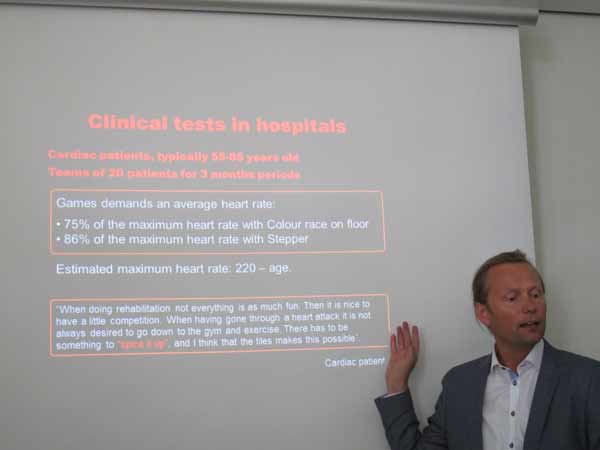
In the hospital, intellectual “classics” and other devices created by the Danes thanks to Playful Care Technologies allow to achieve faster rehabilitation. The clinical trials were attended by groups of cardiological patients. “After a heart attack, patients do not always have a desire to do gymnastics and exercises. There must be something that will revive these exercises, make them entertaining, ”said the Danish professor. Taking on intellectual keys, patients who practically re -study walking, see how the colors they became, if the step was not very strong and you can try to step on the cage more confidently.
Intellectual toys can also be used for fitness of older people, the development of the center was successfully tested in public 63-95 years. It turned out that game intellectual "classics" are useful for both children and adults.
Each of us was able to jump on musical "classics." “So this thing can be used to teach children mathematics! There may be not different colors on the cells, but numbers, ”I said to Lunda. It seems that he liked my idea.
Lego future
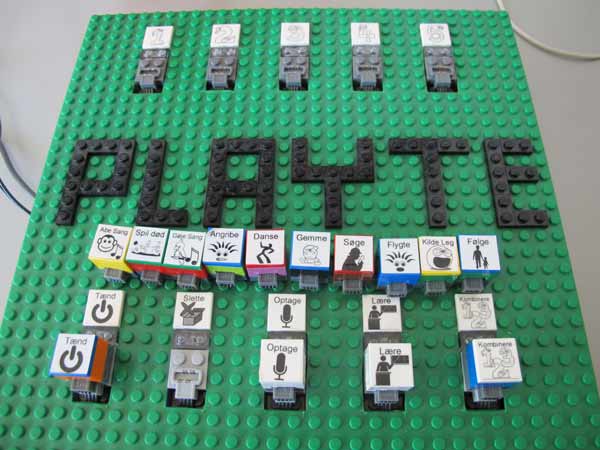
Rune Fogh, a cheerful blond, working on his phd in robotics, showed us a funny lego-pchelle, which can be controlled using intellectual lego-bricks. He is one of those who work in the field of tangible programming ( Tangiable Programming ).
Click on one lego-brick-the bee giggles from tickling, click on the other-the bee becomes aggressive, you will click on the third-the bee begins to dance under your pops. Pressing all three keys leads to a funny effect - an aggressive bee laughs from tickling and dances. The bee also obeys the commands “Follow Me” (Follow Me), “Run away from me” (Escape from Me), “Sing” and others.
A pancake robot can be controlled with the help of a gamepaD, a control panel with a joystick. The child will have the opportunity to program his lego-bricks, teach the bee how to move his head and make some other movements. You can combine several actions in one brick by teaching a bee to more complex behavior. “This technology teaches the child a creative approach, teaches his robotics,” Ryun remarked.
“I want such a toy! Where to buy? How much does it cost? ”I asked Ryuna, but he replied that this is just a prototype, he was very interested in Lego, but when this toy will appear on sale, he does not know. So far, the prototype from the Modular Playware Technology project is very expensive and is unlikely to be available to the mass consumer.
Henrik Lund also could not say when the bee appeared in the hands of children around the world. There is still a lot of work between scientific ideas and the use of the market. “It may turn out that my son will grow up, and the toy will not appear on the market yet?” I asked, he shook his head and said that yes, this is possible. They do not have enough heads and hands to bring all ideas to commercial applications.
Music 2.0
Another development that can already be touched with your hands, or rather with your fingers - Musictiles , makes it possible to become not a passive, but an active musical fan. Now, using the iPad application, we can determine what we want to hear in sounding music: only vocals, or vocals + guitar, vocals + synthesizer, vocals + shock or all this together. The user can also change fragments of the melody in places, creating his own, making remixes. Alas, there is no version of this application for the Android, the center’s employees will have to create a more “light” version of it.
Peter Gabriel liked the idea of musical "tiles" so much that he allowed the creators of the application, to use his melodies from the legendary album "SO", creating a kind of new album "So 2.0".
Henrik Lund talks about music 2.0
The employee of the Max Center, who came from Italy, held a video tutorial for me with small musical cubes, more like boxes of matches. The rotation of the cubes allows you to add or remove this or that effect from the melody, for example, turn on or off the sound of drums, or change it. “You see that music reacts very quickly to cubes. Communication with the application goes through Bluetooth. ” Such intellectual cubes, but much larger, appeared at the concerts of Peter Gabriel during a tour of Europe.
Perhaps the most during the excursion to the center of game technology, I was struck by its general humanistic orientation - using interdisciplinary, using psychological concepts and robotics to help children, help the elderly, make their life more interesting. Older people sometimes like to play no less than children. Scientists also think about how to make the rehabilitation of heart patients more fast and interesting for them.
Thoughts about commercial applications, about promoting ideas to the market, leg in the foot with the thought of those to whom intellectual robotechnics can help overcome disbelief, illness, get rid of some kind of drawback, become stronger, healthier, mobile and more confident in itself. Is this not this robotics 2.0 - robotics of the future?
The game with the intellectual system has a positive effect on the child, its motor skills 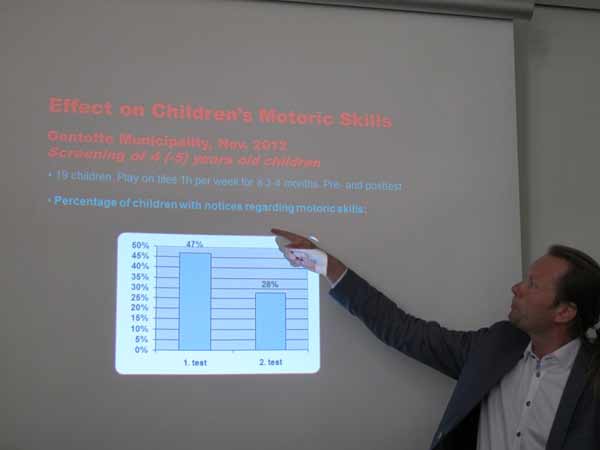
It also helps cardiological patients