
Translated material
Landing strip
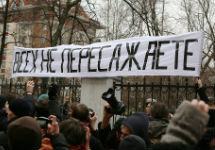
In anticipation of new protests, the police state armed themselves with a powerful club. In the near future, a new law on rallies will come into force, tightening punishment for participating in peaceful street actions. In addition to a sharp strengthening of sanctions on administrative articles, criminal liability for participation in rallies is introduced. Under the new article of the Criminal Code, citizens threaten up to five years in prison.
Article 20.2 of the Code of Administrative Offenses (violation of the rules of the rally), according to which most detainees are executed on street promotions, in addition to the new dragon fines, now provides for an arrest for up to 30 days. Participants in pickets and rallies at the courts of courts face up to 20 days of arrest. According to article 19.3 (disobedience to the requirements of the police), the maximum term of arrest is increased from 15 to 30 days.
The bill, introduced by Unicorn Andrei Sidyakin and Andrei Krasov, as well as Igor Zotov from France of Fair Russia, was adopted by the State Duma in the third reading last week and was immediately approved by the upper house.
Will the new law apply in point reprisals or mass repressions? Will it be possible to intimidate the protest participants? The situation is commented on by lawyers, civil activist and political scientist.
Olga Gnezdilova , lawyer, legal adviser to the AC ACTION20

Until the last, it was not believed that the bill on criminal liability for formal violations during peaceful pickets and rallies would be adopted. Nevertheless, on July 9, the Federation Council approved the Federal Law adopted by the State Duma in three readings on amendments to certain legislative acts of the Russian Federation in terms of improving legislation on public events. "
In relation to those who received the third court ruling under articles 20.2 or 19.3 of the Administrative Code of the Russian Federation, will be initiated by criminal cases with a punishment of up to 5 years in prison.
The law comes into force from the date of its official publication, which can happen in the near future. From the passport of the bill it follows that legislators symbolically decided to attribute the bill on public events to the industry "Criminal Law. Punishment.
On the "Faces" has already been published an overview of the bill with a detailed description of fines and terms that can be obtained for access to the action without notification. Administrative fines for citizens increased to 300 thousand rubles, and the term of administrative arrest increased to 30 days. In the process of considering the bill, the punishment was not softened.
In the accompanying documents to the law, we were not able to find a justification for the need for such toughening punishments for formal violations at public events. Between the lines, of course, the fear of the Maidan is read, but in an explanatory note to the bill it is mentioned only that more than 600 people were detained for peaceful standing near the Zamoskvoretsky court during the announcement of the sentence to Prisoners of Bolotnaya .
According to the conclusion of the legal administration, "the Federal Law complies with the Constitution of the Russian Federation, including the provisions on the rights and freedoms of a person and a citizen, and is consistent with the system of federal legislation." And the conclusion to the third reading contained only one phrase: "According to the draft federal law, there are no legal, legal, technical and linguistic ones."
The legislator through supercalative sanctions wants to limit the freedom of expressing opinions where it “breaks out”, where a person is even ready for a 10,000th fine, because he cannot be silent. But if it comes to a five -year period for participating in peaceful actions, many, of course, will not dare to go out.
It is worth noting that the minimum punishment under the new article 212.1 of the Criminal Code of the Russian Federation (for the third offense within six months) is a fine of 600 thousand rubles, that is, the court will not be able to appoint less, even if the violations at rallies were formal and insignificant.
Article 20.2. The Code of Administrative Offenses of the Russian Federation will now consist of 9 parts - independent compositions of offenses (at the beginning of the third period of Putin there were 3 parts in it), and Article 19.3 will be supplemented by part 6. Thus, the compositions are formed for almost all occasions.
The bill also provides for a long time de facto implemented by the police right to prevent public events. Amendments are made to the law "On the Police" that allow restriction of freedom of movement, the cordon (blocking) of areas of the area now and for preventive purposes - in order to prevent the riots. At the same time, it is not clear how the reality of the threat of riots will be evaluated, and the line between "riots" and a formal violation of the procedure for conducting public events (for example, a picket without notice) is practically erased.
A journalist present at a public event should now have a clearly visible distinctive sign of the media representative. At the same time, in Russian legislation, there are no such requirements for a journalist, who, for example, in the war zone, are not.
Thus, the value of the notification of the public event and the coordination procedure - not oral negotiations behind closed doors, as this happens now, but official legal correspondence and a thorough appeal of each refusal, up to the European person on human rights, is serious.
Elizaveta Regina , lawyer, human rights activist, lawyer of detainees in administrative cases:

The law on the introduction of criminal liability for the repeated violation of the established procedure for conducting public events is one of the manifestations of the general trend of the attack on the constitutional rights of citizens. In this case, the rights prescribed in the 31st article of the Constitution, which establishes only one restriction for public events: they must be peaceful.
But the so -called law enforcement practice for a number of years systematically introduces the restrictions of the right to freedom of assembly, which are not provided for by the Constitution: the arbitrary right of the executive authorities to refuse to agree on a public event, huge fines, an accusation of a judicial consideration of cases of offenses related to public events. The legal doctrine (that is, the theory that is taught in legal universities and constructed in textbooks and dissertations) argues that the allegedly the presence of independent judicial control guarantees citizens from illegal conviction. As a practicing lawyer, I can note that real practice has nothing to do with theories.
Judicial decisions are made on the basis of administrative protocols and reports of police officers, which, to put it mildly, cause serious doubts about the reliability of the information presented in them, are often compiled in violation of the formal requirements of the law. The courts, as a rule, ignore the arguments of the defense. Although the violations are often so obvious that everything as it should be, the defense would not have to give any arguments - the judge himself would have seen everything.
Pavel Kuznetsov , civil activist:
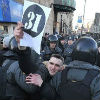
I believe that it all depends on the civil courage of a couple of hundred opposition activists. If we can reach a repeated protest action with this amount, the law enforcement of this law will become impossible. I do not think that in the absence of a clearly expressed messianic totalitarian idea, the authorities will go to mass plantings of activists (by mass I mean dozens of non -administrative, namely criminal arrests). If we are not able to massively reach a protest, the authorities will inevitably choose 5-7 people for indicative flogging for repeated detention, and this will extremely deplorable to affect the state of protest.
Unfortunately, we do not live in the ideal society of heroes, and the economic situation does not yet allow us to hope for a massive tributary in protest of all desperate inhabitants. On the other hand, the power itself complicates its life, because the energy of protest will not go anywhere, it will simply take the form of short unexpected actions in crowded places: they got posters - shouted - scattered leaflets - fled. In order to fully lime protest as such, the introduction of this law will clearly not be enough, but the control over the holding of shares will completely fall out of the hands of our not too far -sighted power.
Vladimir Golyshev , political scientist:

The new de facto norm is barrage for professional oppositionists - those who wear pieces of paper in the city hall and pay fines for exceeding the number. These people have long and successfully controlled by power. And at first glance, tightening the rules seems unreasonable.
But if we consider it as a measure “for growth”, one can guess that the Russian government is not sure in his future. Obviously, in the near future she is waiting for the growth of protest activity. The reasons can be both a decrease in the standard of living and the “Crimean-Donbass syndrome”, which may well play the same role as the Russian-Japanese war in 1905. The authorities continue to consider the protest of a controlled one and believes that, having scared potential organizers, guarantees its safety. I think she is mistaken.
Pushing the protest from the legal field, it only exacerbates its position. The “millions of millions” completely safe for her will finally give up the place of “Okupa” technologies. And they, in turn, will become much more like a Kiev Maidan than on the square in front of the monuments of Abai. And this is at best. The worst case we are now observing in the east of Ukraine. I think that neither the authorities nor society should count on good.