
Translated material
DJ Sniff: "DJs are musicians"
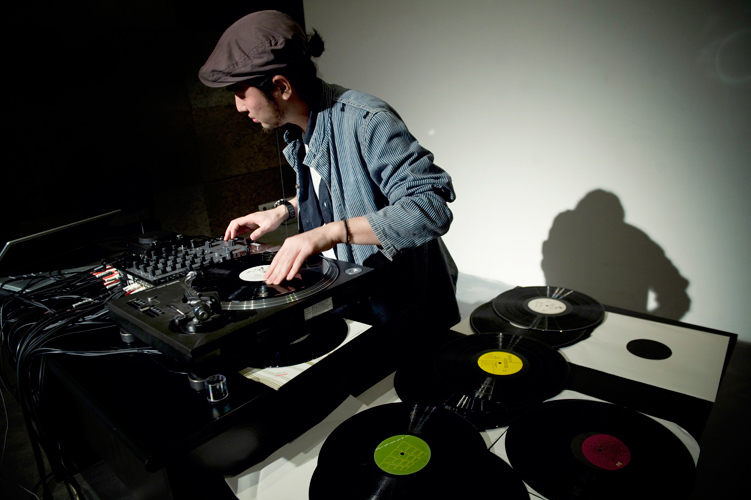
DJ Sniff, in the world of Takuro Mizuta Lippit, plays free-jazz plates at his concerts, and its partners often become giants of improvisation like Evan Parker, Otomo Yoshihide or Erikm. In an interview with COLTA. RU he talked about why computer software is not replacing electronic tools and why DJs should be considered musicians.
-Tell us how you began to use free-jazz records-this is still not the most obvious choice for DJ.
- It began when I moved to Europe and began to play with improvisers, with those who use acoustic instruments. And I tried to match them not only in flexibility and virtuosity, but also in the texture of sound. The search for a suitable material led me to Free improvy, I began to collect the notes of the previous generation performers, explore European improvisational music and the Japanese Free Dzhaz of the 70s ... This helped to establish good contact with my partners-because I used the music that they know, the recordings of the people with whom they played, or sometimes even their old records. In addition, it was convenient to work with this music: there are great attention to individual votes in free improvisation, often they sound solo or in a duet, that is, they are more isolated than in a large composition or even in a trio, so it was easier for me to get a sample of drums or, say, a saxophone.
- And before that you were an ordinary DJ?
-Yes, more or less. He played techno, hip-hop, house, in general, club music. And then I began to get carried away with more and more abstract forms of dance music. I wanted more action in my sets, in the sense - more manipulations with sound. I did not want to move towards the DJs who play hip-hop-battles, but I was very interested in the possibilities of Live . I came up with instruments that help record sounds that I play, and how to make their remix on the go. Well, somehow it turned out by itself that with these strange activities, I gradually shifted in the field of experimental music. When I was just starting to do this, I thought to use the Live technique for something like an abstract hip-hop or some kind of dance music, but moving to Europe, my new environment-all this led to the fact that I turned out to be closer to free improvisation and experimental electronics.
A laptop itself is an unremarkable object, like a calculator.
“We are talking about Amsterdam, right?”
- Yes.
- Tell us then how you came together with local improvisers.
- In the Hague there is such a saxophonist Kia Noringer - he organized weekly improvisational concerts, and on one of them I first ended up on the same stage with musicians playing acoustic instruments. In Holland, there is generally a long tradition of such cooperation - for example, Michelle Weisvitz, the inventor and former director of the Steim Institute, in which I worked, played a lot with musicians from Instant Composers Pool , with Misha Mengelberg and Khan Banninsk. I have not heard this in neither in the USA nor in Japan - as a rule, acoustic instruments call up, and improvisations with the participation of electronic workers are intense, loud. In Europe, on the contrary, electricians play quieter and thinner, adjusting to the sound of acoustic instruments.
In this track, DJ Sniff brought together the notes of the guitarist Otomo Yoshihide, two drummers - Tatsuhise Yamamoto and Manoomi Sandju and two Saxophonists - Katsutoki Umeza and Akira Sakata
-You were an art director at Steim for five years-what exactly did you do there?
- At first I got on Steim as the Internet and collected there instruments for other musicians and artists, was engaged in iron, sensors. Then, when I became an art director, I oversaw a series of concerts, chose the people whom we invited to teach us. In general, I determined the course of development of the institute. Steim is a very old organization, and Holland was just a stage when the state funding system changed a lot, the criteria were reviewed by which the relevance of the work of the institutions was evaluated. Therefore, for the past five years I have been engaged in the fact that I directed the institute’s activities so that it remained relevant in changing conditions.
- By the way, tell me: does it really make sense in the development of new electronic tools at the level of opportunities that Soft's software has already reached?
-I think, despite the fact that computer software is becoming more and more perfect, it still makes sense in the construction of new electronic tools. Closer to the beginning of the two thousandth laptops began to play an increasingly important role in electronic music, but as in instruments for live performances, many were disappointed in them. Well, you know, it’s strange when a person is hiding behind the screen, as if he was checking mail there. So the situation is gradually changing: the new generation of electronic workers is interested in a more direct, tactile interaction with technology. Therefore, different external controllers become more popular, so many connect ordinary musical instruments to computers, and therefore modular synthesizers are returning. And if you are looking for in this direction, then one way or another come to the need to change existing tools for yourself or collect your own.
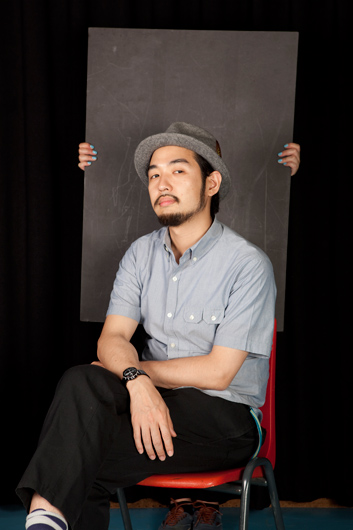 © Jaap Scheren
-You know, the guitarist Derek Bailey considered it a widespread idea that the instrument is just a reproduct and that the music is born in the minds of the musician. I quote inaccurately, but he wrote that in fact, tactile contact with the instrument, literally the desire of fingers to touch it one way or another - all this also plays a very important role, especially in improvisation.
- Yes, I absolutely agree with this. And in the game on traditional, acoustic instruments and electronic there is a certain similarity. We, those who work with technology, also need a frame, a structure from which you can start - without this there is no tension, conflict. For those who play an acoustic instrument, such a frame is set by its very shape, how its strings vibrate or resonate the metal from which it is made. With practice, a feeling of this structure comes, and the tension that is born in working with it, in my opinion, makes the music interesting, especially improvisational. Let me explain. We play the instrument, our muscles remember it better better - in parallel, we can say, we get an increasingly clear idea of the boundaries of the capabilities of this tool and are constantly trying to go beyond these boundaries. The most interesting in improvisational music is the moments when musicians manage to do this. You can call it “dilated techniques” or we can talk about the relationship of the musician with his instrument. Of course, we know how the guitar works, but for the musician and, by the way, the most interesting for listeners is to overcome the boundaries of the instrument. And playing with other people, you find yourself in a similar interaction - but not only with an instrument, but also with time and form of sounding music, that is, with its frame. Therefore, I would say that “free music” is not completely free - this is what turns out from the clash of our ideas about music and relations with our instruments.
In Europe, on the contrary, electricians play quieter and thinner.
So, if you are engaged in electronic music, then, on the one hand, the possibilities that the computer gives are limitless, and on the other, the laptop itself is an unremarkable object, like a calculator. So it is very difficult to build a relationship with him as a tool. Therefore, electronic workers have to create for themselves a frame from which they could be repelled. For example, build a base of sounds, determine the parameters to be controlled, work with the interface or write a program code, as in my case. And all this is not to create something amazing, say, in its sound characteristics, but first of all in order to establish personal relations with the technology. Having created the boundaries for yourself, you can try to push them away, play with them, try to go out for them. For me, all interest is in the relationship of the musician and his instrument and what is happening between them.
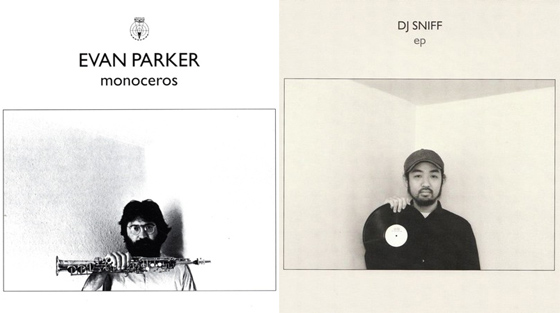
An attempt to reconstruct music from the solo album of Evan Parker "Monoceros"
- Then tell us about your tools.
- I use the vinyl player, the source of all my sounds is records. The turntable is connected to the computer, it has been launched by Max/MSP , for which I wrote my algorithms. The process of sampling is controlled by the movements of my hands on the mixer remote control and by pressing the pedals that are under my table. I can give the exact command to the computer, I can use the randomness algorithms, controlling the degree of this accident. With the help of these instruments, I can grab fragments of sounding phrases and reconstruct them directly on the go, create new rhythms or textures, without stopping to twist the plates. That is, I mix original sounds and samples - so from the same material I can collect different structures, different combinations. Or you can take one plate, take the sounds I need from it and put the next one, as if connecting heterogeneous materials.
- By the way, it seems to me that DJing is first of all a way to listen, the tendency to interpret music through its premises into a new context.
- My music is definitely a reflection of my way to listen. When I play, I choose a record, choose the moment at which the needle will fall on it, I decide what I want to do with this record. So this is not just a reproduction of someone’s music for me, but a reproduction of how I hear this music with its history, its baggage. I mean that when you put the plate of Evan Parker or John Coltrane, it pulls a lot of things along. Listeners will recognize this music, she already turns to the memory of each of them. And, of course, I mean this, and any DJ mean it in mind. After all, we work with a fixed past and with our attitude to it, so for me interpretation is part of what I play with.
- If you look like this, then the old dispute about whether the DJs can be considered musicians, loses its meaning: just DJ, as it were, works at the macro level, and the instrumentalist or you, for example, at the micro level.
- Yes, and I always defended the idea that the DJs are musicians. If we play the notes of other people, this does not mean what we do is less than music than in the original. I completely disagree with this: in my opinion, even if the DJ does not bring anything and just plays someone else's music, all the same, he chooses what kind of song to include in this particular place at this particular moment. It seems to me that this is an equally important musical act than extracting sounds of a certain height from a regular instrument.
DJ Sniff came to perform in Moscow as part of the Platform project