
Translated material
Than Lubyanka is better than Nogin
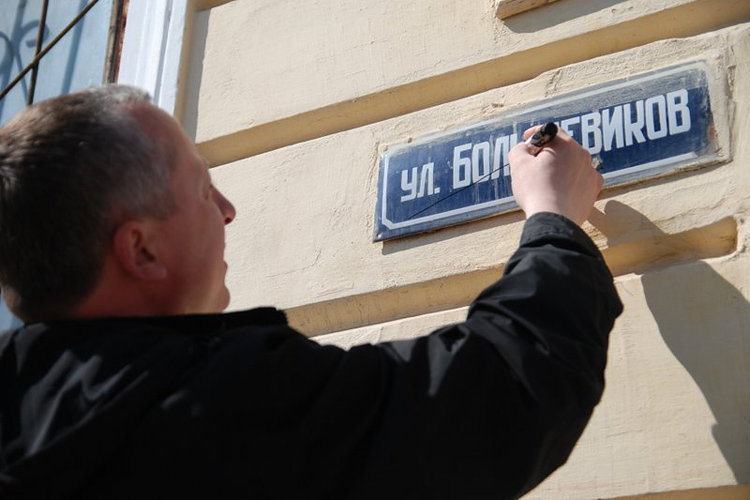
Geographical names, being primarily a tool for navigation, take a long time in memory. You can still hear from the mouth of representatives of older generations: Gorky Street, Nogin Square, the city of Zhdanov and much more. Doctor of Philology, Chairman of the Board of the Guild of Linguists-Experts on Documentation and Information Disputes, Mikhail Gorbanevsky, told the project “The Museum of the 90s” about how exactly the mass return of geographical names took place in the late 80s and early 90s.
- Who and when was the topic of returning historical names for the first time?
- The discussion of the restoration of historical names began in fact with perestroika. In the media, the first publications began to arise timidly on the fact that we are surrounded by such geographical names, which, first of all, are inconvenient in pronunciation and use - what is “26 Baku Commissars Street”?! It is clear that in oral speech they were pulled to the “Baku commissars” or a question on the bus: “Are you going out on the commissars?” But multicomponent combinations cannot successfully perform the function of geographical names. Because the main function of the name, of course, is targeted - a kind of business card, and the second function is the thesis, or cumulative. It accumulates the experience of generations, information of a historical and cultural nature, preserves an associative background related to both history and with ancient words that have become out of use. From this point of view, the names are no less valuable monuments of history, culture, language, geography than archaeological, literary, architectural or visual monuments.
Like archaeological monuments, the names very often have several layers, sometimes they are modified. For example, Lubyanka is not a Moscow name, it was transferred from Veliky Novgorod, where Lubyanitan Street existed. This happened after the accession of Novgorod and Pskov to Moscow, when the Moscow kings commanded to relocate about two hundred families of large Novgorod boyars here in order to deprive the Novgorod land of the Kremlin opposition and remove the focus of "dissidentity". They were settled in Moscow in the area of the cannon yard, where the building of the Children's World is now. And any immigrants very often in memory of their native places brought geographical names with them: for example, on the map of America there are several St. Petersburg and toponyms of Odessa and Moscow. Therefore, when the Novgorodians moved here, they themselves called Lubyanitan Street, but Muscovites in oral speech remade the Novgorod name in a more familiar look for them - Lubyanka (like Stromynka, Ilyinka, Barbarka).
There were cases when in Soviet times the historical name returned: few people know this-Gatchina for some time, from 1923 to 1929, was called Trotsky. But the historical name, known since the 15th century, returned not because they considered that it was such a valuable toponym, but because Lev Trotsky became an enemy of Stalin and the Soviet people. And then the name Gatchina returned in 1944, and after Trotsk it was the city of Krasnogvardeisk.
And then Gorbachev came, perestroika began, and the opportunity first appeared about these toponymic topics publicly.
- What were the arguments in favor of renaming, except for the difficulty in pronunciation?
- Here is an example for you. Metrostroevskaya-Ostozhenka. Both names consist of one component and therefore are pronounced equally conveniently. But only one of them closes the other, like a layer on an ancient icon. The name “Metrostroevskaya” “recorded” the ancient name “Ostozhenka” that existed since the 17th century (here the sovereign of the stable courtyard was not far, and Ostozhye - this place with the stacks of hay, later the popular memory led to the fact that the street that arose here was called Ostozhenka). And this is unique to Moscow, for Russian speech the name "recorded" by the faceless name Metrostroevskaya. No one rejects the role of Metrostroy in the life of the capital. But the construction of this metro section in the so -called open way is not a reason for the old name, rare, which is a monument to the Russian language and the historical geography of Moscow, to replace and “write down”.
A classic example of a toponymic thistle is the 4th street of March 8. Listen. I'm not talking about the contradictory history of the holiday of March 8 ...
There was another important topic for discussion - what I subsequently called the toponymic thistle, weed. In Soviet times (until 1917, this was almost gone) on the map of Moscow appeared quite a lot of license plates, such as, for example, the 1st and 2nd Street of Bebel (I am silent that August Bebel, the figure of German social democracy, has never been to Moscow). One of the striking examples of the toponymic thistle is the street on March 8. In Moscow in the Dynamo area there were four streets on March 8. Once they were called Istominsky streets-along the homeowner, then, in 1928, were renamed in honor of one of the leaders of the Soviet state, chairman of the Council of People's Commissars A.I. Rykova, then, when he was repressed and shot in 1938, the streets were again renamed the streets. A classic example of a toponymic thistle is the 4th street of March 8. Listen. I'm not talking about the contradictory history of the holiday of March 8 ...
Another mistake in the toponymy of cities was the incorrect perpetuating the memory of famous people. For example, in the case of the poet M.Yu. Lermontov - he was born in 1814 near the Red Gate, and this played a role in renaming the Red Gate Square in 1941 and the metro station in 1962 at Lermontovskaya; But Leo Tolstoy lived in Khamovniki in Dolgoy Khamovniki Lane, and not on Leo Tolstoy Street. These are the substitutions of the historical names of streets and squares are completely incorrect.
All these issues in the perestroika press were also actively discussed along with political topics such as the unworthiness of numerous names in honor of the terrible Stalinist ideologist Andrei Zhdanov.
- And how and when was a commission responsible for geographical names?
- Such a commission has long existed in the structure of the executive branch in Moscow, but its activities with rare exceptions were very formal. Moreover, it must be said that the historical experience of this commission was good. It was established after the October Revolution of 1917. At the beginning of the 20th century, the situation arose: that Moscow develops as a large city and a complex structure, including economic, it was necessary to conduct a certain ordering of the system of geographical names, which until 1917 formed quite spontaneously. The names of streets in Moscow, for example, often duplicated each other, as they were associated with the names of Orthodox churches. And due to the popularity of one or another saint, St. Nicholas, for example, or, due to the special veneration of the icons of the Mother of God on the map of the city, they were repeated and partly complicated orientation. In order for the city to function, it was necessary to eliminate this one. In June 1921, the Presidium of the Moscow City Council issued a special resolution “On the procedure for renaming streets, passages and squares of Moscow”, in particular, a special expert commission was created, which prepared the decisions of the Moscow City Council on toponymy. The commission at the executive committee carried out a fairly large and correct work to eliminate the names-duplicates; But other changes were also carried out, already an ideological nature. But after all, Starosadsky Lane appeared in 1922 instead of another Cosmodamian, in this toponym, scientists restored the old name of the Moscow Grand Duns of Old Gardens. The commission included not only officials, but also many scientists, but this was the key to the effectiveness of work: historians of Moscow P.N. Miller and M.A. Aleksandrovsky, Director of the Communal Museum, famous P.V. Sytin and others. But then for many years the commission did not do anything like that, because the country has formed an authoritarian regime, all these names in honor of someone rushed. But memorial names are not a tradition of pre-revolutionary toponymy, but are part of Bolshevism, which the wise philosopher Berdyaev called "Erzats-religion." It came to the point that, as soon as some academician died, his wife fled to the Moscow Council Executive Committee and said: “How so, here they are on the map, but mine?” - And the commission in all seriousness was considering all this. The memorialization of Moscow toponymy has reached the point of absurdity and became the norm and today's life, unfortunately. The Moscow map turned into a toponymic pantheon, and this is abnormal.
 © Katerina Belenkina
The commission once again, as a bird of Phoenix, rebelled from the ashes in 1960, when Nikita Sergeyevich Khrushchev decided to expand the borders of Moscow and they became the Moscow ring road. And what happened? When the cities of Perovo, Kuntsevo, Lublin, Babushkin, the settlements of Biryulyovo, Chertanovo, etc., were legally part of Moscow, in which, in accordance with the Bolshevitsky ideologist, the Soviet, school, worker, trade union, pioneering were its streets, it turned out that there were many identical toponyms at once on the map of the capital. The commissions then had to urgently do something, and the authorities remembered that we have scientists, and they did a good job: the real “patriarchs” of the commission by the names of the streets-G.K. Efremov, L.A. Yastrzhembsky, L.Ya. Talalai et al. They were confronted with the need to very quickly eliminate this one of the same name. And then the "bushes" of the names were invented - with the motivation of the names on the compass. In the north of Moscow - Belomorskaya, Onezhskaya streets, Dezhnev and Bering streets, in the south - Simferopol Boulevard, Yalta, Odessa, Azov streets, etc. Plus thematic, historical names, such as Kutuzovsky Prospekt, and next to it “bush of names”, reminiscent of the Patriotic War of 1812. This was a very good model.
It is important to understand that the commission neither in the 20s, nor in the 60s, nor in the 80s, nor now he has the right to rename, give a name-this is done by the authorities. The commission only carries out the examination and gives recommendations.
At the time of the beginning of perestroika, the commission did not carry out practically no work related to the restoration of historical names. And the Literary Gazeta and the Soviet Culture tried to draw the attention of the public to this problem. People began to send letters with bags - such a reaction to these publications. Another most important factor in active attention to the topic was the activity of the Soviet Culture Fund, which was then headed by academician Dmitry Sergeyevich Likhachev, who became the ideological inspirer of the social movement for the return of historical names.
And in this way three principles were connected: scientific, political and public.
- What event became starting? When it became clear that the process of returning the names is inevitable?
- In 1989, the conference “Historical Names - Culture Monuments” was organized in the Soviet Fund of Culture. I was her scientist secretary. School-toponymists came to her-representatives of all fifteen republics of the Soviet Union. I believe that it was a turning point, because, in particular, the idea of the Red Book was developed. That is, D.S. Likhachev, along with his like-minded scientists, introduced into circulation the concept of the historical name as a monument. We had to make a list of names that would be listed in the Red Book and under no circumstances should not be replaced in Moscow (Arbat, Lubyanka, Tverskaya St., the countertops per., Taganskaya pl., Etc.). The idea of Likhachev was also that the Red Book of Moscow would become model - and in other cities its red books would be created. Plus, it was necessary to supplement the legislation.
And then a knock came. This Raisa Maksimovna tapped the polished table with her fingernail and said: “Gorky? Who are you swinging for? On the Petrel of the Revolution?! " Then, Professor Nergobs told me that at that moment he had a whole life in front of his eyes flashed, and he felt that a sunset of a scientific career was possible ...
The conference made a definite decision that it is necessary to restore historical names. The scientific approach was combined in this and the fact that the people did not want to live in the Soviet museum, surrounded by Soviet names. Although much is left. Here we are talking in my office on Kibalchich Street: Nikolai Kibalchich is a talented Russian scientist who created a sketch of a reactive aircraft, but in addition, he entered the extremist party “Narodnaya Volya” and created bombs to terrorists with their own hands. For the murder of Emperor Alexander II, the liberator Kibalchich was executed along with Perovskaya, with Zhelyabov, with other terrorists.
- When did the topic of returning the historical name Leningrad rose?
- By 1990, the political processes went seven -mini steps. And one of the most powerful tools indicating the course of the course, I think, was the return of the historical name to Leningrad - thereby “bend” the conservatives. Gorbachev understood this very well.
After the conference in 1989, it was decided to return historical names to the cities - for example, Kalinin (Tver), Kuibyshev (Samara), Zagorsk (Sergiev Posad) and others. But even not all names are restored at all - like, say, Kirov (Vyatka), Ulyanovsk (Simbirsk), Sovetsk (Tilsit), Kaliningrad (Koenigsberg), etc. He headed this list in the red book of cities, of course, St. Petersburg, then walked Nizhny Novgorod.
In connection with the latter, there was an interesting, iconic story that I witnessed at a meeting of the board of the Culture Fund (one of the members of the board was Raisa Maksimovna Gorbachev). Academician D.S. Likhachev. The suggestions of scientists on the list of names of cities, which were proposed for the Red Book and to restore the USSR authorities, were heard. Professor V.P. The Naroznak (the chairman of the social scientific council on historical names) stood with the pointer at the map and listed: Tver, Samara-and did not reach St. Petersburg (because Likhachev wanted to say about him), as he said: “We also propose to restore the name Nizhny Novgorod.” And then a knock came. This Raisa Maksimovna tapped the polished table with her fingernail and said: “Gorky? Who are you swinging for? On the Petrel of the Revolution?! " Then, Professor Nergobs told me that at that moment he had a whole life in front of his eyes flashed, and he felt that a sunset of a scientific career was possible ...
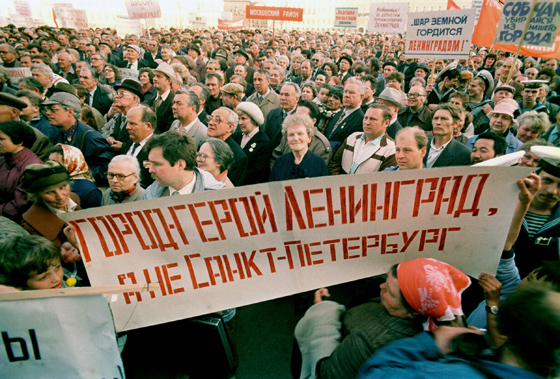 © ITAR-TASS Miting against renaming the city of Leningrad, 1990
And regarding St. Petersburg, Gorbachev was beneficial to use the moods that existed in society, to violate the balance of power and make it clear to everyone in 1990-1991, that we can even this. Primary sociological surveys showed that the population of Leningrad was divided exactly in half. We proposed to carry out educational work with residents in the SCC. Likhachev always emphasized a very important thought: St. Petersburg was named not in honor of Peter I, but in honor of his heavenly patron. Thus, it was emphasized that St. Petersburg is not a memorial name. And then a referendum was announced on the return of the city of the original name-St. Petersburg. He took place in Leningrad simultaneously with the 1991 referendum, June 12, one day with the elections of the President of Russia and the mayor of the city. The residents of the city on the Neva were asked the question: do you want to return to our city its original name-St. Petersburg? About 65 percent of Leningraders took part in the vote. The result is this: more than half of them - about 55 percent of the voting - spoke out for the return of the city of his original name. On September 6, 1991, the Supreme Council of the Russian Federation approved a decree on the return of the historical name of St. Petersburg to the city of Leningrad. After that, in St. Petersburg, as the media wrote, mass dismantling of monuments to Lenin and Soviet leaders began, renaming streets and squares.
I still think that at that moment it was actually a careless decision. Historical names must be restored, this is a fact! But it is not necessary for toponymy to divide people and even create new grains of social hostility. This is a very important thesis. Putin now wants to disclose people again with the help of Stalingrad. And then Mikhail Sergeyevich partially hurried to Leningrad.
- Tell us who came up with the idea of signs with the mention of all the names.
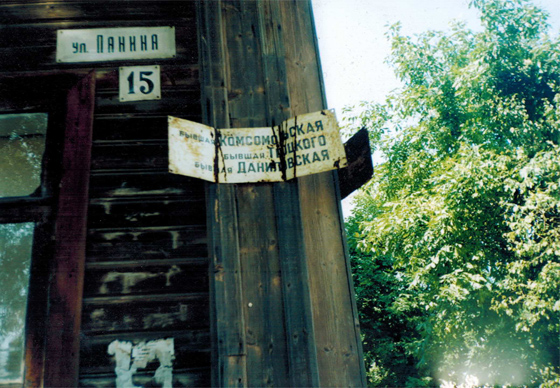
-In the late 80s-early 90s, when we were not given the opportunity to return historical names, we decided not to waste time and engage in educational work-to hang signs with historical names. G. Popov and S. Stankevich also participated in this - they approved a sample of the tablet. In many cities, such a palliative form of restoration of historical names is practiced, and people like it. Because it shows all the nonsense of power, which sometimes changed the name four times. In Moscow, one of the authors of this project was V.S. Dormidontov, who first headed the streets commission in the "democratic" Moscow Council.
- And how do you now evaluate the role of society in the process of returning names?
— Важно, чтобы люди поддерживали эту идею, но общественное мнение не должно быть главным и решающим. Я в этом уверен, и чем дальше мы идем, тем больше я убеждаюсь в справедливости этого тезиса.
Не стоит решать такие вопросы на площади бюллетенем, не стоит лишний раз опрокидывать политику в географию, и как мы делегируем врачам право лечить людей, а реставраторам — иконы, так же и здесь надо дать специалистам-ученым право заниматься географическими названиями, проводить важную экспертную работу.
— Назовите наиболее яркие примеры первых возвращений исторических названий.
— В 1986 году улице Остоженке вернули историческое название. Это было одно из первых возвращений. Пречистенка, кстати, была возвращена намного позже — до 1992 года она была Кропоткинской. Казалось бы, рядом с Остоженкой, но раньше 1992 года власти не пошли на это. Нам объясняли: Остоженка — да, это историческое название, но не Кропоткинская, понимаете, ведь Кропоткин не большевик, не надо менять название улицы.
«Вы не поняли нашей гениальной задумки!» — и показывает мне на карте: «Вот видите, здесь Лев Толстой, здесь, наверху, — Маяковский, и мы решили соединить площадь Маяковского и улицу Льва Толстого — Шолоховым! Great?!"
В 80-е годы было три-четыре возвращения. Рождественка вместо улицы Жданова. В этом приняли активное участие историк Юрий Афанасьев и писатель Юрий Карякин. Ни Карякин, ни Афанасьев не были топонимистами — они выступали за свержение с исторического постамента мрачной личности Жданова, но к этой же идее пришли и ученые, которые считали, что Рождественка — это хороший исторический памятник географии Москвы.
Еще пример. Возвращение названия Зубовской площади. Она потеряла свое историческое название и была названа площадью Шолохова в 1985 году. Покаржевский, будучи секретарем комиссии, в ответ на мой недоуменный вопрос говорил: «Вы не поняли нашей гениальной задумки!» — и показывает мне на карте: «Вот видите, здесь Лев Толстой, здесь, наверху, — Маяковский, и мы решили соединить площадь Маяковского и улицу Льва Толстого — Шолоховым! Great?!" Вот таков был уровень научной компетенции фактически руководителя комиссии при Промыслове.
— На какое время пришелся пик переименований — возвращений исторических названий?
— Были точечные переименования, а были пакетные. Пик пришелся на 1990—1993 годы. В 1994 году вышло постановление Лужкова, все эти переименования узаконившее. Но важно отметить, что в какой-то момент тем же Лужковым был наложен негласный мораторий на все процессы, связанные с изменениями названий. Я сам столкнулся с этим, уже работая как эксперт-топонимист в составе комиссии.
— На основании какого законодательного акта проводилась работа по переименованиям?
— В 1991 году при мэре Москвы Г. Попове комиссия при Моссовете была обновлена, и руководил ей В.С. Дормидонтов. Переименования фактически проводились волевым способом — решили власти и ученые, что нужно восстановить, и все. Была разработана внутренняя инструкция, подзаконный акт, а самого закона не было. А мы же учились создавать правовое государство. И вот мы в 1996 году вместе с профессорами В.П. Нерознаком и Е.М. Поспеловым начали работать над этим законом, я стал его третьим соавтором. И в 1997 году закон был принят. Его точное название таково: Закон города Москвы от 8 октября 1997 года № 40-70 «О наименовании территориальных единиц, улиц и станций метрополитена». Это было очень важно еще и потому, что Москва послужила всем примером. Мы закон разработали, Московская городская дума его приняла, и дальше этот закон стал моделью для других городов России. Даже в небольшом городе Выкса Нижегородской области есть теперь свой топонимический закон по аналогии с московским.
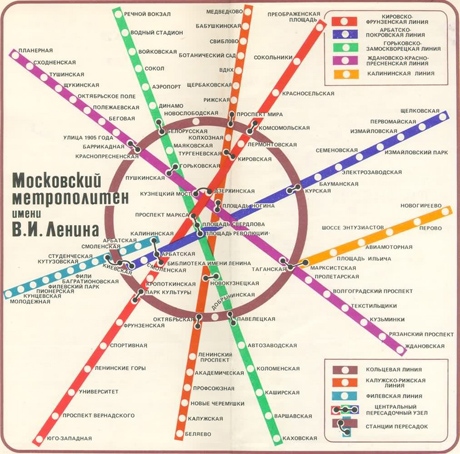 Схема Московского метрополитена им. V.I. Ленина, 1980 г.
— Какие позиции этого закона вы считаете наиболее важными?
— Кто, как и на основании чего должен производить наименование географического объекта, станции метро и территориальной единицы. Какие требования предъявляются к названию (в том числе краткость, удобство, связь с историей); в каких случаях можно производить замену названия. Кстати, по этому закону невозможно переименовать станцию метро «Войковская» — это первое название; нет иного исторического названия, нет измененного статуса объекта и нет одноименности, прописанных законом как условия для замены. Соответственно вы не можете переименовать станцию, хотя она названа в честь цареубийцы (он выписывал ту самую соляную кислоту, в которой пытались растворить тела убиенных детей царской семьи). НЕОБХОДИМО оптимизировать закон. Я эту оптимизацию предлагал, подробно разработал варианты доработки текста закона, но они были положены под сукно. Я думаю, это связано с тем, что в коридорах бывшего Моссовета опять запахло застоем. И я ушел из комиссии.
— А были случаи, когда историческое название так и не было возвращено?
— Немалое количество. Например, Прогонная улица в ВАО, в Преображенском. Этот топоним — памятник истории Москвы. Но в 1925 году улицу переименовали в честь террориста Халтурина из «Народной воли». Да и пресловутыми улицами Восьмого Марта пора бы заняться, как 3-й улицей Августа Бебеля, бывшим Церковным переулком. Кстати, немецкий социал-демократ Август Бебель в Москве даже не бывал, а «память» о нем впечатана аж в три улицы Бебеля в Савеловском районе Москвы. Ну, между прочим, М.И. Калинин, «всесоюзный староста», ни разу не был в Кенигсберге, что не помешало Сталину переименовать его в Калининград — в награду усопшему члену его ближайшего окружения. До сих пор не переименована станция метро «Библиотека имени Ленина», тогда как главная библиотека страны уже с января 1992 года (22 года!) называется Российская государственная библиотека. И никакого Ленина! А название станции метро должно соответствовать названию наземного объекта — так гласит упомянутый мной закон № 40-70! Таких противоречий с законом очень много.
Или, например, город, который я очень люблю, — Старая Русса (Новгородская область); в романе Достоевского «Братья Карамазовы» она стала прототипом Скотопригоньевска. В городе чуть больше 200 названий улиц. Но до сих пор там восстановлено название только одной улицы — Георгиевская, по древнему храму. Город древнее Москвы — а в нем в центре до сих пор и улица Ленина, и Маркса, и Энгельса, и Клары Цеткин, и Свердлова, и пр. А в следующем году ему предстоит официально отмечать тысячелетие… И это патриотизм??
Знаете, что писал Константин Паустовский? Эти слова писателя, помню, очень нравились академику Д.С. Лихачеву: «Названия — это народное поэтическое оформление страны. Они говорят о характере народа, его истории, его склонностях и особенностях быта. Названия нужно уважать. Меняя их в случае крайней необходимости, следует делать это грамотно, со знанием страны и с любовью к ней. В противном случае названия превращаются в словесный мусор, рассадник дурного вкуса и обличают невежество тех, кто их придумывает».