
Translated material
Wals with tanks
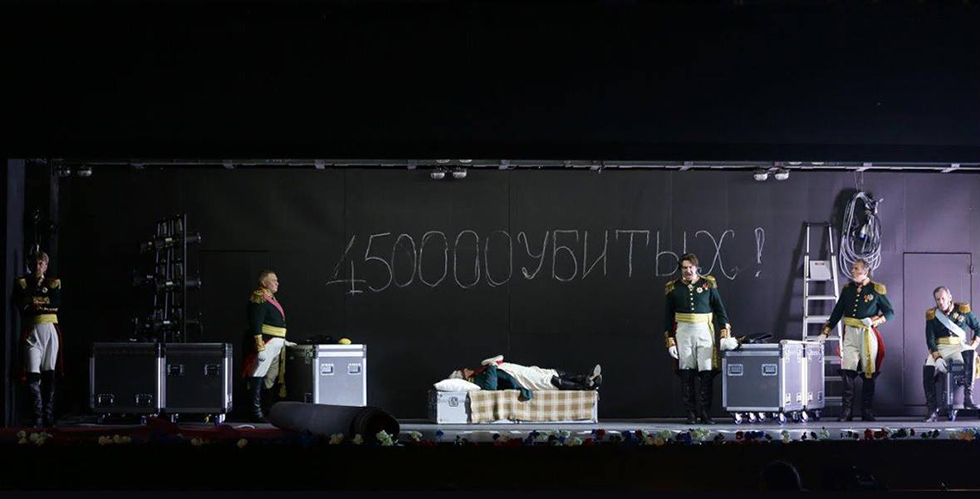
This is the third setting of the blockbuster of Prokofiev in the Gergiev era. One of the previous ones was done by Andron Konchalovsky in 2000 with a very young Anna Netrebko in the role of Natasha Rostova, and the other was the same Gram Vic as now, only much younger; It was in 1991 - and it was already a version without bills.
Now she is. That is, more than four hours of music, and with delay and wires for recording television version - and all five. Not all spectators can withstand, the hall is noticeably empty after the death of Prince Bolkonsky - the time of the St. Petersburg metro and the graphics of Valery Gergiev have not been habitually not coinciding for several decades.
But the length is not the only problem of this opera (in its difficult staging life was the following option: to give one evening “peace”, and in the other “war”). Torn fragments, fractional installation, dimensionless mess of individual human destinies and human crowds - this is what you have to deal with. And it would be nice to take into account that the theme of “war and the world”, and at the same time, the patriotic window dressing does not cease to be relevant since the time of Napoleon, Tolstoy and Prokofiev. And such a director as Graham Vic (his previous Russian work, the Non -Berry Boris Godunov in Mariinka two years ago), certainly takes into account this.
He staged an incredibly excessive performance, sewn from a huge and even tiring number of shreds - unexpected, paradoxical, annoying, predictable, worthless, funny, incomprehensible, absolutely understandable. In a coherent whole, they do not add up. So everything remains shaggy mishmash. However, this performance is pleasant to you or not, but it does not allow you to relax, it provokes all the time, asks, argues with you, you won’t confident from it, it will overtake you even in the auditorium, where all the time there is also some kind of life and dusty tourist kutuz (Gennady toothless with a dusty voice that is very sinking to his museum) in the surroundings of tall guards in ties, good-naturedly Brates in the final with the audience.
Something Natasha Rostova is not so fabulous-poetic as we are used to? Yes, at first - a long -legged glamorous durech (young Aida Garifullin approached both in a voice and a physique). Heels, pictures, red carpet, a black car, a brand bag and tanned advertising girl's limbs on a huge screen on the back of the stage - here it is, such an alluring “world”. His quintessence - a wall of a sparkling onyx removal with a plumbing built there, on which the most sane deputy of our State Duma Maria Maksakova - as Helen, as a glove. Her brother Anatol (vocal Ilya Selivanov) is completely beautiful in his fading.
 © Natasha Razina / Mariinsky Theater
The onyx wall, the symbol of Mariinka-2, is contrasted with the good old blue curtain of Mariinka-1, personifying the Old General “Mir” of the old prince of Bolkonsky (Mikhail Petrenko without pants flashed in this small role). It should be borne in mind that the co -author of Graham Vika was the artist Paul Brown, who is common to actively pull the blanket over himself (Mariinsky “Electra” and “Woman without Shadow”). So there are a certain number of puzzles in this patchwork blanket from it.
Social pointlessness captivates the director more psychological studies, therefore - a rare case - “war” to watch is even more interesting than the “world”. Actually, the war is present in the performance from the very beginning-Bolkonsky (perfectly singing and muffled-shawl Andrei Bondarenko) in civilian clothes, already disappointed in life, with a gun in his hand, which he almost brings to the temple, appears before us against the background of the tank. This tank lies along with the gathered at the first Natashin Balu. The rest of the waltzing - in gas masks.
After the intermission, Prince Andrei is already in military camouflage and with a machine gun in his hand. Behind him, a hysterical spell is written - “Peace”. An endless series of personnel passes - frightening, sarcastic, touching. Gergieva orchestra, which makes all these sharp Prokofiev gluing, spurred the action. The war is the coffins, and the digging of graves, and the solemn parade of mourning wreaths, and then-the uragic-patriotic choirs of the mummers, and the abandoned cozy and warm peaceful life with a bicycle, a refrigerator and a mushrooms on the stage are a cellist, and the looters, which are in a row, even a onyx wall with plumbing, and, of course, a genetic memory of the genetic memory of the genetic memory of the genetic memory The main war, during which Prokofiev wrote his opera. One of the strangest and most important episodes is the frames of the Soviet military newsreel that people watch in the audience chairs built on stage. And when they are empty, Napoleon (Vasily Herllo) sits in them with a retinue, which is very uncomfortable there.
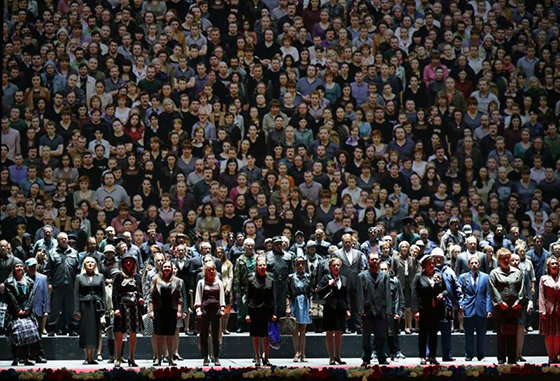
But also war is normal, ordinary people who, apparently, should understand the director so - are much more sympathetic than those masks that were at the beginning of the performance. There are a lot of these people, the whole sea, they periodically fill the scene and the screen backdrop. They, not funny Kutuzov, win the war. In them, Pierre Bezukhov (Evgeny Akimov), to whom Natasha joins in some proletarian overalls, is poured into them, having previously said goodbye to Prince Andrei. This is a quiet seat side by Natasha and Andrei, who buried in the iron rods of the bed, while the orchestra simply splashes out of his pit along with the sounds of that very first waltz - the most nicer moment in the play. Of course, if you survived to him, and did not run to the subway.