
Translated material
Iran: the price of sanctions
Iran is preparing to return to the oil market as one of the leading players. In June, President of the country Hassan Rukhani announced the lifting of all sanctions and permission to enrich Uranus for Iranian nuclear power plants. In terms of oil and gas reserves, the country is in third place in the world. How much Western sanctions cost Iran - The New Times found out
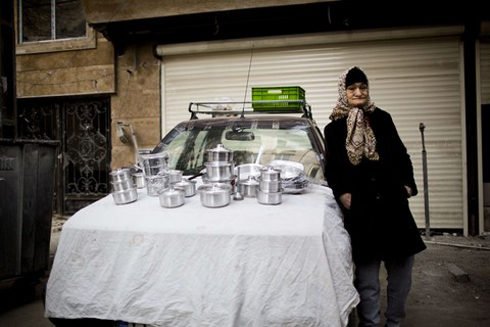
International sanctions affected every Iranian. Tehran Bazaar, January 20, 2014/Photo: Behrouz Mehri/AFP/East News
Tehran liquidated his reserves of uranium enriched to 20%, diluting it to less dangerous forms, BBC reported on July 21 with reference to the Magate report. Negotiations are also underway with a relatively unfinished 40-megavatta reactor in Arak: the “six” demanded to rebuild the reactor from the heavy-industrialist to the lightsuit, as in the Bushera, and Tehran in response proposed to build it in such a way that it could produce plutonium, but five times less planned. Magate inspectors have not yet reacted to this proposal, but one thing is clear: the last round of tough international sanctions against Iran, introduced in 2011-2012, forced the Ayatall regime to submit to the requirements of the West.
A bowl with poison
However, Iran is not the first time to accept the conditions of the “Big Satan”, as the United States is called in Tehran. Twenty-seven years ago, on July 20, 1987, the Islamic Republic adopted a resolution No. 598 of the UN Security Council, which laid the end of the Iran-Iraq war, the most protracted war of the 20th century. In the face of the real risk of falling a regime, exhausted by eight years of battles, Ayatollah Ruhollah Khomeini decided to forget about the official slogan “War to a victorious end”. In his own words, it was like making this decision, like "drink a bowl of poison." What is unfolding in Iran today is nothing more than a nuclear remake of the same scenario: after tens of billions of dollars were spent on a completely meaningless project to create nuclear weapons and the country was on the verge of collapse, the Ayatall regime was again threatened. That's only this time it is more than another diplomatic somersault, this is a real unconditional surrender to the “American arrogance” - another Iranian cliche in relation to overseas enemy. For the second time in 25 years, you won’t drink a bowl of poison, so the new Ayatollah Ali Hameni invented the term “heroic flexibility”, using it in September 2013, speaking to the highest revolutionary command. Two months after this speech, Tehran signed an agreement on joint actions in Geneva, which the world called the “first step” in the settlement of the Iranian nuclear problem.
"
This is more than another diplomatic somersault, it is a real unconditional surrender
"
| *Under the Turkmanchai Treaty of February 22, 1828, Persia lost its Caucasian territories in favor of the Russian Empire. |
Naturally, in Tehran this step was perceived ambiguously. “The Geneva Agreement is so shameful that after it you can worship the generosity of the Turkmanchai treaty”*, ”wrote Sadech Zibakalam, a former high -ranking official of the Ministry of Foreign Affairs, and today - a member of the University of Tehran's Scientific Council. What so angered a prominent functionary, and with it many representatives of the Tehran elite? The Geneva Agreement suggested the suspension of the chemical stage of the production of atomic weapons: the enrichment of Uranus at the enterprises of Ford and the Nathan, as well as the construction of a heavy -water reactor in Arak, which did not have any other purpose, as the production of plutonium necessary to create a nuclear bomb.
Oddly enough, Tehran, and previously promised a lot of things, just to win the time, this time reacted seriously to his obligations. Already on March 5 this year, the Magate said that "Iran began to perform six initial practical points approved with the agency in November 2013." The next seven steps were also determined, to which Iran should begin on May 15, 2014.
How much is a military atom
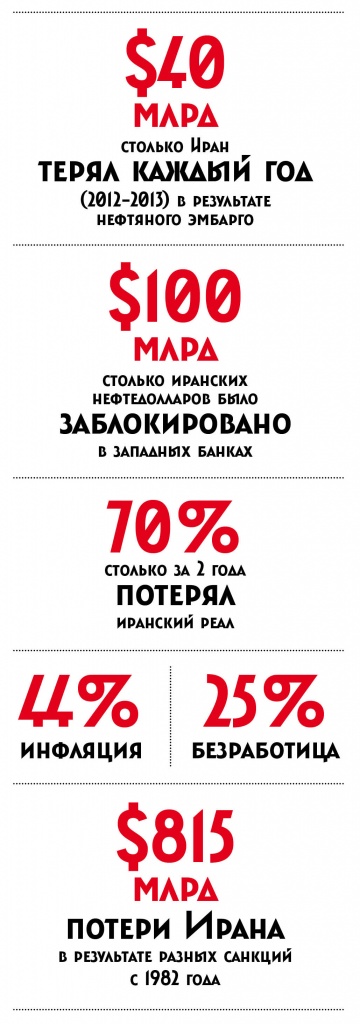
“Iran’s rapid return to the zero position in order to avoid additional losses,” Rena Tagizade, Iranian expert in nuclear energy, describes the current situation. The zero position, however, does not mean a complete rejection of the atom. The Islamic regime enriched up to 20% uranium began in January 2012, creating about 200 kilograms of this material in two years. Rena Tagizade estimated this supply of $ 2 million - this is its cost in the international market. However, the nuclear program, which cost Tehran the most stringent in the history of the confrontation with the West, cost Iran much more. From 2012 to 2013, Iranian oil exports decreased by a million barrels per day, which cost the country to $ 40 billion a year. Over the same period, about $ 100 billion of Iranian petrodollars were blocked in Western banks. The sanctions against the Iranian banking system cut off from the rest of the world have led to a decrease in foreign trade by about a third, increasing the cost of imports by 30%. The sanctions led to the fact that the Iranian Real over the past year lost 70% of its value, the economy entered the stagnation regime, the picture was completed by 44% of inflation in annual terms and unemployment of 25% (all these numbers are given according to exemplary estimates of experts, since the real indicators of the Iranian economy are a state secret).
According to a study published in Israel at the end of 2013, the total damage incurred by the Iranian economy since 1995, when the United States imposed the first sanctions for the development of a nuclear program, amounted to $ 170 billion. In other words, this is the price paid by Ayatollahs for 200 kilograms of uranium, the cost of which is only $ 2 million, if we add financial losses from the Iranian-Iracian war, estimated by Pierre Once, the director of research on the Institute for Strategic Research of the Military Academy in Paris (IRSEM), $ 645 billion, the militaristic Iranian policy has led to the fact that since 1982 the country has underway about $ 815 billion. Losses are colossal, given that other developing countries, many of which have been much poorer than Iran in the late 1970s, over the past 30 years, over the past 30 years. They escaped forward, in particular, creating a group of BRICS.
Guardians of the Revolution and $
In politically, Iran’s nuclear defeat in November 2013 can have much more consequences than the inglorious end of the Iraq-Iraq war. Firstly, the Supreme Ayatollah Khomeini, the leader of the Iranian revolution, enjoyed much more respect than his successor to Ali Hamenie, so he could take personal responsibility for the very “cup of poison”. Khamenei, whom people close to him describe as a person of a weak and paranoid, decided to avoid responsibility by shifting her to the new President of Iran Hassan Rouhani. But the alignment of forces in Iran today is not at all the same as in 1987. Then the guards of the Islamic revolution were only an ideological rod of the regime, which lost military power after a heavy war. Today, the guards are an omnipotent military-industrial conglomerate, holding almost the whole country in its hands through the largest holding Hatam Ol Tybia, whose commercial interests are also in the help of Iranian business to bypass Western sanctions. The involvement of the guards in smuggling schemes of various kinds (from oil exports to weapons imports, spare parts for aircraft or even alcohol) was so wide that the last Iranian President Mahmud Ahmadinejad publicly complained about this lawlessness, speaking in 2011 at the annual assembly of the crew command of the revolution. The irritation of Ahmadinezhad was so strong that in his speech he called the guards only "our brothers smugglers." The total volume of finance, controlled by the guards of the revolution and personally the supreme Ayatollah Ali Hameni, according to the investigation conducted in 2013 by the reporters of the Reuters agency, is about $ 190 billion. On the other side of the chessboard, the current president of Iran Hassan Rouhani, one of the main pre -election promises of which was the improvement of the daily life of the Iranians, the struggle with the struggle with poverty and unemployment. Rowhani understands: this is impossible to achieve this without crossing the road of the military-industrial Iranian elite, interested in the further isolation of the country.
The situation in today's Iran is similar to the last years of the existence of the USSR: there is a struggle for power between the two camps that understand that the system hangs in the balance. But while some will do everything for rapprochement with America, which will unlock billions of Iranian dollars in Western banks and give a sip of fresh air to the Iranian economy, others will conduct tireless work to disrupt the agreements reached. Who knows, maybe in the bowels of the guards of the revolution the era of the post-Hameni is being prepared?