
Translated material
Loznitsa and "Maidan"
In Kiev, the film shown for the first time at the Cannes festival , the film by Sergey Loznitsa about the Maidan was perceived by many with obvious distrust. The direct participants in the events who remembered the Ukrainian revolution as an endless flickering of events, each of which threatened to become fatal, plunged into the atmosphere of their own lives of their own life - singing, waiting, throwing Molotov cocktails, dying, defeating and burying the fallen. But in this atmosphere there is nothing that made up the information "vinaigrette" of the Maidan: neither accelerations, nor speeches of opposition leaders, nor negotiations. And most importantly, there is no Yanukovych in it, the same Yanukovych, for the sake of the victory over which the people gathered on the Maidan, screaming in all the pharynx of "gloomy!" And no idea how this can happen: we will leave, but he will remain? And this is the first film about the Maidan? And on this film will foreigners draw conclusions? The journalist of one of the most honest Ukrainian television channels who told the truth about what was happening even when most of our other colleagues talked about the stability and fears of the president about European integration, sincerely perplexed: did I really see the Maidan in this film?
But this may turn out to be the best film about the Maidan. Then there will be others. Documentary and artistic. With Yanukovych and opposition politicians. With some beautiful love story, with a wedding, with a tragedy. There will be films about the guys from the "Heavenly Hundred" and about Russian intelligence officers, in the silence of offices developing plans for the dispersal of the Maidan and the occupation of Crimea. But in all these stories, heroic and not very, the most important thing may be lost - the people.
The second Ukrainian Maidan from its first day to the last was the creation of this very people. No political technologists could force people to gather after the dispersal of the "student" Maidan at the walls of the Mikhailovsky gold -farm monastery. No one could organize the coming of people to the “pressed” special forces of the Maidan. And the willingness to go to death under a bullet of snipers cannot be foreseen or directed, because all this is a manifestation of collective will.
When I stood on the stage of the Maidan next to politicians, social figures, singers, priests, journalists, and in a word, those who are accepted to be called the elite, and peered into a thousands of thousands opposite, I clearly understood from almost the first minute when the events broke out of control and began to develop along the “folk” scenario, that the masses are not people. The mass is we. Maidan is the first real folk revolution that I saw. The revolution in which people dictate their will to politicians, and not politicians impose their idea of what is happening to people. And while people stand in the square, they are invincible. This is what Yanukovych could not understand. This is what Putin can never understand - even when he will lose power, he will look for the answer to the question "Why?" - And do not find. This is that even many opposition Ukrainian politicians who risked their lives and their own future for the success of the Maidan, were not able to understand to the end. And I understood Loznitsa.
Therefore, in his film, Maidan is a living creature born of popular breathing. A creature that lives with their own emotions, expectations, an instinctive sense of the boundaries of good and evil, inherent only to young children and people who have not lost children's faith in a miracle. Loznitsa probably admired the Maidan, like all of us, but he did not flatter Maidan: we see personally how patriarchal and naively the society that gave birth to the Maidan - and at the same time we understand that in our time only such a society can stand to death. As a journalist, I probably should have explained the Maidan, his reasons, his hopes, the predetermination of his victory. And in his film, Loznitsa did not become either a journalist or a chronicle - he became a painter who wrote a portrait of this amazing creature in the square. I don’t know how correct this is from the point of view of the present. But this is true from the point of view of the future.
Because the years later, when the Maidan turns out to be a small luminous point in Ukrainian history, and Ukraine itself will become a boring European country, whose residents will be concerned with taxes and construction of new maternity hospitals and will not immediately remember who the prime minister has today, we may want to tell our young fellow citizens about the people who came out and survived. Not about Yanukovych, not about Putin, not about Yatsenyuk or Poroshenko - about the people. What will the speeches, negotiations, press conferences and rallies say to us? How can we explain to children what an association agreement is? Whether we will explain to them that there was also Anti -Maidan, to which people came for money - it is impossible to understand a person with a non -healing psyche. But when the child that has not yet been born today will look into the clean faces of people in the square, in their eyes, waiting and hoping, he will understand everything. And he will only look at us with distrust: did we have such eyes then?
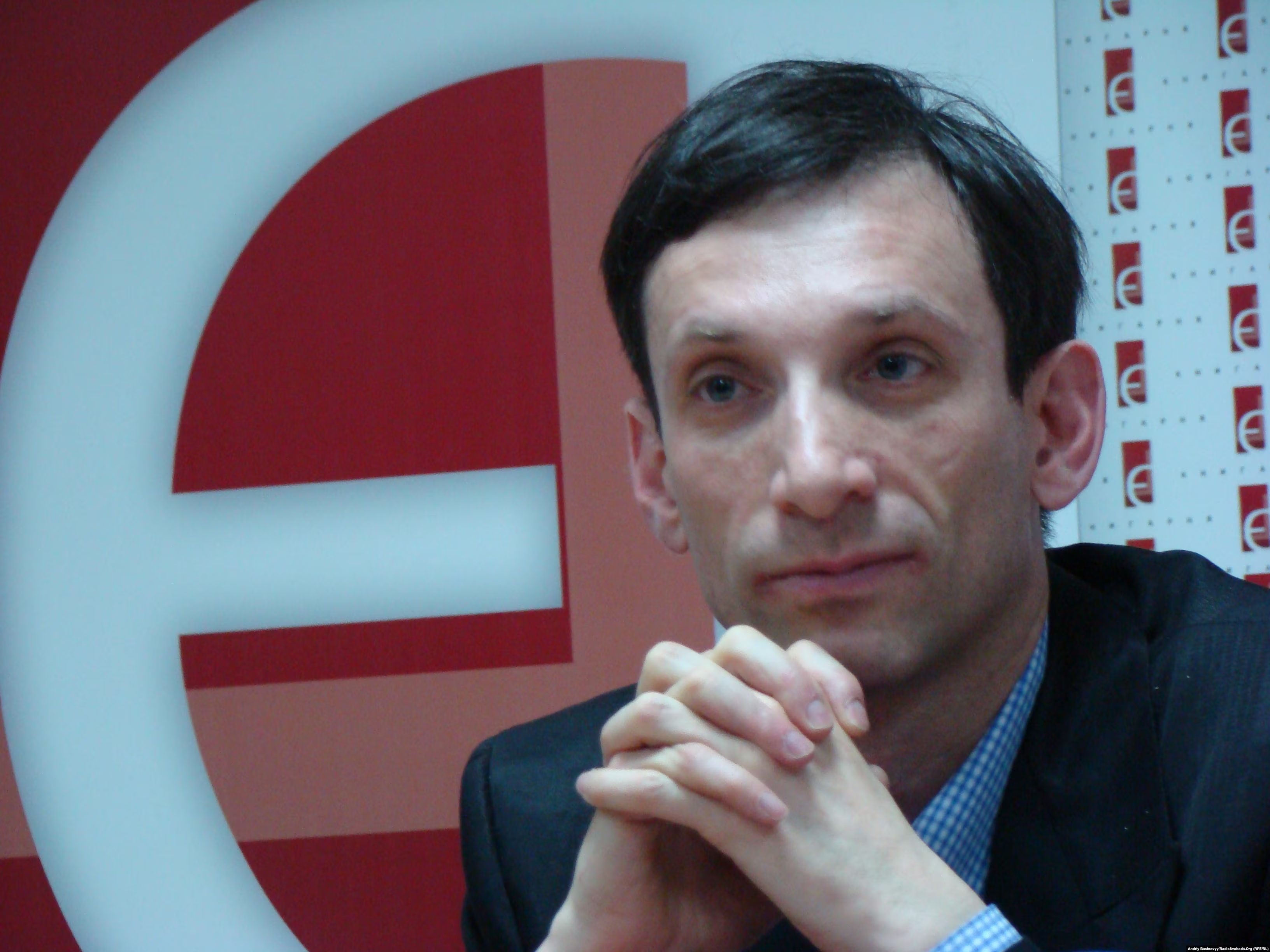
Vitaly Portnikov - Kyiv journalist, observer of radio freedom
Opinions expressed under the heading "Law" may not reflect the point of view of the Radio Liberty editorial