
Translated material
The fall of Ukrainian cinema
At the request of C OLTA . Ruu editor-in-chief of the chief Ukrainian Samizdatovo Internet magazine about cinema Cineticle conducted a detailed diary of his impressions from the Odessa International Film Festival (in fact also the main thing in Ukraine).
July 10
Last year, four buses of journalists brought from Kyiv to the Odessa film festival. This is only two. Each time, one question does not give me rest: who are all these people? What publications do they write for? Where does so many journalists come from if we almost do not have normal media or even sections about culture? Another observation is now added to this: why are they all so young? There are ten people of honored critics, the articles of which none of us have ever read, but who, as they say, once wrote something somewhere. But the rest - 25 and less. I am 30, and I feel old against their background. I see the difference between us and I am afraid that I will soon remind them of “Honored Critics”, with nostalgia for recalling the departed acquaintances, drinking cognac during a bus stop and talking about the time, which, perhaps, has never been.
Perhaps 30 years is a line for film critics? After you either start falling into insanity, or must change something. A few more years-and you will finally understand that your discussions about the cinema were needed only by you and a couple of your friends, that film criticism will never feed you and it can change, in general, only you, but not the world around. On the other hand, all these discussions about film critics in Ukraine seem so ridiculous ... Is it possible to talk about film critics in a country where there are practically no cinema and where people who write more than just essays about rental are easy to count on the fingers of one hand?
On the bus with Sasha Taleuk, we discuss plans for the festival - watch all Ukrainian cinema, often walking at sea.
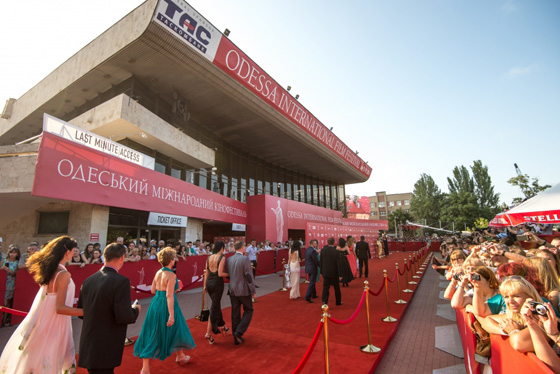 © Odessa International Film Festival Red Plant of the Fifth Odessa International Film Festival
July 11
We live in a hotel near the forecast, and this at first oppresses. On the way to the cinema, you see dozens of local marginals, people sleeping in the middle of the street, disfigured men and companies, daring directly at the stop. This is Panteleimonovskaya street. Closer to the center, of course, changes. Odessa is a city of contrasts, a small country inside the country, whose resident is primarily Odessa, and only then - a Ukrainian. Recent events, however, have changed this a little. There are more Ukrainian flags in Odessa. They try not to talk about May events here. They sometimes react to the Ukrainian language wary.
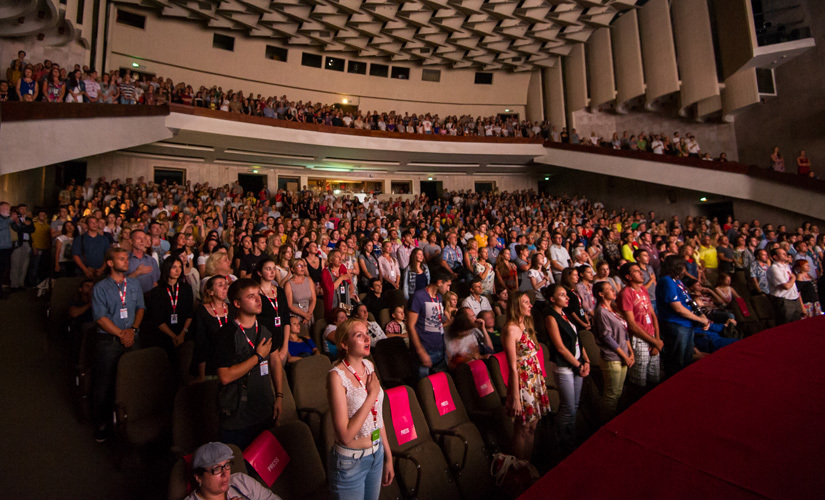
From nothing to do, we go to the opening. The first thing that is amazing is the theme of the ceremony, which seems to be deliberately distant from Ukraine. It seems strange. Today, this is a conversation about the history of our country, about the history of our cinema or culture. Only in this way can we better understand the present, more to realize our belonging to a single nation, no matter how dangerous it may sound. But instead, on the stage, they say about neutral: music in world cinema, composers of Hitchcock and Fellini. Some of the friends notes something hypocritical in this ...
The main shock, however, turns out to be ahead: the buffet is arranged right near the cinema, protecting it with an impromptu fence. All this is horrified to reminiscent of Bunuel's films: people in tuxedos eat and drink before the eyes of the local public, which, as if in the theater, watches this action. It is strange that no one thought of taking a plate of food and starting to distribute it to the audience.
As a result, we buy Odessa wine and locked in the room.
July 12
The first time this year was at sea. In the afternoon I watch films of international programs. After each show, I meet one of my friends: everything is delighted, I do not. I give myself the word to discuss cinema only with colleagues in Cineticle and not to criticize anyone. I immediately violate him. Because of the Angel, I do not get to the show of the "Black Notebook of the Maidan."
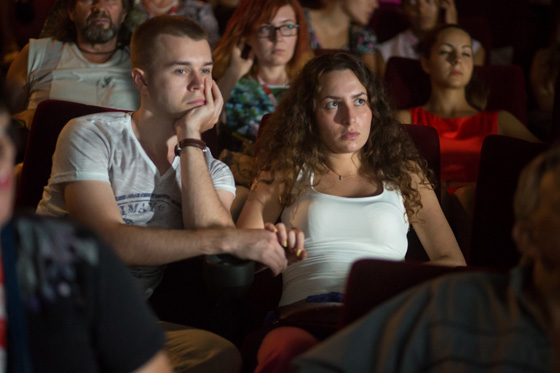 © Odessa International Film Festival Presentation of the film "Black Notebook of the Maidan"
July 13
In the dining room near the hotel I meet literary critic of Volodarsky. He writes about a movie for the Ukrainian version of Forbes magazine. We recall with a friend that one well -known music critic has long reviewed films for another popular publication, a PRA distributor company is a full -time film expert on the X website. We recall that in Ukraine there is no longer a single printed publication about the cinema, with the exception of the mysterious magazine "Kino-theater"; that there are only two cinema sites, where the main content has long been made up of funny tops and the posters of cinemas. This is not criticism of criticism - rather observation.
Before the festival, Forbes asked to take part in a survey about the most influential directors of Ukraine. Without thinking, I called Muratov. Then he added Shapiro and Podolchak as directors who have been trying to create a movie in spite of everything in recent years and inspire many of us with this struggle. Of the names called other participants in the survey, the most popular are Miroslav Sloshpitsky, Sergey Loznitsa, Vladimir Tikhiy. But what does all these directors influence? And in general, does cinema affect something in our country?
Cinema for Ukraine and many of our directors and spectators are rather a pleasant pastime, work, satisfaction of their own ambitions, and mandatory activities after the end of the film. In general, anything - but not art. You can recall hundreds of times about the deplorable state of the film industry, the inactivity of state institutions, but all this is nothing more than the mediocre Alibi of a person who has just committed a terrible crime before the eyes of others.
Perhaps it takes time. Maybe only now, after all the events that we worry, we will have another, much more free and relaxed, generation of directors. After all, the Maidan taught us one important thing: let we cannot change the system on the move, but we can change something local - ourselves and things regarding the areas of activity close to us.
From Ukrainian, he watched the documentary “Larisa Kadochnikova. Self -portrait ". I saw her itself in front of the cinema, heard her conversation with someone. Large actors who cannot accept old age are tragic.
In the evening we look at the roof of the hotel final of the World Cup - so far this is the best that I saw at the Odessa Film Festival.
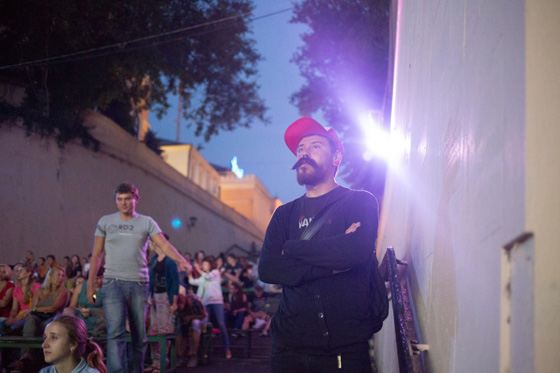 © Odessa International Film Festival of Langeronic descent
July 14
Three Ukrainian full -length films at once: “Twilight” by Valentin Vasyanovich, “ F 63.9 Love disease” Dmitry Tomashpolsky and Alena Demyanenko and “Haitarma” by Akhtem Seitablaev.
"Twilight" stands out. Valentin Vasyanovich represented his phenomenon “Credent” last year in Odessa. Twilight is a documentary film, which was shown in the Docudays festival in the spring. Vasyanovich is an ambiguous character. He is a good documentary, but a rather weak director of a feature movie (perhaps for now). "Credence" was a film that I wanted to forget. The Twilight Documentary Film is still the best Ukrainian film of the year. It has several layers, on the one hand - this is a story about the elderly mothers and the son living in the village. They both know that one of them is about to die. The son is sick with diabetes and is already blind. He is still trying to do something around the house, although almost the entire economy remains on the mother. So they are engaged in conventional affairs, sometimes they argue and gradually prepare for the funeral. Death is what is now invisibly present in their life, being as if the third hero of the film, whose appearance is inevitable.
On the other hand, these two people resemble ghosts, creatures living between life and death, one of millions in a country that does not care about its inhabitants. Plus-we all know that the Ukrainian village, once sung by Dovzhenko, is almost dead today. And this turns a film from a chamber story into a story about the disappearing: people, generation, history and traditions. At the same time, the heroes of the film are the relatives of the director himself, which allows Vasyanovich to overcome the barriers between the director and his heroes, making it possible not to pay attention to the camera. The latter, however, plays a cruel joke with Vasyanovich. He carefully builds a frame, tries to achieve a similarity with painting. Why does a certain duality appear, where this eternal confrontation is felt between the intimacy of history and the deliberate stagnation of the frame.
Haitarma is an almost classic military film that at the same time as a strong series, Hollywood films of the 40s and old Soviet cinema. The advantage of Seitablaev is in his desire to make an honest mainstream using those that are close to him personally (the history of the Crimean Tatars) and genre cliches. In Hightarma, for example, there are almost all components of such a movie: from pronounced bad and good, cool guy in trouble to compulsory music, emphasizing every dramatic event.
The most crazy film of the day is “ F 63.9 Love disease” Dmitry Tomashpol and Alena Demyanenko. In Odessa, his version duplicated in Russian was shown, which gave him even more thrashness (dubbing often diverged from the articulation of the lips). This is a story about the love of an venereologist and an astronaut by the name of Chaika. Going into outer space, the seagull picked up syphilis, the female doctor decides to sleep with him to test his theory. At the same time, the bosses of the astronaut are preparing it for the first copulation in open space, and the astronaut Lena Golovach is trying to prevent his connection with the venererologist. The film has enough stupid humor, a rather stale stalk over the stamps and the obligatory serial component (Tomashpolsky is known for dozens of series). But the main advantage of the film in the context of Ukrainian cinema is in his irony. Tomashpolsky immediately declares: I wanted to make a bad film just to laugh. It follows this rule to the very end. Most Ukrainian directors with pathos are trying to shoot something serious, receiving as a result a bad movie, Tomashpolsky and Demyanenko with a cunning squint do the same, but intentionally. As a spectator, I accept these rules and are ready to follow them with the directors. As a critic, I respect such a position much more than another hypocritical game in the seriousness and meaning of life.
In the “Diseases of Love”, one of the patients is played by the program director of the Odessa Film Festival. Now every time I see him, I involuntarily think about a sexually transmitted disease.
July 15
What are they shooting in Ukraine? Is it possible to understand our country by Ukrainian films? If you believe international selectors, then Ukraine is something between Romania and Russia. A country with beautiful nature, simple, embittered and unhappy people; Numerous marginals and cruel teenagers talking surgeon and obscenities. The latter is partly true. This is one of the components of our lives. This is what we see daily in the sleeping areas of Kyiv (and not only), provincial cities; What is part of dozens of daily news. This is our reality-devoid of any identity or collective memory. It is beneficial to everyone - selectors, local directors, news, activists, politicians.
Our new cinema is trying to follow this canon, but here is its main problem: Ukrainian directors want, but they do not know how to work with reality (creating or rethinking it is still something unattainable for us). In an unequal battle, they find themselves obviously losing, and their weak attempts to struggle result in recognition of their own failure. The most striking example of such a failure is the Green Jacket. Its director Vladimir Tikhiy is a good organizer, activist, producer. But in recent years, he wants to be the voice of the country, and countries in a form that will cause interest among the Western viewer. Therefore, any quiet project can be in demand in the West, but will not tell anything new to an ordinary Ukrainian. The same "Babylon'13" , Despite all the innovation, it was much more interesting than Russian liberals than Ukrainians who saw all this with their own eyes on the Maidan or through dozens of video stacks.
The Green Jacket is a film where almost all festival cliches are used, but none of them are justified. The quiet takes reality, but immediately completely exaggerates it: its heroes are embittered because they are embittered; They exist in shit because it is so customary in Ukraine; And their actions are irrational because the country itself is irrational. Nothing personal, only cinema. At the same time, it is difficult to evaluate the film from some critical positions, since any component is frankly weak. Scenario? Conditional. Mizan scene? She simply is not here. Working with actors? Forget about it. After the film, a quiet admits that all this really did not matter, which for him was much more important to tell about society.
Again I remember the "disease of love." These are two completely different films in which the audience laughed equally a lot. Something clearly does not converge here.
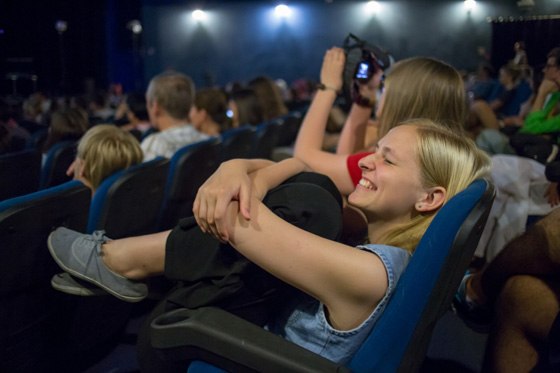 © Odessa International Film Festival
July 16
In the morning they show the main Ukrainian blockbuster of the year - the “guide” of Olesya Sanina. At first, the film resembles the “Guardian of Time” by Scorsese - and this is not so bad. Then everything turns into a “state adviser”. Everything is done on a scale, and the story of blind kobzars for some reason turns out to be pulled by the ears. Instead of kobzars in the film, there could be just some blind warriors of Shaolin. One of these warriors saves the boy whose American father was killed the day before. The boy becomes his guide. People of the NKVD hunt for them. The worst thing in the film is that it is sterile.
“Kofta”, “Guide”, advertising in front of competitive films, which is sometimes more interesting than the films themselves, bait, news from the east - I begins depression.
I meet with Borea ridiculous. I catch myself thinking that because of all the events I feel a small wall between us. Previously, it was easier for me to listen to someone’s problems, now I am fixed on my problems and problems of my country. I understand that all this is in my head. There is friendship and support - and this is more important than many things. Gradually, the wall collapses.
I go to the video truck. There are about 50 films that did not get into the competition. The first to watch the short films, which I have heard about at least something. These are mainly participants in the Cannes Short Film Corner . In May, the creators of each of them joyfully reported their participation in Cannes. On the table near the computer - several magazines and flyers of short films of Miroslava Khoroshun. I look at her first. I feel shock. I think about the directorial security. The next work is not so terrible. But I can no longer describe my feeling. I am devastated, I go to the first block of Ukrainian short meters.
My depression is aggravated. An unexpected surge in the first thirty seconds “in the trees” of Marysi Nikityuk. They look like the most beautiful Virasetakul Lomo-Film. After - one disappointment. All this game with the aging of the camera is nothing more than a show off. Further - only a simple story about two gopniks, who, having stolen an antenna in the country, run away from dogs. They climb a tree, pierced and embark on strange discussions about life. Nikityuk is the main screenwriter of the “New Ukrainian Cinema”: the same “Mudakov” and “Ukrainian evil”. “In the trees” - her directorial debut, and it has all the same problems that we had previously seen by the Pacific. The street jargon here suddenly goes into a theater conversation about God, the usual urination turns out to be a protracted scene of self -torture in the worst traditions of naturalism, and any motivation is reduced to this obsessive “well, we live, you know”.
Another short film - “and God has taken a step into the void” of the Boadze’s Zazi - causes less rejection, but more questions. For example, who is Zaza Buadze and how was his short meter financially supported both the Ministry of Culture and the Akhmetov Foundation? The second question is more difficult, the Internet helps with the first: Buadze - Georgian working in Ukraine, he is 52 years old, he is the screenwriter of the film “Ursus” (the story of a man who, having changed into the skin of a bear, runs from the country) and, as a director, shot two full -length films. “And God took a step into the void”-this is the almost free remake of “Mr. and Mrs. Smith” (with Jolie and Pitt) on the Ukrainian-poetic motive. Two elderly people live in the neighborhood and fight with each other. From time to time, products are brought to them. All action takes place in the Chernobyl zone of alienation. The director uses the crane, and the camera now and in Malikovsky takes off to the trees. At some point, it seems that the whole film was created for these flights.
Even before the show of Listopad, Maria Kondakova, I will find out that this short film got into the Locarno competition. I love Locarno, and this news inspires hope. In fact, everything is not so joyful. “Listopad” really stands out against the background of the rest of the work from the first block (I recall only three here, the rest are still higher than my understanding), his specialist is all the same Maryya Nikityuk - and this, of course, is the continuation of the “assholes” cinema, that is, the cinema that they love to receive from Ukraine in the West today. In the center of the plot is a love story of a janitor and killer. She leads him to her home, they spend the night together, chatting about life. In the morning, the killer leaves, leaving a pack of money. The average festival film, and this is perhaps its main force.
We have dinner with ridiculous in a cafe called "buffet". Suddenly the light goes out. They say that all over the street. Минут десять сидим в полной темноте, из соседнего зала доносятся суровые споры мужиков, напоминающих героев фильма Никитюк.
July 17
В Видеоруме просмотрел уже 30 короткометражек, пытаюсь делать какие-то заметки.
Стоя в очереди на второй блок украинского короткого метра, узнаю о сбитом «Боинге». Все время до показа ищем информацию в интернете, передаем друг другу последние новости. Все вокруг кажется бессмысленным. Но страшнее другое — за последние месяцы мы так привыкли к страшным новостям, что это больше не шокирует. Когда случился этот перелом? После февральских событий в Киеве? После начала войны на Востоке? Или, может, после первых столкновений с «Беркутом» на Грушевского?
Перед показом каждый второй режиссер выкрикивает «Слава Украине», у одних это звучит искренне, у других кажется обязаловкой… Я уже действительно не знаю, что писать об увиденном: что некоторые фильмы не так плохи, что в какой-то работе есть надежда. Во втором блоке собраны документалки и анимация. Здесь особняком стоит «Магазинчик поющих птиц» — мультфильм Анатолия Лавринишина. Но разве можно судить анимацию по тем же законам, что и документальное или игровое кино? Я слаб в этом.
Вечером никто не хочет оставаться один. Едем на вечеринку, сидя у моря, много говорим о кино как о чем-то абсолютно нейтральном.
July 18
С большим трудом заставляю себя подняться с постели, мечтаю весь день не выходить из номера, ничего и никого не слышать, отключить интернет. Боюсь новых новостей. Мечтаю уехать, но боюсь возвращаться. Собираюсь с силами и отправляюсь на пресс-показ «Майдана» Лозницы.
«Майдан» — это фильм, который все ждали с наибольшей опаской. В первых же кадрах звучит гимн, и весь зал поднимается. Рядом со зрителями суетятся операторы, норовящие выхватить удачный крупный план, чью-то слезу. Вскоре в фильме будет второе исполнение гимна, и все снова встанут, многие — только потому, что не захотят выделяться.
Я постоянно вспоминаю мастер-класс Лозницы. Накануне он показывал отрывки из своей ранней документалки и рассказывал, как искусно монтировал кадры хроники с людьми, которых везут на строительство нового русла, с кадрами со скотом, который перевозят куда-то. Я не могу отделаться от этих образов. Я вспоминаю «Черную тетрадь Майдана», посмотренную накануне в Видеоруме. Там Майдан был показан через активистов и частные истории отдельных людей. «Майдан» Лозницы — это история толпы, которая сметает все на своем пути. «Черная тетрадь Майдана», несмотря на свою наивность, была набором историй о людях вокруг нас, фильмом, который кажется важным смотреть здесь и сейчас. «Майдан» Лозницы напоминает экспортный вариант киевских событий. Здесь вам и вспомогательные титры, которые все поясняют, и отстраненный взгляд, дающий возможность комфортно почувствовать себя в этих событиях.
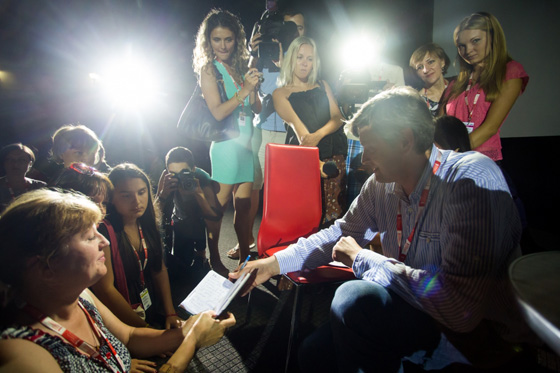 © Одесский международный кинофестиваль Сергей Лозница. Мастер-класс
На протяжении всего фильма я думаю о том, что для меня это все же больше операторский фильм. Я вижу Сергея «Стефана» Стеценко на Майдане, снимающего в такой опасной близости от происходящего, я вижу его, заклеивающего объектив лентой, чтоб не стать мишенью снайперов. И вижу Лозницу, монтирующего это все в удобном офисе в Германии и размышляющего о Брейгеле. Однако Лозница явно не так прост, и воспринимать «Майдан» как отстраненную хронику событий было бы большой ошибкой. Он знает, что делает, знает, что простая структура позволяет провести контрабандой куда больше скрытых смыслов. И здесь вопрос: совпадает ли то, что видим мы на экране, с замыслом режиссера? Например, вся первая часть фильма с Майданом до февральских событий происходит под непрекращающийся спич политиков. Толпа существует, перетекает из одного состояния в другое. Но за всем этим постоянно слышится чей-то голос свыше, извне. Разумеется, во многом все так и было — на Майдане политики не замолкали ни на секунду. Но имел ли это в виду Лозница, когда накануне так много говорил о пропаганде и управлении толпой? Сам фильм заканчивается похоронами на Майдане и песней «Пливе кача». Сейчас это воспринимается как открытый финал.
После фильма никому не хочется ничего обсуждать. Долго брожу по Одессе. В первые дни я чувствовал себя здесь некомфортно, теперь же не хочу возвращаться в Киев. Смотрю «Моя русалка, моя Лореляй» из украинского полнометражного конкурса. После получаса ощущаю страшный приступ тошноты. На улице попадаю под дождь. Всю вторую половину дня провожу в Видеоруме.
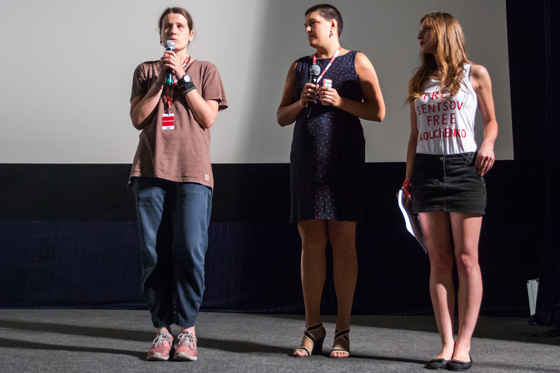 © Одесский международный кинофестиваль «Гамер» Олега Сенцова. Показ в поддержку
July 19
Самое время подвести какие-то итоги: я посмотрел почти 60 украинских короткометражек в Видеоруме плюс 13 — в конкурсе. Выделяется только одна — «Фабрика изящных убийств» Александра Морева (из Видеорума). Это очень странный 41-минутный фильм-нуар, снятый на пленку в стилистике постперестроечного кино, а также оммаж «Бегущему человеку» со Шварценеггером. Здесь также есть некое реалити-шоу, есть герой-участник, который должен выжить, в то время как за ним охотится некий головорез. При этом все снято в Одессе, то и дело узнаются местные улочки и подворотни. Режиссер также цитирует «Гражданина Кейна» (или мне показалось?) и снимает стилизацию, где хватает места авангарду, безумию 90-х и той наивности кино, которую мы потеряли. Из смешного — топорные титры, сделанные в самом примитивном редакторе, и неожиданная концовка, ставящая в тупик. За финальным титром неожиданно появляются титры из какого-то совершенно иного фильма, где режиссером уже значится Юлий Луговой. What does all this mean? У меня есть несколько вариантов: 1) это перемонтаж старого фильма; 2) монтаж из отснятого материала, который ранее не был смонтирован; 3) умышленная шутка.
Позже у организаторов выясняю, «что фильм “Фабрика изящных убийств” создан в жанре фантасмагория-фарс-нуар по мотивам фантастического рассказа Роберта Шекли “Премия за риск” (1958) и стилизован под старое черно-белое кино. В главной роли — заслуженный артист Украины Лев Перфилов, это одна из последних и неизвестных ролей знаменитого мастера. Реставрация и новый монтаж фильма произведены в 2013 г.».
Самое грустное, что об этом фильме больше нет никакой информации. Но я мечтаю посмотреть его еще раз и пишу режиссеру…
После прошлой «Молодости» была вера в то, что в украинском кино намечается подъем. После Одесского кинофестиваля кажется, что мы поспешили с этим утверждением. После «Молодости» мы много говорили о некоторых фильмах и короткометражках, сейчас же — только слова разочарования.
Большинству наших молодых режиссеров элементарно нечего сказать, а те, кому вроде бы и есть что, попросту не умеют говорить. И здесь речь даже не о насмотренности или какой-либо «школе». Это скорее похоже на историю о туземцах, живущих на необитаемом острове. В мире уже что-то происходит, где-то создаются великие произведения искусства и пишутся большие трактаты о них, все уже давно летают в космос и знают все обо всем, а в это время в украинском кино первые энтузиасты только открывают для себя алфавит и пытаются изобрести первый в мире велосипед.
Вечер провожу на крыше гостиницы. Вместо вечеринки выбираю личные разговоры в номере.
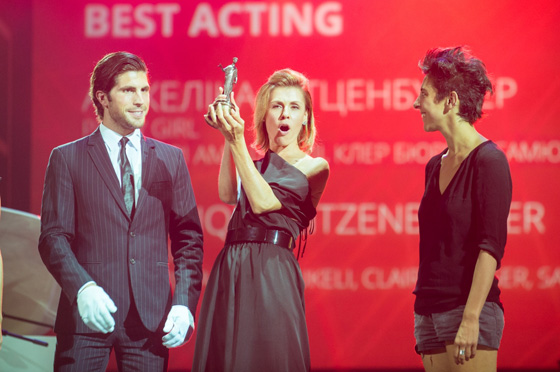 © Одесский международный кинофестиваль Призеры пятого Одесского кинофестиваля
July 20
В автобусе по дороге в Киев составляем топы впечатлений: лучшие фильмы, главные события, разочарования и т.д. Кажется, в этот раз с нами уже не так много детей. Или я просто не обращаю внимания? Пытаюсь вспомнить, все ли из запланированного успел сделать в Одессе. Понимаю, что мало общался с друзьями. Думаю о фразе Жака Розье об одном из самых летних и свободных фильмов «новой волны», о «Прощай, Филиппина»; в нем молодые люди радовались жизни на берегу моря, в то время как тысячи солдат отправляли на войну в Алжир. «Я хотел выразить самым неискренним способом самые неподлинные чувства», — говорил о своей картине Розье. Возможно, его фраза могла бы стать эпиграфом к этому дневнику.