
Translated material
Very terrible movie
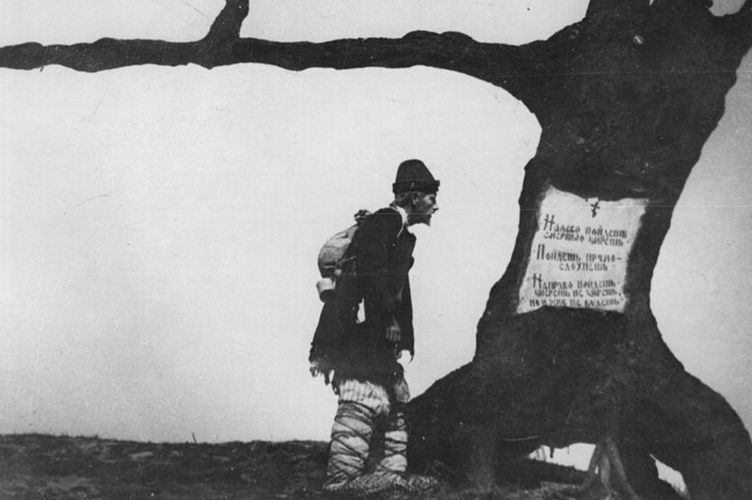
Tomorrow, July 29, is the third part of the Soviet Cinema - Living Music program, which is in the Moscow Museon Moscow Art Park. On the screen - “Happiness” by Alexander Medvedkin to the electronic accompaniment of Alexander Zaitsev (“Christmas toys”) and XI Zhuang. Maxim Semenov about why happiness in this film is so frightening.
A year before the tramp of Chaplin from the film “New Times” tried to find his place in the changed world, another character of the dumb comedy - the peasant Khmyr from “Happiness” by Alexander Medvedkin was engaged in the same search. Like a vagabond, the flap on the way, fortunately, numerous difficulties were in wait, but if the hero of Chaplin in the finale was waiting for only a hint of a successful outcome, then Khmyr, like all the heroes of the entertaining Soviet cinema, was doomed to a full -fledged, weighty happy end -as he saw in the 30s.
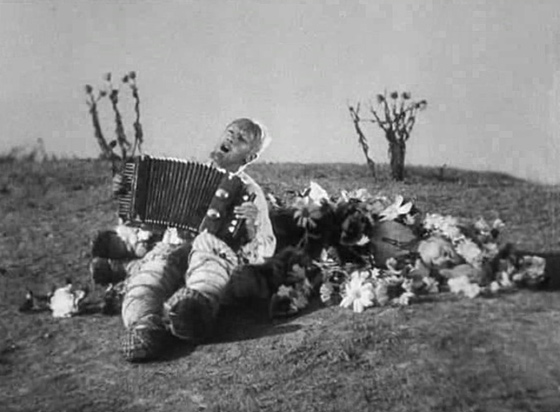
The idea of the similarity between “happiness” and “new times” suggests itself. Both films are almost the last dumb paintings, both films are comedies, their heroes are little people who seek to find happiness in an openly hostile world, both heroes dream of a better share (scene of their fantasies are incredibly similar and come down to a hearty food in an exaggerated interior).
But the larger between these films of similarities, the more visible fundamental differences. Chaplin makes a film for the urban population, trying to understand: can a person survive in the chaos of social disasters and new technologies that fell on him. Medvedkin makes a movie for residents of a large agrarian country, and his goal is to deal with the past and his last relics, which Medvedkin does. Brilliant and a little cruel. The emerging changes are an obvious good for him, this cannot even be discussed.
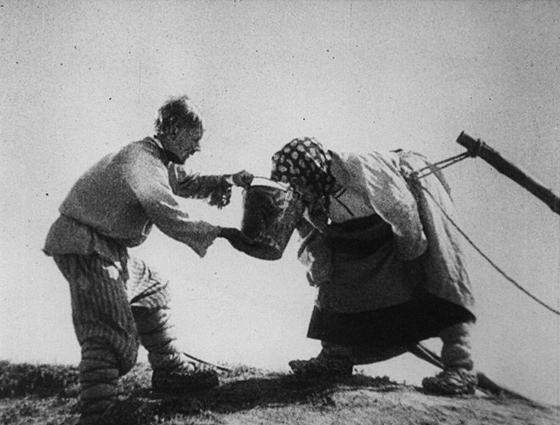
Yes, the film "Happiness" is considered avant -garde, but its origins should not be sought in the tradition of Eisenstein or Pudovkin. The avant -garde of Medvedkin is much closer to Mayakovsky’s campaign plays with their emphasized conventionality and fantastic assumptions. This avant -garde does not require the viewer of complex work of thought, on the contrary, it is close and understandable to the most wide audience. It is not for nothing that Medvedkin for a long time traveled across Russia as the commandant of the film train, removing propaganda short -terms in the field.
Preferring the life of the peasants, Medvedkin does not construct it from mounting speakers, like Jiga Vertov, and does not turn popular life into a beautiful mystical ritual, like Dovzhenko. On the contrary, like all propagandists, he makes a film not about, but for his heroes. The need to be understandable and public leads to a unique style - the style of the folk puppet theater.
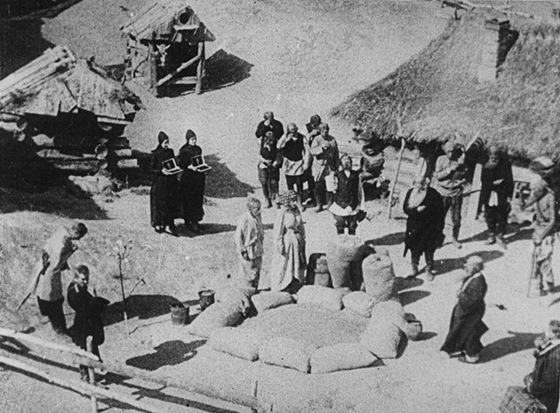
In all the gripping and jumping of the heroes of “Happiness”, one should see not only the continuation of the eccentric comedies of the 20s, which were strongly influenced by Chaplin and Keaton, but also the knee that made the heroes of the theater of parsley. Like the puppet theater, "Happiness" is incredibly decorative. Like the puppet theater, under the thin layer of comical “Happiness” hides the story of very terrible things. “Happiness” is a film about death and constant violence against a person, which begins with the death of the father of the protagonist, and ends with the fact that Khmyr and his wife make fun of the poor.
Stylistically "happiness" breaks up into two parts. The first occurs before the revolution and is painted in fabulous, emphasized radiant tones. The second is dedicated to the world of the Soviet village, fairy -tale elements in it are gradually giving way to signs of Soviet reality in order to completely disappear to the finale.
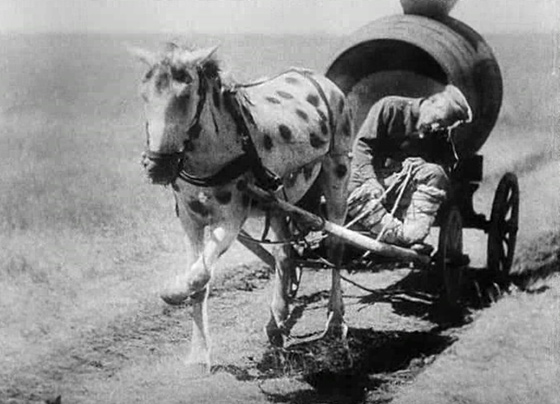
Fists, priests, generals and police officers interfere with the search for happiness. Happiness in their world is impossible, and if possible, then not for the flash. Only the parish in the village of Soviet power is able to give the hero prosperity and respect. But what is strange: the pre -revolutionary part comes to Medvedkin much more humane. Pop, nun, generals and police, ministers and fist - all of them are endowed with bright individual features. In each of them - despite the fact that they obviously exploit the flap - there is something related to him. All of them belong to one world. And this world is in the opposite of the collective farm paradise.
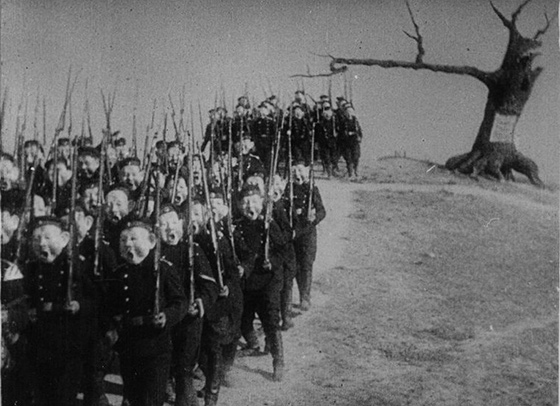
In pre -revolutionary scenes there is one important episode: rebellious against the world around, Khmyr decides to die. To prevent this, the government introduces troops into its village. These are very terrible troops. All soldiers have the same puppet masks with open mouths. Medvedkin is unfamiliar with the horror that Chaplin experiences before impersonal mechanisms that lower the person to the level of the still necessary appendage, but he knows about horror before the loss of his face. His soldiers are the strongest image of a brutal state machine, they are stupid, deprived of individuality and are capable of only the implementation of the simplest orders. However, while watching the film, you involuntarily catch yourself on how exactly the faceless royal soldiers rhyme with the faceless collective farmers.
A new hero appears in the second part - the chairman of the collective farm. It is not needed for the plot, it is rather a symbol, designed to indicate the presence of the new government. In comparison with other characters, almost nothing can be said about him. He is not the father of the peoples, but the one who comes after him is one of many people without properties that nothing really is known, except for the very fact of their existence. It is also difficult to say something definite about the chairman's wards. They are “people”, the conditional mass of some people who are engaged in “agriculture”. What kind of agriculture is also unclear. It seems to be hidden bread, but in the end they receive watermelons. They also expressively go with a poultry in their hands, they usually loved to portray on the bas -reliefs of Stalin's time.
Khmyr, who became a collective farm water over the new power, is more like a dead man. Among the smiling faces of the 30s, he seems an anachronism-the pale ghost of the past, grinded the First World War and civil wars. No happiness, which he has been looking for so long, no. But the films of the 30s cannot end poorly. And then the khmyr suddenly exposes the intrigues of a fist that has penetrated into the team, who out of love for villainy wants to destroy the best collective farm horses.
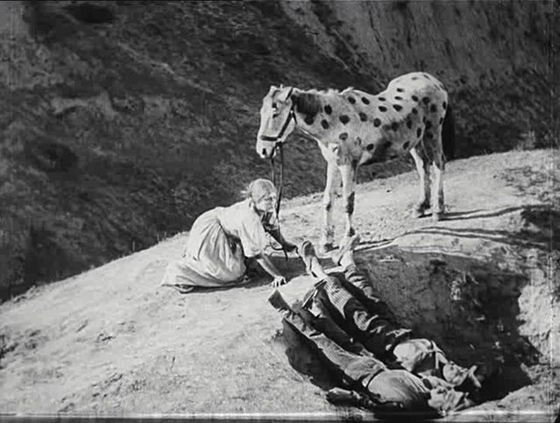
The horses are saved, the fist is neutralized, and the beautiful wife Anna Khmyrev seeks to return to the hero. Now he can become part of Soviet society, for which his wife leads him to a huge store filled with huge and faceless smiling mannequins to buy new clothes. There is no more flap, in his place an ordinary Soviet citizen appears from those who look at us a little scared with old photographs. His old clothes are thrown into a ravine, and there it is divided by former exploiters, now erasing the beggarly existence, and the spouses of Khmyrev are amazing over them. It seems that this is happiness.
No, do not laugh at the poor - to be like everyone else, dissolve in a crowd of other people. But why does the Medvedkin film slow down so much when the Kingdom of Kulaki, eating flying dumplings, is replaced by the world of rosy Soviet people? Why is the happiness of the heroes so doubtful?
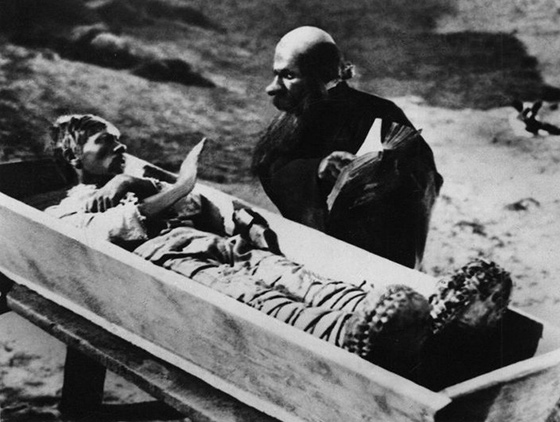
Exposing the types of old Russia, mocking their stupidity, hypocrisy and what it is now customary to call spiritual scrapers, Medvedkin involuntarily admires all this. Yes, the pre -revolutionary society seems to him a bunch of lousers, but all these lousers are so different from each other, to study them so interesting. But new people cannot be unlike, since they are a team, they are a mass, class. So the rhyme, which he least wanted: soldiers - collective farmers - mannequins in the store, come out with Medvedkin.
Medvedkin himself, although he believed in the revolution, could not become part of the system she generated - and could not, reveal his heroes Kulak conspiracies at least every minute of screen time. An individuality was too strong in him, dissimilarity to the rest. “Happiness” has become perhaps the only picture of his, released on the screens in those years. With all the chairers, collective farmers and fists, it did not turn into a simple agitation, and its viewing can still bring the viewer that the main characters never find.