
Translated material
Hipping Orpheus
Orpheus Monteverdi is the only premiere of the Munich Opera Festival now, which is the rest of the new productions already shown in the season. She confirmed the repertoire priorities laid down by the quartermaster of Peter Jonas. It was Jonas for the 14 years of the leadership of the Bavarian opera who chose the Munich audience, habitually adored Richard Strauss and Wagner, to the operas of Handel and Monteverdi. It was not easy and not at once. However, consistently, after year, introducing Handel's opera into the repertoire (and the Bavarian opera is a repertoire theater), Jonas achieved his own. Munich learned to find pleasure in the pathos roulads of baroque arias, got used to the length of the Gendelev operas and, in general, became much more refined and susceptible to the whimsical palette of baroque affects.
Jonas gathered an excellent team of baroque: the directors competed who more spectacularly and ironically “sharply” the magical and mythological plots, and in the orchestra pit, Ivor Bolton, responsible for the spring Baroque drive.
 © Bavarian State Opera
Under Jonas, the most wonderful princess - an ideal container for baroque operas, was restored and transferred to the Bavarian opera. The building - a very successful example of Yugendstil - was built in 1900-1901, and the Bayroit FestSpilhaus became the architectural model for him. Inside is a pretentious decor, excessively luxurious painting of the ceiling and walls with paradise birds and paradise linems. Alchiy fits perfectly into this space 10 years ago in the production of Christophe Loy with the participation of Veselina Kazarova and Ani Harteros. Here, in the princess, in 2005-2006 there was a Monteverdi trilogy in the production of David Olden: “Orpheus” / “Return of Ulysses” / “Coronation of Poppei”. The 2006 festival became a real Baroque triumph. Six operas of Handel plus also the scened Saul oratorio, and Callisto Cavawli, and all three operas of Monteverdi.
Everything changed with the advent of the quartermaster of Nikolaus Bahler; The “man from Vienna” had other priorities and another vision of the development of the theater. In general, he was quite skeptical at first to the prevailing opera tastes of the Munich, believing enough to throw them from time to time the handout - Wagner and Strauss. And especially advanced offered experimental products that were walking in a special pavilion behind the main building (it was there that Christoph Shlingenzif staged his last performance), and on the main stage - modern operas of the Babylon of Babylon Jorg Vidmann.
 © Bavarian State Opera
However, this summer, after an almost eight -year break, the “Orpheus” Monteverdi reappeared at the scene of the Principal Gentianger again. The director is David Besh, the director of the new call, who has already very successfully made “love drink” and “Idomena” in the Bavarian opera. It seems that baroque discourse is returning to Munich; And then to say, in our time without baroque operas, the repertoire of the self -respecting opera theater cannot be considered completely staffed.
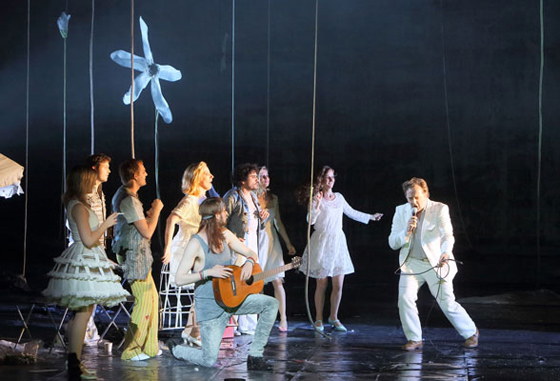
The title party in Orpheus was performed by Christian Gerheier, a German baritone, who recently received a gold nightnage statuette in Salzburg - a special prize of German critics for recording Schubertovo songs. Gerheier Nimalo was not concerned about the authenticity of execution: he is not at all special in baroque vocals. However, his interpretation was filled with such a surface, sincere and deep experience that two hours without a smaller that the performance was following him only after him. In fact, it was the benefit of the singer; Neither experienced Anna Bonitatibus (Proserpina/Herald), nor the young Anna Virlanian (Eurydice) could compete with Gerchaeer.
 © Bavarian State Opera
Gerhayer, however, turned out to be so atypical Orpheus that this circumstance deserves a special consideration. Middle -aged, melancholy, miniature; He is 45 years old. The singer began his career relatively late; Before that was a practicing doctor. I am still not sure of the correctness of the selected path. There is not a drop of stardom in it. But the abyss of mind, delicacy, refined feeling; And also - a subtle understanding of the style and meaning of the music performed.
Many compare it with the legendary German baritone Dietrich Fisher-Discu, from whom he studied. But Gerhayer is not at all like that. It does not have an impressive confidence of Dskau. His charm is in a painful intelligent reflection. It is reflection that relates him with the heroes of the Schubert and Schumanov songs; The self -identification is almost complete. This is done by Gerhayer, perhaps the best performer of the German Lieder today.
The exact, professional, lively accompaniment of the Monteverdi-Ansemble and the virtuoso sound of the choir of the Zurich vocal academy made up a very advantageous sound background; It is noteworthy that the main forces of the theater in the production were not involved.
 © Bavarian State Opera
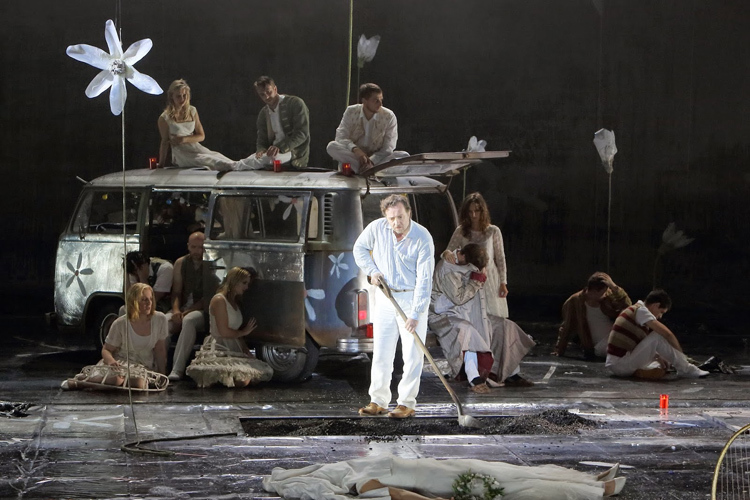
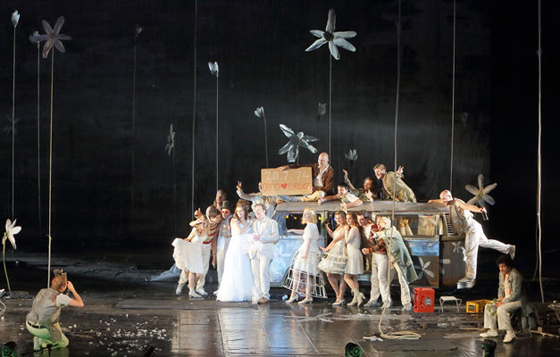
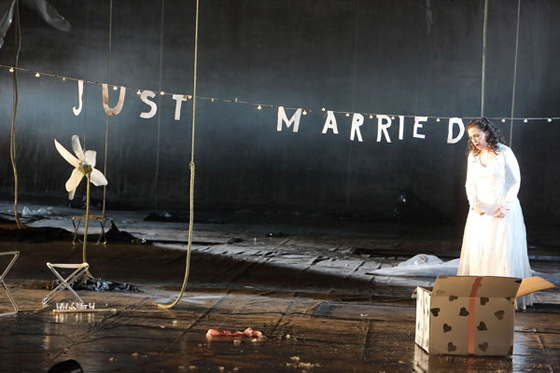
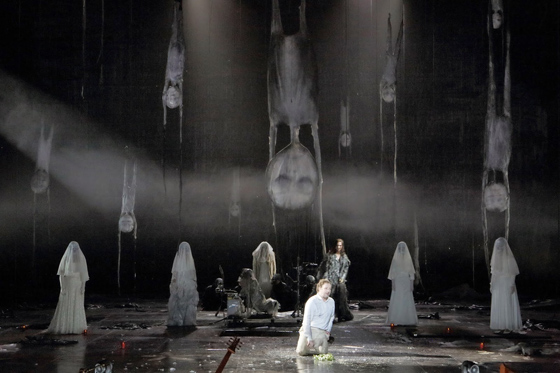
The stage decision turned out to be typical of Besh: he, together with the artist Patrick Banshart, created an homeless space decorated with untidy leaks inside a classic black box, decorated with all the winds of eternity. The touching flowers crawling out from under the wrinkled plastic bags stretch to the sky with long stems, but there is no sky-only blackness. Life is a temporary misunderstanding, random mold on the body of the Earth. And even a cheerful hippy crowd of guests, who arrived at the youth wedding for through the rusted UAZ, cannot dispel ontological darkness.
The time of action is marked with enviable accuracy: “07/23/1974” - scratched with small in ritual wedding photography, which is kept by the friends of the newlyweds. Not quite the time of hippies; "Children of flowers" bloomed in the mid-60s. The mid-70s is already flowering, growing time, new challenges loom ahead.
 © Bavarian State Opera
The marginal gop company does not bother with special preparations for the wedding: a pair of beer boxes, a pair of flags and balls, a tent zontik-and is ready. The bride puts the veil, simultaneously uncorked a bottle of champagne; The groom hastily pulls the chicken jacket, but refuses the tie - a symbol of lack of freedom. An attempt to quickly sex in UAZ ends with failure - the guests fall on the ill -fated car, and the newlyweds have to get out.
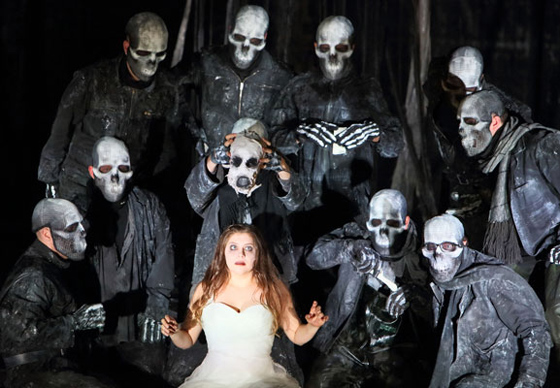
The news of the death of Eurydice comes. A hole is opened, covered with a terrible black substance: either the earth or the ash. Orpheus digs a grave for her lover, exhausting from grief, and soon he fit into her. An attempt to rescue the Eurydice from the paws of Pluto is unsuccessful. Orpheus is again on earth, but no longer sings, he broke his lyre. He turned into an alcoholic bum: neither the future, nor friends, nor hope. Frozen petals fly around from a single flower.
Suddenly, at the last moment before his death, Orpheus seems to be supported and again sees a cheerful holiday, friends, a living eurdian. And it is at this moment that you cease to hope: death cannot be defeated, not to return back, the myth of Eurydice will never be crowned with a happy ending.