
Translated material
Airlines: recalling precedents
Following the results of a large plane crash, the media often begin to publish collections with a description of similar cases over the past 10-50 years. Here, however, the context is of great importance - more precisely, how much the event seems to be plot -forming. So, according to the Bureau of Archives of the Airlines ( B3A ), a non-governmental organization with headquarters in Geneva, about 245 airlines have been taking place in the world over the past 50 years every year. It is clear that the press pays attention to these events insofar as they seem significant for a particular publication.
In 2014, three plane crashes took place, which developed a kind of plot, and therefore the number of such publications in this genre is very large. The first event took place in March 2014, when the Malaysian airline plane, heading from Kuala Lumpur to Beijing, disappeared . Four months later, on July 17, 2014, another plane of the same airline, heading from Amsterdam to Kuala Lumpueper, crashed over Ukraine. Here, on the one hand, a significant event, from the point of view of international contradictions in connection with the situation in Ukraine; And on the other hand, Malaysian airlines again. Then, a few days later, the Algerian plane crashed in Niger. In other words, there is an occasion to create the appropriate factual materials, and the materials were not slow to appear.
I must say that, taking into account the large number of plane crash, regarding the regularity of such publications, the principles of compilation of collections usually vary depending on the specifics of the case. For example, if the causes of the crash are unknown or the plane is missing, precedents recall. One way or another, usually in these lists there are cases that, according to the already mentioned organization, in the TOP-10 plane crashes by the number of dead:
Date | Company | Place | The number of dead |
12/128/1985 | Japan Airlines (jal) | Tokyo | 520 |
03/03/1974 | Turkish Airlines | Paris | 346 |
03/27/1977 | Pan American World Airways (Pan Am) | Canary Islands | 335 |
06/23/1985 | Air India | Atlantic Ocean | 329 |
12/11/1996 | Saudi Arabian Airlines | New Delhi | 312 |
19/08/1980 | Saudi Arabian Airlines | Er-Riyad | 301 |
07/17/2014 | Malaysia Airlines | Shakhtersk, Donetsk region | 298 |
03/07/1988 | Iran Air | Persian Gulf | 290 |
19/02/2003 | Iran Airforce | Kerman, Kermanshah | 275 |
05/25/1979 | American Airlines | Chicago, Illinois | 273 |
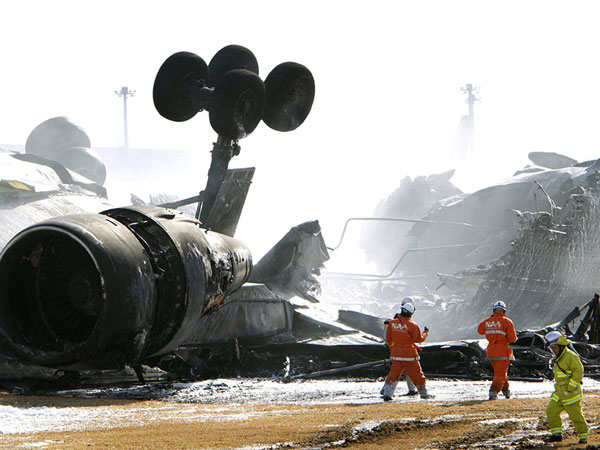
To date, the largest plane crash has become the fall of Boeing 747 of Japanese airlines, which flew out of Tokyo, heading for Osaka. This happened in August 1985. 12 minutes after take -off, problems began with the control of the aircraft. The pilot tried to plant him, but 30 minutes after taking off the plane crashed into a mountain ridge. As a result of the disaster, 520 people died. Four passengers survived. According to one of the survivors, after the crash, many of the passengers were still alive. However, rescuers appeared at the site of the disaster only 14 hours later, and most of the initially survivors simply did not receive timely help. According to one version, the reason for the crash was the negligence of this aircraft in 1979.
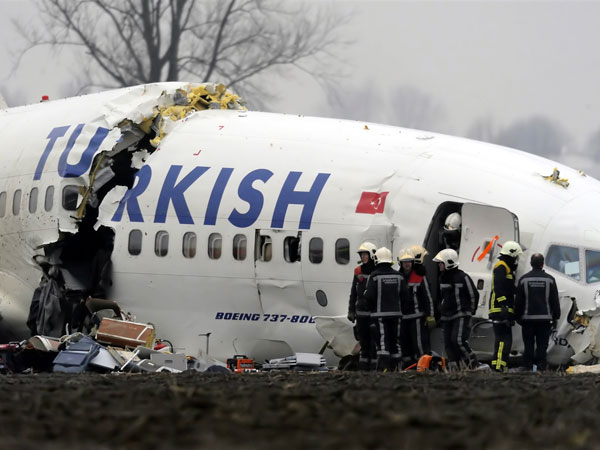
The crash of the DC-10 aircraft near Paris in March 1974 (flight 981) is currently considered the largest plane crash in which none of those who were on board survived (in total, counting the crew, 346 people). This flight from Paris to London was made by Turkish Airlines. The collapse was caused by the depressurization of the luggage compartment a few minutes after taking off, as a result of which the aircraft became uncontrollable and fell in the Ermenonville forest. In addition to the scale, a lot of noise around this disaster was caused by the fact that two years earlier the same malfunction was recorded by the plane of the same model owned by American Airlines. Then, according to the results of the investigation, the manufacturer was recommended to fix the door fixing mechanism in the cargo compartment (the problem was that even with incomplete fixation, which was impossible to judge by external signs, there was a signal of readiness for take -off). In that case, despite the malfunction, no one died. However, the crash that occurred in 1974 showed that the problem was never eliminated.
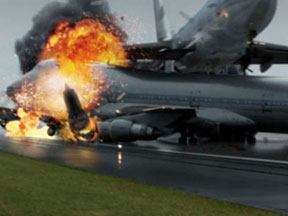
The catastrophe of the Pan Amican aircraft, which occurred in March 1977 and led to the death of 583 people, became the result of a collision of two Boeing 747 aircraft in the runway. The second plane belonging to KLM, 246 people on board, from whom no one survived. There were 396 people on board the Pan American aircraft, of which 61 survived. According to the official version, the collision occurred as a result of the coincidence of several factors. First of all, a few hours before the disaster in one of the waiting rooms of the Las Palmas airport, a terrorist attack occurred (it was arranged by participants in the movement for the independence of the Canary Islands), as a result of which no one died, but the airport administration, just in case, closed the terminal. Reception and departure of large flights were transferred to the Los-Zhodos airport. The second factor was a strong fog, due to which visibility was significantly broken. Finally, the third factor was the incorrect interpretation of the dispatch messages of the KLM crew, which went to take off. As a result, the landed “Boeing” Pan American and the KLM take -off of the KLM aircraft moved to meet each other in the runway, not seeing each other until the distance between them reached about 700 meters. Captain Pan American tried to take the plane from the runway to the grass, but only managed to turn around, after which a collision occurred.
Flight 182 AIE India, heading along the Montreal -London - London route, crashed over the Atlantic Ocean in June 1985 as a result of the attack (bomb explosion on board). All 329 people, passengers and crew were killed. It was the largest terrorist attack in the history of Canada and the first attack on the Boeing aircraft. The attack was organized by representatives of the Sikh movement, which led the struggle for the independence of the unrecognized Sikh state of Khalistan in India.
The collapse of the Boing-747 belonging to the company Saudi Arabian Airlines occurred in the New Delhi area in November 1996 as a result of a collision in the air with the IL-76 aircraft owned by the Kazakhstan Airlines. On board the Boeing there were 312 people, and 27 people on board silt. All died, although rescuers found four still living passengers IL-76, who soon died, without receiving timely help. According to the official version, the reason for the clash was the incompetence of the radio operator of the Kazakhstani aircraft (in particular, the inaccurate understanding of the dispatcher perpreclations in English), as well as the specifics of the IL-76 structure, which provides for a separate place for the radio operator, which is negotiating the ground, but does not have its own devices for determining the height. In fact, having received a warning about the Saudi aircraft flying below, the Kazakh plane continued to reduce, as a result of which the planes collided.
Among other things, B3A offers airline rating in the number of dead passengers. The top 30 of this rating is headed by the Russian company Aeroflot:
Typically, the rating is indicated only by the actual absolute number of deaths, but does not take into account the number of flights made by the airline. For comparison: the leader of the Aeroflot list was founded in 1923 and regularly performs flights to 129 points in the world. Occupying 25th place in the ranking of Malaysian airlines, which Wall Street Journal is now predicting a gloomy future, were founded in 1946, and transportation began in 1972.