
Translated material
Hope in a hopeless position
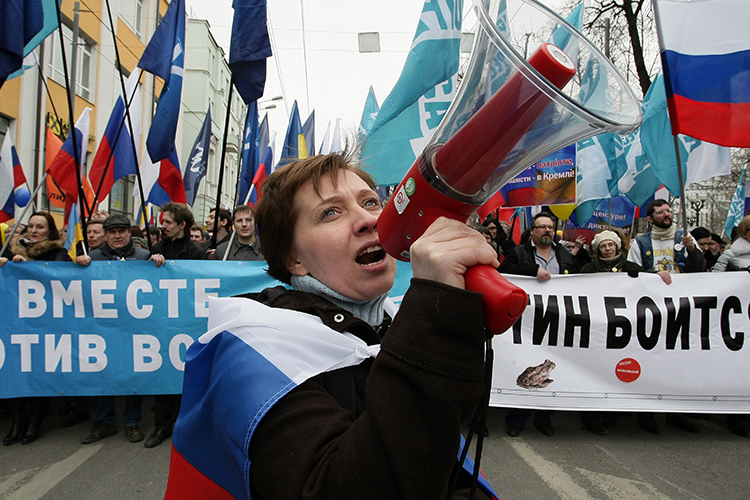
Why is there no anti -war movement in Russia? Why are there so few those who are ready to take to the streets to publicly throw a prosecution in person in the continuation of the war in the east of Ukraine? These questions continue to ask each other those who several months ago supported the “march of the world” on March 15 in the center of Moscow. The circle of these people is constantly narrowing, but the main thing-even those who still maintain the spirit of protest, no longer have confidence that the protest can at least change anything.
If the new military (or pre -war) state, in which Russian society is more immersed deeper, and there is a consensus point that unites social and cultural strata, then it consists precisely in this enveloping and terrible awareness of its complete powerlessness before the elements of the interstate conflict. The without that the fragile coordinate system of each individual citizen is suppressed by the stream of news. The psyche does not withstand tension and surrender to the unknowable, opaque logic of events, which, it seems to us, is less and less able to obey anyone's concrete will. “It is not consciousness that controls the war, but the war controls consciousness” - as Lev Trotsky wrote about that war, the centenary of the beginning of which is somewhat fearfully celebrated today.
In the front edge of the clash with the destructive elements of the war, the unfortunate residents of Lugansk and Donetsk are in these minutes. Their evidence on social networks is an exchange of stingy information about the dead, photographs of destruction after artillery shelling, requests and suggestions of elementary mutual assistance - these are the votes of the victims, the voices of those who have already lost. Here they do not divide each other into supporters of “New Russia” and “United Ukraine”, they do not expect the victory of “their own” - but only the world: it does not matter where, on any conditions, from any power. Together with houses, infrastructure, schools and hospitals in the east of Ukraine, society was practically destroyed to the ground. And this means that the winner who can bring stability even on smoking ruins receives such a degree of humility and obedience, which no state could dream of in peacetime.
The consensus uniting strata is a terrible awareness of his powerlessness before the elements of interstate conflict.
The waves from this barbaric destruction cover the population on both sides of the border. Already a common place was the assertion that from March this year, domestic politics had disappeared in Russia. Moreover: using the definition of the philosopher Jacques Ranciere, it can be argued that politics quickly disappeared as “the form of human action based on disagreement” - and, on the contrary, state policy as “the art of managing communities” reached perfection. Everything that deviates at least by a millimeter to the right or left of the President’s line instantly deviates, losing at least any independent meaning. Those who are trying to applaud the state louder than the others are just as politically invisible and helpless as those who contrast themselves. Patriots supporting their state instantly turn into his obedient instrument. The liberals who criticize their state freely or involuntarily begin to act as a stranger lawyers.
The logic of war inevitably leads to the identity of the government and the people, their complete merger with each other, the merciless destruction of any hints of “disagreement”. This identity is founded, contrary to widespread opinion, not only on chauvinism, which quickly saturated collective consciousness. The military “unity of the nation”, which we are approaching today, draws its strength in fear of instability, in anticipation of protection from above, in the experience that subjects and rulers, ultimately, are “in the same boat”. It is difficult to imagine what incredible freedom of hands in relation to citizens the state receives in a similar situation. This victory of the ruling elite over its own society - at least in the near future - outweighs the losses from the sanctions and the shame of international isolation.
Today it is impossible to predict how long this state will turn out to be - in any case, the preceding successful stories of “military unity” were often able to keep the majority in absolute subordination for years.
The logic of war inevitably leads to the identity of the government and the people, their complete merger with each other.
So why do we need anti -war movement today? It is necessary to honestly say - almost never civilian anti -war movements, arbitrarily massive, could not prevent or stop the war. Since the beginning of the First World War, it took more than three years of tremendous victims and destruction, while supporters of the “world without annexations and indemnities” from a marginal minority in their countries could not turn into force that could change the course of events. For almost a decade, a textbook movement against American intervention in Vietnam has tried to influence the social opinion of the West before forceing the new president in the face of serious military losses to begin the withdrawal of troops. Finally, the most massive anti -war demonstration (more than a million participants) against the invasion of Iraq in February 2003 was simply ignored by the Tony Blair government.
But the anti -war movement even when it is obviously against the current, it has one incredibly important function - telling the truth. State propaganda, which demonstrated its enormous capabilities in recent months, lies not just for the sake of lies - in a state of “military unity”, the lie becomes a direct continuation of hostilities and acts as a key remedy for strengthening the “internal front”. And the trust in this lie and complicity in its distribution turn into civil virtue, into a responsible understanding of the "state interest", whose agent begins to feel every citizen. In recent months, many of us have discovered that it is possible to get to the truth only by comparing a military lies coming on both sides of the conflict. This method is largely non-alternative today, however, a huge danger is fraught with-at some point one of the sides begins to seem more convincing.
The lie acts as a key tool for strengthening the “internal front”.
Anti -war movement - if it really seeks to return disagreement to society - should always adhere to the “third position”. The victims, losing and intimidated, all whom the "military unity" deprives their own voice must find this voice in anti -war movement. Such a movement should not fundamentally determine the greater or lower measure of responsibility of each side, it should not “enter into a position” of those who will never enter our own position. That is why in today's situation, the anti -war movement in Russia, opposing its government, can be completely honest and effective if it goes along with the same movement in Ukraine. Both in Moscow and in Kyiv, we must again and again cast doubt on the state’s right to the monopoly representation of the “nation”.
This “third position” - barely audible, almost invisible - can easily be lost in the humanistic pathos of free or involuntary carriers of the lies of “state interest”. If, in one case, from an arbitrarily analysis of the situation in the Donbass, the factor of the direct intervention of Russia completely disappears and is described exclusively as a “civil war”, in which the Kiev government of the oligarchs fights against its people, and in the second, on the contrary, it all boils down to the hidden intervention of Russia, and any elements of the internal conflict are consistently ignored, only the next variety of “military tricks. "
To tell the truth means not only to expose propaganda, but also to indicate the causes of military conflict: the struggle for military budgets, redistribution of markets and property, the desire to establish complete control over the lower ones in the interests of the elites. Exactly a hundred years ago, such a message, which seemed radical, utopian and naive, was able to ultimately change the world. And this fact, it seems, is able to inspire hope in our hopeless position.