
Translated material
For a trading war with Ukraine, Russians will pay a jump in prices
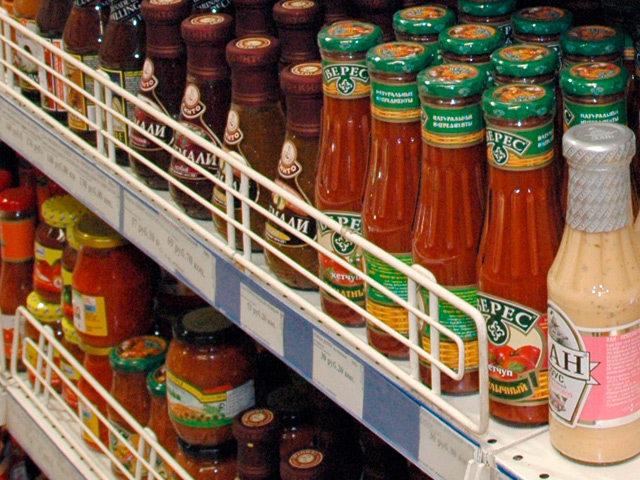
Since July 29, the import of Ukrainian fruit and vegetables and canned fish into Russia has ceased. Rospotrebnadzor motivated the ban on regular phytosanitary violations.
A day earlier, Russia limited the import of milk and dairy products from Ukraine. Then restrictions on the import of Ukrainian plant products in hand luggage, baggage and premises began to operate.
Already prohibiting the supply of pigs and food potatoes from Ukraine to Russia. Last week, RIA Novosti was informed in Rosselkhoznadzor that they could completely suspend the import of food from Ukraine during the negotiations on its European integration.
In addition, almost all of the agricultural production of Moldova came to the Russian Federation for certain restrictions: these are fruits, fruit and vegetables, meat and meat products, beetroot sugar.
Also, it seems that it was practically decided to introduce a ban on Belgian fruits, Polish apples and American poultry. Each ban in Rosselkhoznadzor and Rospotrebnadzor is explained by concern for domestic agricultural producers, as well as the health and rights of consumers.
The more Moscow introduces prohibitions on the import of food products, the more inevitable a jump in prices will be, the “independent newspaper” claims.
A trading war can lead to the fact that, in some commodity positions, prices will grow sharply, perhaps even twice. And the increase in general can reach 1-2 percentage points to inflation.
Belgian fruit manufacturers are afraid to become the next victim of sanctions discussed in the European Union against Russia. According to the Flemish edition of HET BELANG VAN LIMBURG, Belgian farmers believe that if the European Union applies strict economic sanctions to Russia, Moscow will respond with a sharp restriction of the supply of Belgian fruits to the Russian Federation.
Rosselkhoznadzor already answered this. "The fears of Belgium and other large suppliers of fruit from the European Union to Russia are not base, since such a dangerous pest as the Eastern Frostozhorka is distributed in these countries, " Sergei Dankvert told Interfax . It is precisely because of this pest that apples from Poland, which account for almost half the import of apples in Russia, may be prohibited.
Finally, in the Russian Federation they can also prohibit poultry from the United States. According to Dankvert, in recent years, dangerous substances and microorganisms are regularly found in the products of American poultry farmers.
It will be necessary to replace the reduction in supplies either by products from those countries that have not been prohibited, or domestic goods. Both will not work out instantly. So, it is possible that until an alternative is provided, Russians can face both a shortage of certain types of products and a sharp jump in food prices, the publication writes.
“When products from the market are leaving, the offer is reduced accordingly. Moreover, a proposal for prices that is quite comfortable for the consumer. Of course, this is an additional incentive for inflation, which already significantly exceeds the target levels of 2014,” says Igor Nikolaev, director of the Institute for Strategic Analysis of the FBC.
According to him, it is still difficult to unequivocally assess exactly what the increase in prices will be, because the final scale of restrictions will not be clear, but it can be assumed that prohibitions can add another 1-2 percentage points to inflation.