
Translated material
Police blocked the Chelyabinsk drug addicts access to "designer" drugs distributed through caches
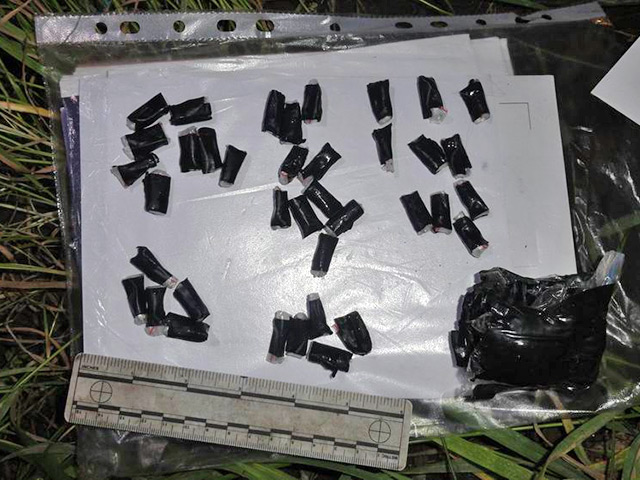
In the Chelyabinsk region, drug police simultaneously detained two large groups that distributed "designer" drugs in five municipalities. In the final part of the operation, about 40 drug control officers were involved, including special forces, dog handlers and experts.
According to Lentachel , drugs spread in a contactless way. Money was transferred through electronic payments, and the finished goods were left in the "bookmarks"-Tales. Drug dealers were looking for the clientele using SMS newsletters, messages in social networks and wall-mounted "painting".
At first, about a dozen buyers in Yuzhnouralsk, Troitsk, Kyshtim, Chelyabinsk and Kopeisk were detained. Then the law enforcement agencies managed to first reach the couriers that lay out drugs in caches, then on dispatchers and, finally, on the organizers of the criminal business.
Both groups worked with a large scale. During the day, about 100 "bookmarks" were left in secluded places. The Federal Penitentiary Service believes that in the end it was possible to "cover" the entire asset. During searches in places of residence and caches, 70 "bookmarks" were found in one case, in the other - 20. The detainees threatens from 10 to 20 years in prison.
In total, more than 18 kg of “designer” drugs have been seized in the Chelyabinsk region from the beginning of the year, this is about 70% of the total number seized by all law enforcement agencies in the region. As Ural24 clarifies, this is approximately 2 million conditional doses of a dangerous synthetic drug.
"Designer", recall, are called drugs developed from synthetic substitutes for natural psychoactive substances. In some cases, artificial analogues allow in some cases to circumvent the current legislation despite the fact that narcotic properties are preserved.
The first synthetic drugs appeared in the 20s of the XX century after the largest states, within the framework of the International Opium Convention, signed an agreement on a special monitoring of morphine turnover.
According to Drugsnamnedrug , the term itself appeared in the early 1980s and was used to refer to synthetic opiates that appeared as an alternative to heroine.
And today, smoking mixtures, the so -called "mix" and "spice" have gained particular popularity. When it turned out that they owe their narcotic properties not of plant substances, but a synthetic derivative, in many countries, including Russia, the mixtures were prohibited.
Representatives of the FSKN admit that the problem of the spread of "designer" drugs is acute in almost all regions of the Russian Federation. “The state does not have time to track the appearance of new types of substances. Several components are changing in the chemical formula, and the substance is already falling out of the list of drugs prohibited for circulation. But the narcotic effect remains the same and sometimes even intensifies,” said Valery Safyanov, who had recently headed the Arkhangelsk division of the department, in an interview with the Moscow Komsomol .
According to the Main Karelian drug police, Alexander Pshenitsyn, from 50 to 80 new types of "designer" drugs appear on the illegal market annually. They are developed in Ireland and, mainly in China, wrote the Moscow Komsomolets . These substances are stronger than hashish and marijuana at times, and addiction to them often begins the first time.
The Science and Technology in the Russian Federation claims that at the Ural Federal University, together with specialists of the forensic and forensic department of the Federal Penitentiary Service in the Sverdlovsk region, they developed a methodology that allows you to disassemble complex synthetic mixtures and classify complex compounds. For this, the method of nuclear magnetic resonance is used.
"Such mixtures create, of course, chemists, most likely, from India and China, but it cannot be said that they have some kind of know-how that are capable of focusing on. There is nothing unusual from the point of view of science. There is simply a modification of the main structural components by various chemical deputies. Our technique reveals all this," says one of the participants in the study, an employee of the department of organic synthesis of Urfu Olegf. Yeltsov. Scientists believe that their work will be in demand by the drug police, the Ministry of Internal Affairs and the customs service.
We add that the consequences of the use of "designer" drugs have not yet been fully studied. The effect of most of these drugs and sometimes even their formula remain unclear in commercial reasons, as well as due to the illegal status of these substances that make research difficult. It is known that every six months "thanks to" new psychostimulants at least 35 thousand people become drug addicts, mainly young people. They often have psychoses, severe intoxications and depression.