
Translated material
Schutshchiko as such

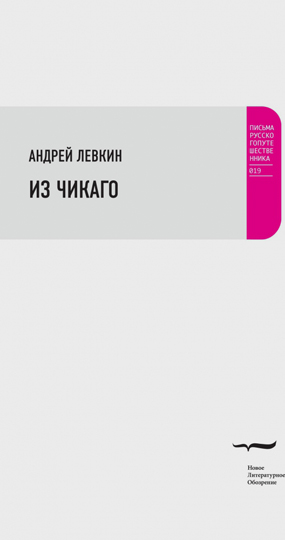
Andrey Levkin. " From Chicago ." - M.: New Literary Review, 2014. - 224 p. - (letters of the Russian traveler)
“Yes, cities,” admits Andrei Levkin, “a convenient thing, they can be consumed for anything.” He continues to demonstrate the variety of ways of using cities both to us and himself - and invent them. How many such methods can be, the author most likely does not know - and can this be known? Most likely, there are exactly as many of them as there can be questions posed by a person to himself. And even more - to leave a place for questions not yet posed.
"For any structure, whose inconsistent essence I would like to make an obvious, a city that is almost like it will always be found."
Cities are universal identifiers. Know how to handle them only.
In his “Chicago” book - just as he did in the book published a couple of years ago, in the same publishing house, the book “Vienna” - Levkin conducts experiments more with his own consciousness and perception than with the city. True, without a city - as a necessary incentive - the experiments of this kind could not take place.
The “Viennese” book fell, I remember, in the “artistic series”, “Chicago” is attributed to the “letters of the Russian traveler”, but these texts of such a properties that any assignment of them as a particular of the established headings will inevitably be associated with a fair amount of conventionality and coarsening. To the artistic-or rather, to the aesthetic-the texts of Levkin have only that (disappearing and indifferent) attitude, which in exceptional accuracy coincides with the indigenous meaning of the word Aisthesis: feeling, perception. He is about that. And, of course, traveling what he is doing can also be called with big reservations. The letters of this traveler in internal spaces are rather protocols of experiments. Levkin writes - also approximately as in Vienna - their detailed chronicle: not even a diary, but the momentary - a record of internal movements and events in the mode of their occurrence, the text on the other side of the draft and the cleanliness. “The author is the author, he will not,” Levkin promises us from the first pages, “to artistically transform, he is a registrar, not a dreamer.”
Artistically - maybe it will not be, but whether it will transform at all, change during the experiments - this is still a big question. And I think it will certainly be. Where is it visible so as not to get out of experience?
Before us is a lively, direct and single inner speech, designed to catch what is usually not caught by attention, is left in the unpretated area, is pushed into the periphery, to the background - so that the required figure appears on it. In this case, the figure turns out to be this: the very substance of the perception of the city as a phenomenon preceding all disciplinary classifications. This is not psychology, and not urbanism, and not geography (they have another terminology, other goals) ... But what? Yes, probably, aesthetics. You can't say otherwise.
And in this case, of course, we can say that Levkin expands (characteristic of our culture) the space of aesthetic - and the range of its means. He develops and describes a special way of thinking-and-sensing, in their inseparability, cities, spaces, environments. Not so much themselves as them - as continuations of their own organs of perception.
Exactly as in the case of a vein, with the help of the city, he solves problems that are not too typical for cultural practice of acquaintance with cities, leaving completely out of attention such typical objects as, for example, “common” tourist attractions, architectural beauties, monuments of large historical events, city legends and myths - he simply does not build any judgments or judges or judges or judges or judges or judges. The narratives as a whole is sometimes a brick or two from this reserve.). It occupies a “direct presentation, without projecting third -party ideas into local realities,” - and a “attraction” or, say, “historical significance” is, without doubt, deeply third -party ideas. And they distort the vision - in any case, they tune it not at all like it is important to Levkin.
True, this time he sets himself completely different tasks.
Throughout the vein, a large “operating system”, we recall, the author-hero of the book pushed his own existential states, authenticity and accuracy (so thin that-elusive of words, their usual and established inventory) of their own attitude to existence. Vienna was involved in this as a large tool - which, like any tool, upon reaching the right one - or at least by approaching it - could be quite calmly put aside.
In fairness, I must say that himself - “as a physical and emotional face” - the author turns into such a search tool.
With Chicago, somewhat wrong - although yes, this city (and, accordingly, the author) did not pass the instrumentality. And she did not pass it, maybe somewhat contrary to the author’s intentions. From the very beginning, he poses this to himself this: “You can at least once in a life take a specific city, without using it as a resource? What is this city by itself, without my calculations: how to do it with it and what to extract from it?” “In Chicago, I do not realize my ideas at his expense,” he insists, “I am writing about the city.”
Levkin really writes a lot about him. It is meticulously chopped, notes everything that can, the details of the urban environment in the order in which they fall in the field of its perception (and this order, which is important, the only one, there is no more ordering principle here, no hierarchies). “There is all mostly one -story with gardens,” he does a verbal cast from the Chicago suburbs, “(the center is also mostly one -story, small) - flowers of all romantic colors: from below, and on top, and lawns, and the lake nearby, the horizon is not visible, that is, nothing is visible on the horizon, exactly the sea or ocean. The red -brick house, but the entrance to it is completely manor ... "In general, if we suddenly need to learn from this book about the city - we will learn a lot of things about it: and how the transport goes here - what, in particular, the metro - and what monuments are standing, and how people behave on the streets, and how is the museum of natural history, and what can you see there ... Well, what, it would seem, not a guide? - Unless the driver of copyright, piece paths.
Only, however, the city is now becoming a kind of demanded tool: a tool for identifying itself. It is anyway - "resource", and even what!
So, this time the author (again, for reasons, dictated by his own internal events rather than the city), the question occupies the question, which allows the city to perceive the city in its only, piece individuality, in its essence spilled in the air, “substance”, if we use the word from the Vienna book. Thanks to how it is possible to recognize the city right away, “feel the area as a chicago”, even before conscious conclusions about this? What makes him in our eyes by himself? What contributes to this, and what, on the contrary, interferes and takes to the side? He is looking for a point “which sets the city”-from which the city is covered by a feeling more accurately and most fully, or the totality of points that, of course, have nothing to do with the “attractions” that help tourists to navigate: this is at least “some kind of advertisement over a denouement with the words“ Easy Come. Easy Go "; constantly monitors the quality of the urban environment in search of the most given hints:" ... Wednesday here is evenly filled with small separate suburbs and parts of the city - the general feeling of the city should be quite weak, not sharp, but this is not so. So, this unknown point very powerfully broadcasts ChiSago into all its angles. "
“What is it, Chicago?” He does not get tired of asking himself, not taking care of what extent he repeats to, “makes himself focusing on the question posed.“ What exactly is Chicago? What exactly is this Chicago? What is this, this is what is Chicago, and then what is it not? ” More precisely, the Schshchikago, as here, and only here, this city is called (it, therefore, is real, internal, only for its understandable name, name-paralle). "Schutshchiko as such." Without reduction, without references to the external.
So, Levkin clarifies the conditions of vision - that is, how this one, it is this city and it is possible to see here and now. The previous experience with other cities here, of course, is not that it is completely useful at all, but it is more useful in the sense that it is to be repulsed from it. In order not to repeat it.
“... in other cities,” the author thinks at the entrance to the city and by accidentally passing it, I was upset that here is the new city, and we drove it out. In such cases, some of its main, main point, based on which the sensation from the place will certainly be needed. It is not formally the main point, but some segment, the zone of the city, where you have to feel something else, and this is not this one ”, namely, and this is not this one. The city, and here we are passing through the center - at home higher, then very high, then very high, after Dautaun - in the reverse order, but - there is no feeling that the city is left behind, it continues, it continues, although in different forms ... "
This is how Levkina’s work is different from what we are familiar with research: the researcher is looking for common features, confidently going beyond the case of laws - Levkin - the only, unimaginable, which happened once in being. What he pronounces, for any next time he can turn out differently.
The matter is not in the details of space, not in the city substance, which is falling on a newly coming person from all sides - and not even at the assembly points that the urban environment can offer him to order all this (although they are more important). The only thing is how a person here and now gathering himself - and it is for himself that - the sensual image of the city. This image, yes, can be so stable that it may be quickly collecting it in Moscow and, in Moscow, writing about Chicago - it’s even better, because there is a distance that itself holds the eye. Or maybe completely change. But one thing is fundamentally important: how to do it.
In parallel, in the same mode of the momentary chronicle, the author reflects over his own-well, by the method not by the method (the method is still something alienated from his creator and the circumstances of his occurrence, applicable in other situations and in other hands), but by solving the problem and even its production. Thelling this method, and having groped for, considers it - is it good? - He is surprised at him, feels in another confusion, goes on ...
In that method of speech that Levkin cultivates, everything is in the modus of the question, any wording is temporary, not one - not to dwell on it. All he says is the construction forests of an unknown building, and even fluid. You can put your foot on each of these phrases, probably no longer than one minute-no more than reading lasts. This is a text-laboratory: he develops himself before our eyes.
In fact, the author speaks - to the very end, where it should be indicated what he came to a long way of the book. It is indicated. The experiment is built carefully and correctly - and neatly completed. “She,” says Levkin about the book, “is not about Chicago at all, he is a special case here.” “Some good parts of life are arranged the same”: they also develop their own individuality, which develops their sources, only to them inherent in the manner of the “connection of things and events”. This personality can be captured - and used with goals that are in no way connected with its original sources. "Air going beyond the boundaries of this environment." More than that: all parts of life seem to be arranged just like that. And most likely - and all of it entirely.