
Translated material
VDNH returns
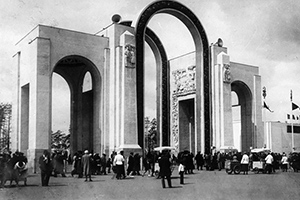
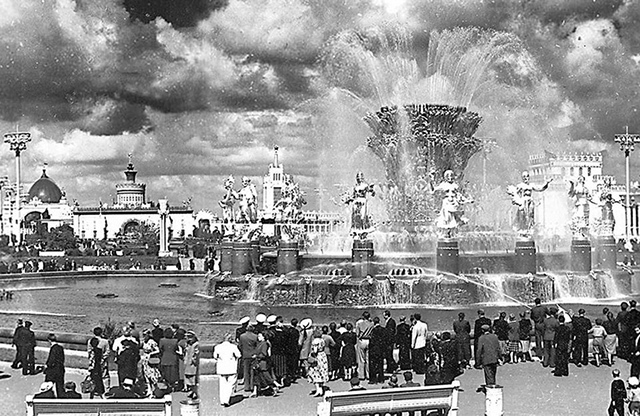 General view of the 1954 VSHV from the VSHV to the VVC and vice versa
The candidate of art history and Researcher Rah Maria Silina tells how 75 years they built, rebuilt and reconstructed an exhibition of achievements of the national economy, for example, the seven most remarkable exhibits of the exhibition from the 1930s to the 1980s.
On August 1, 1939, the All -Union Agricultural Exhibition was opened in Moscow. Over the years, the exhibition from the temporary turned into constant, occupying an important place in the cultural life of the USSR, and later Russia. Now it is reconstructed, and on August 1, 2014, after exactly 75 years, the grand opening of the anniversary exposition in the main pavilion is planned. The exhibition, in addition to the general trend of recent years, reconstruct and restore the Soviet heritage, has also affected another sign of time - renaming. In 1959, the All-Union Agricultural Exhibition (VSHV) replaced the name to the exhibition of the achievements of the national economy (VDNH), in 1992-to the All-Russian Exhibition Center (VVC), and since 2014 it again promises compatriots to achieve the national economy (VDNH).
In 1939, the All -Union Agricultural Exhibition was built, as follows from its name, to demonstrate the achievements of agriculture. The task at that time was very relevant in connection with the collectivization and industrialization of the late 1920s-early 1930s, processes that became symbols of the Stalinist economy both in order to beginnings and in the scale of coercion.
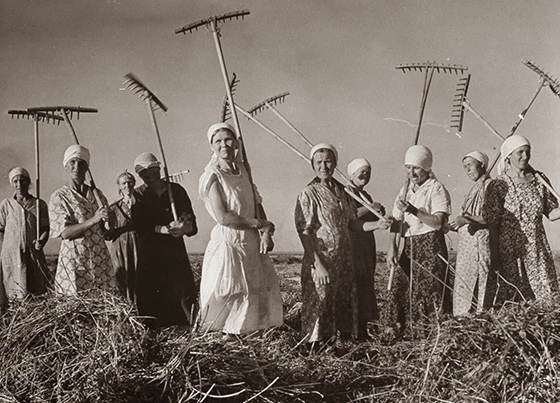 Soviet peasant women. Photo of Margaret Bourke-White. 1930s
In addition to demonstrating the achievements of agriculture, the VSHV was thought of within the framework of the international exhibition movement, which gained momentum since the end of the 19th century. The creation of the Moscow exhibition began back in 1935. The main artist was appointed one of the most influential avant -garde artists of the era, a designer of world -class exhibitions L.M. Lisitsky. For the VSHV 1935-1937, projects were proposed that corresponded to international samples of modernism, and in the pavilions the design of the national building material - a tree was maximally used.
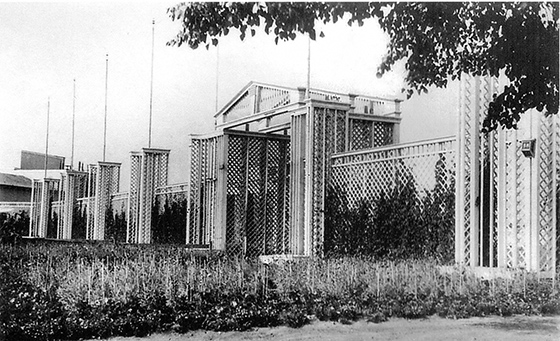 Pergola. 1937
After long delay and the arrest of the chief architect V.K. Oltarzhevsky, who held this position in 1935-1938, instead of the initially planned 1937, the exhibition opened in 1939. By that time, bright innovative solutions became noticeably smaller, the pavilions in return for constructive lightness received additional neoclassical details, which corresponded to the strengthening spirit of socialist realism. In this form, the exhibition lasted until the end of the war.
During the current reconstruction, the modernist facades dismantle and return the historical appearance of the Stalinist time to pavilions.
In the post -war period, since 1948, the idea of restoring the economy and the finished infrastructure of the VSHV 1939-1941 motivated the authorities to reconstruct the ensemble. The development of agriculture in those years was, for obvious reasons, is also super. The territory was significantly expanded, the pavilions were rebuilt, and many were re -erected in a typical late Nestalin style with its neoclassical symmetry of the order facades, the abundance of decor, the golden brilliance of smalules, accepted props, ceremonial courtyards, porters and loggias. The style, which only partially touched the architectural appearance of the 1939 exhibition, became dominant in 1954.
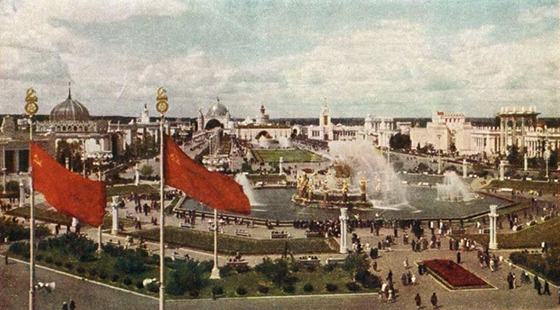 VSHV-1954. General view
 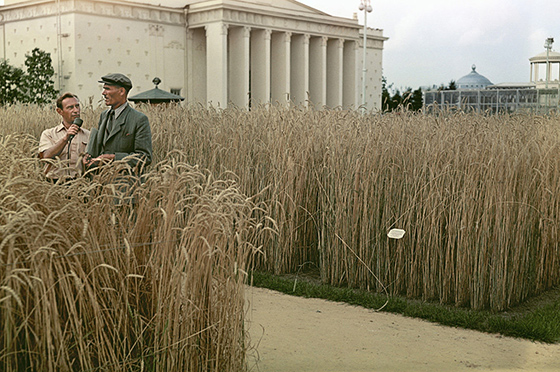 VSHV. 1954
The VSHV 1954 was the last and largest ensemble, built in the style of late Stalinism. The exhibition opened in August 1954, and in December of the same year a meeting of the builders, who proclaim the “struggle against excesses”. This narrow -professional event was part of a wider movement of the Stalinist ideological heritage. It began immediately after the death of the leader in 1953 and in 1956 resulted in the famous report of N.S. Khrushchev "On the cult of personality and its consequences." The meeting of architects laid the foundation for criticism of the totalitarian style. The exhibition turned out to be a monument of the era, which should be forgotten as soon as possible. If the second half of the 1950s, if they were remembered, then only as a sample of the bad taste and false path, along which Soviet art went due to the vicious rule of Comrade Stalin personally.
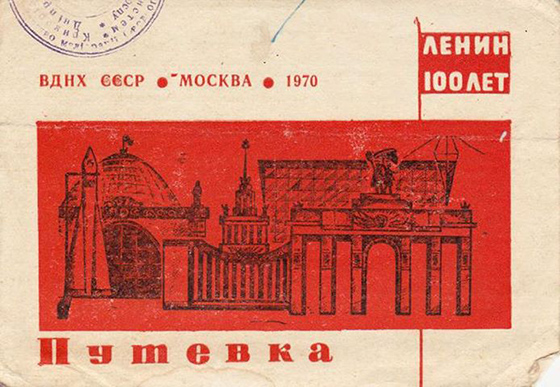 Tulfet on VDNH. 1970
In the course of the “struggle against excesses”, the exhibition pavilions begin to be reconstructed since the late 1950s: stucco molding has been closed with new modernist laconic facades, and the expositions are modernized.
In 1959, there was little propaganda of agriculture alone, the USSR was poured into the international exhibition movement for the first time from the post -war period. The agricultural exhibition is united with industrial and construction. The result is a powerful complex of VDNH with its design workshops, which continued to work until the end of the 1980s.
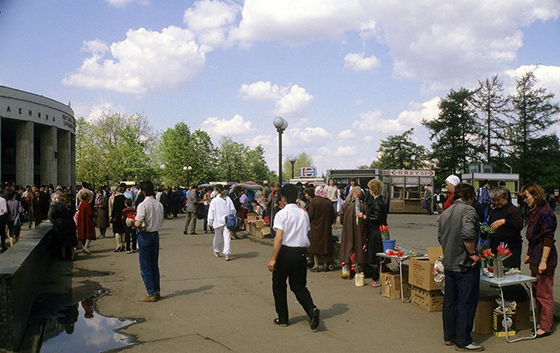 Trade at the metro station "VDNH". 1990s
Since the beginning of the 1990s, the VVC begins to live a new life-the pavilions are taking off "shuttles", here a violent and chaotic trade activity is organized. The expositions are gradually pulled, dismantled, something is simply closed with drywall partitions. In addition to trade in all and the entire VVC of the 1990-2010s, he became a refuge of various private museums-from the “field of miracles” to the museum of butterflies, dinosaurs and mammoths.
By the beginning of the 2010s, the exhibition was a little cleaned from the eclecticism of the 1990s, and since 2011, the owners and city authorities gradually began to pretend certain options for its reconstruction, revival, redeeming, etc. Since January 2014, the VVC received a new old name and Moscow subordination, which resulted in a large -scale reconstruction with the foggy prospects of further operation of the exhibition.
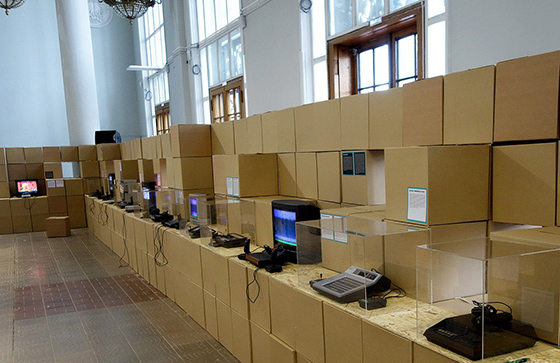 July 2014, the exhibition "MKI Game Station". Pavilion No. 26. Polytechnic Museum. The exposition beats the aesthetics of the 1980-1990s
By the end of the Soviet regime, VDNH turned into a rather eclectic and very colorful ensemble, and it was based on an indestructible, ceremonial plan of the Stalin era. It was the architecture of the exhibition of the 1954 model, which very quickly lost the right to exist at one time, and became the ground for further reconstructions and stylistic layouts. As the History of VDNH shows, the science of teaching and coexistence of modernity with the interiors of the imperial Stalinist ensemble was well learned over these decades. The current events at VDNH suggest that there is no speech about the critical rethinking of this stylistic neighborhood.
Now, if I may put it, emergency cosmetic reconstruction with powerful interventions into the historical appearance of pavilions. Without proper scientific counseling and professional restoration. Since 2013, contrary to the security status of the ensemble, the “largest oceanarium in Europe” has continued to be built. I will assume that the current return to the facades of 1954 is not because this style is so pleasant to modern authorities, but due to the fact that it has become the most consistent and, accordingly, convenient for manipulating the theme of historical heritage. Most likely, after the anniversary opening of the exhibition (something needs to be reported), VDNH will remain the Park of the Soviet period, which will continue its development, and not at all within the concept of the “historical monument”: the rental areas remain in lease areas.
Briefly consider the fate of the most remarkable exhibits of the exhibition from the 1930s to the 1980s.