Translated material
Stalin's handwriting: kill and slander
On the tragic fate of the two prominent Polish figures of the II International
On the tragic fate of the two prominent Polish figures of the II International
Too often recently, a simple -minded maxim of Stalinist times has to be heard recently. Say, yes, there were excessive cruelty, but the time was, and the laws themselves did not differ softness. That is, as it were, not lawlessness - but just following harsh norms. But is it so? Are there few firmly known facts about the gross violating the provisions of the Constitution of the USSR, Soviet laws, in order to prove his personal guilt and the criminal character of its sole authorities once and for all. It is relief to highlight the role of the nearest Stalinist environment in the obedient adherence to his instructions, in the commission of specific crimes against justice.
Published documents testifying to the personal instructions of Stalin of secret reprisals without trial against political opponents or simply who were suspected by people - more than enough. Here is another one, in lengthy comments, does not need.
The tragic fate of the two prominent Polish figures of the II International Viktor Alter and Gersh-Wolf Erlich is a visual example of the fact that it was easy to get into the dungeons of the NKVD, but it was very problematic to get without consequences. Beria’s department was extremely reluctant to let go of his victims. Nothing helped, neither changing political circumstances that depreciate the far -fetched accusations, nor high intercession at the international level.
Arrested by the fall of 1939, Alter and Erlich were initially accused of "conducting the struggle against the Polish Communist Party and the revolutionary labor movement." It was impossible to come up with anything more untimely and ridiculous. It was as if Stalin did not inflict the most crushing blow to the communist movement of Poland, dissolving the Polish Communist Party in the 1938th, accusing its leaders of belonging to "enemy agents". Alter and Erlich sentenced him to be shot, replacing him with a 10-year conclusion.
The war with Germany began its adjustments. Now Stalin was sharply missing allies in a deadly battle with Hitler. An amnesty came out to Polish citizens, and Alter and Erlich, who miraculously escaped death, were released. But they behaved very freely and independently. It seemed to them that all the worst behind. And Beria was very kind, promising to give a move to their proposal for the creation of the International Jewish Anti -Hitler Committee. But such a committee, in this composition, Stalin was not needed. Rather, it is needed, but without internationalization, that is, one where all their own would be, without any suspicious foreigners there.
Alter and Erlich were again arrested just at the time of the stay in Moscow of the chairman of the Council of Ministers and the Commander -in -Chief of the Armed Forces of Poland Vladislav Sikorsky. It seems that the motive for this arrest was the desire of Stalin in no case to allow their possible meeting with Sikorsky and even more so to prevent their departure abroad. They could know too much about the inside of the NKVD, about the perfect executions of Polish citizens. Further reprisal against Alter and Erlich - without trial, with a fake sentence, is quite fading into the usual Stalinist handwriting. Not just kill, but also slander after death.
The decision to hide the arrested in Kuibyshev was dictated by the fact that it was there that central institutions and state security units were evacuated from Moscow and the city became a kind of reserve capital. At the very end of 1942, Sergey Okholtsov was appointed the head of the UNKVD in the Kuibyshev region, which can be fully discussed as a person, clothed with Stalin’s special trust. It was he who in January 1948 was instructed to lead the team of MGB officers sent to Minsk to carry out the secret murder of Solomon Mikhoels. Moreover, Stalin, giving the order to Abakumov on the implementation of the murder, himself indicated which of the employees of the MGB to entrust this, and was the first to name the name of the deputy minister of state security Sergey Scholtsov.
In 1943, Ogoltsov did not fail. Without unnecessary questions, I fulfilled an indication of a hopeless murder. Another Stalin's enclosure - Molotov spoke in his usual role of a smoke curtain. And what, there should be a respectable and frenzied lawyer in the gang of criminals to communicate with the civilian public. Quite conscious of the lawless nature of reprisal, Molotov broadcast to the West, so compiled somewhere in the bowels of the NKVD fake. He did not even care for the accusations to Alter and Erlich to look reliably.
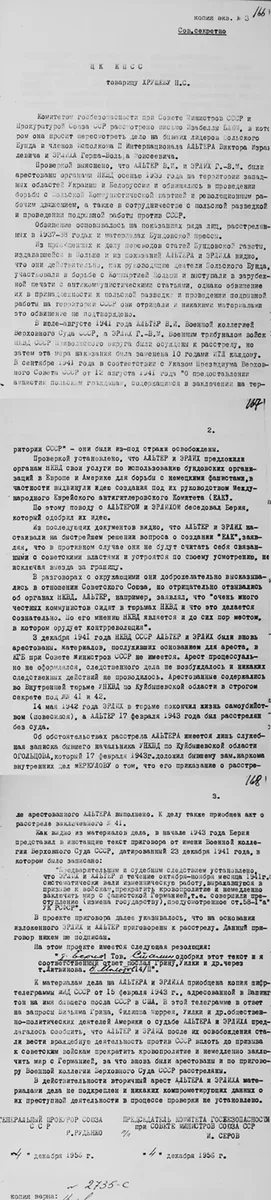
Letter of the Prosecutor General of the USSR Roman Rudenko and the chairman of the KGB under the Council of Ministers of the USSR Ivan Serov to the first secretary of the CPSU Central Committee Nikita Khrushchev about the case of the former leaders of the Polish Bund and members of the Executive Committee of the II International Viktor Alter and Gersh-Wolf Erlich.
Top secret
December 4, 1956
No. 2735-p
The State Security Committee under the Council of Ministers of the USSR and the prosecutor's office of the SSR Union considered the letter of Isabella Blum1, in which she asks to revise the former leaders of the Polish Bund and members of the Executive Committee of the II International of the Alter Viktor Israilevich and Erlich Gersh-Wolf Moiseevich.
The check found out that Alter V.I. and Erlich G.-V.M. They were arrested by the NKVD bodies in the fall of 1939 on the territory of the Western regions of Ukraine and Belarus and were accused of fighting the Polish Communist Party and the revolutionary labor movement, as well as in cooperation with Polish intelligence against the USSR.
The prosecution was based on the testimony of a number of persons shot in 1937–38, and the materials of the Bunda press.
From the transfers attached to the business of the articles of the Bundovsky newspaper published in Poland, and from the testimony of Alter and Erlich it is clear that they really, as the leading figures of the Polish Bund, participated in the fight against the Poland Communist Party and performed in foreign press with anti -communist articles, but they were accusing them of Polish intelligence and undergoing subversive work on the territory of the USSR and denied them and denied any Materials are not confirmed.
In July-August 1941, Alter V.I. The military collegium of the Supreme Court of the USSR, and Erlich G.-V.M. The Military Tribunal of the troops of the NKVD of the USSR of the Volga District was sentenced to execution, but then this measure of punishment was replaced by 10 years of ITL for everyone. In September 1941, in accordance with the Decree of the Presidium of the Supreme Soviet of the USSR of August 12, 1941 “On the provision of an amnesty, Polish citizens contained in the USSR”-they were released from the guards.
The verification established that Alter and Erlich offered the NKVD bodies to their services for the use of Bunda organizations in Europe and America to combat German fascists, in particular, put forward the idea of creating an international Jewish Anti -Hitler Committee (EAA) under their leadership.
On this occasion, Beria, who approved their idea, talked with Alter and Erlich.
From subsequent documents it is clear that Alter and Erlich insisted on the fastest solution to the issue of the creation of the EAA, stating that otherwise they would not consider themselves connected with the Soviet authorities and arrange at their discretion, not excluding traveling abroad.
In conversations with others, they kindly spoke in relation to the Soviet Union, but negatively spoke about the bodies of the NKVD. Alter, for example, stated that “a lot of honest communists are in the NKVD prisons and that this is done consciously. In his opinion, the NKVD is still a place where the counter -revolution is operating. ”
On December 3, 1941, the NKVD of the USSR Alter and Erlich were again arrested. There are no materials that served as the basis for arrest in the KGB under the Council of Ministers of the USSR. The arrest was not procedurally formalized, the investigative case was not initiated and no investigative actions were carried out. The arrested were kept in the internal prison of the UNKVD in the Kuibyshev region in strict secret under No. 41 and 42.
On May 14, 1942, Erlich in prison committed suicide (hanged himself), and Alter on February 17, 1943 was shot without trial.
There is only an official note of the former head of the UNKVD in the Kuibyshev region of Ogoltsov2 about the circumstances of the execution of Alter, which reported to the former deputy on February 17, 1943. The People’s Commissar of Internal Affairs Merkulov that his order was fulfilled on the execution of the arrested alter. An act of execution of prisoners No. 41 was also introduced to the case.
As can be seen from the case file, in early 1943, Beria presented the text of the sentence on behalf of the military collegium of the Supreme Court of the USSR, dated December 23, 1941, which was recorded:
“The preliminary and judicial investigation found that Erlich and Alter, during October-November 1941, systematically conducted a change in the amendment, expressed in the call to the troops to stop bloodshed and immediately conclude peace with fascist Germany, i.e. committed a crime (treason to the state), provided for in Art. 58-1 "A" of the Criminal Code of the RSFSR. "
The draft sentence further indicated that on the basis of the foregoing Erlich and Alter were sentenced to death. This sentence is not signed by anyone.
On this project there is the following resolution:
“ T. Beria! 3 comrade Stalin approved this text and I sent the corresponding text to Green4, Wilk5, etc. Through T. Litvinova. V. Molotov 14/II ".
A copy of the Clinraming of the USSR Ministry of Foreign Affairs of February 15, 1943, addressed to Washington in the name of the former USSR Ambassador to the United States, was introduced to the case file and Erlich. In this telegram, in response to the requests of William Green, Philip Murray, Wilki and other socio-political figures of America about the fate of Alter and Erlich, it was proposed to report that Alter and Erlich, after their liberation, began to conduct hostiles against the Soviet troops to stop bloodshed and immediately conclude peace with Germany, for which they were again arrested again The verdict of the military collegium of the Supreme Court of the USSR was shot.
In fact, the secondary arrest of Alter and Erlich is not backed up with the case file and no incriminating data on their criminal activity in the process of verification was established.
Prosecutor General of the USSR
R. Rudenko
Chairman of the State Security Committee under the Council of Ministers of the USSR
I. Serov
Garf. F. 8131. Op. 32. D. 4575. L. 166–168. A certified copy
*_ __
1bum Isabella (1892–1975) - public figure, member of the Belgian Socialist Party.
2ogoltsov Sergey Ivanovich (1900–1977) - in 1942–1944. Head of the UNKVD-UKGGB for the Kuibyshev Region, from December 1945-1st Deputy People's Commissar of State Security, in 1946–1953-Deputy, 1st Deputy Minister of the GB, Lieutenant General. He was arrested by decision of the Presidium of the CPSU Central Committee of April 3, 1953 for organizing the murder of Mikhoels, but in August 1953, at the direct instructions of George Malenkov, he was released. Deprived of the general rank in 1959.
3 components and further the words highlighted by italics are inscribed by hand.
4grin William (1873–1952) - President of the American Federation of Labor.
5walls Wendell (1882–1944)-lawyer, candidate of US president from the Republican Party in the 1940 elections.
6murry Philip (1886–1952) - American trade union figure.*