
Translated material
Jurmala, or vacation
About love
About love
Continuation. Start in No. 25, 39, 45, 58, 66, 75
1
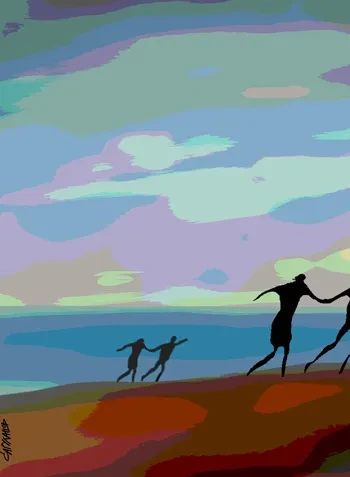
Another thing is summer. Finding all the dreams at once, it was endless and began with the late March with the first spring rain, for some reason leaving the smell of watermelons in raw air. I checked - it doesn’t smell anywhere else in the world. But those who grew up with me firmly remember this unconditional sign of change, which drove crazy children, cats and adults. People, however, were kept in captivity in the spring.
Minka did not recognize her and wrote to everyone in spite and where it went, until he was the first to be taken to the cottage in order to leave there to the mercy of fate that he had never complained about. Two months later, Minka, no longer paying any attention to the cats still waiting for him on the fence, met us pushing, happy and again home.
The summer paradise was located on our street named after Name-Alexander, in a complex structure, separated by a frail fence from the house-museum of the people's poet Jan Rainis, who surrendered to vacationers during his lifetime. Actually, ours in the dacha was one veranda glazed with matte glass, like in a bathhouse. Everyone lived in it: dad with mom, my brother and I, both grandmothers, at times Minka and at night a friendly hedgehog, who was noisily stomped with his paws and loudly squinted with milk. By the evening, the lining of caskets that had a difficult, like Origami, grew in the room. Since I could not go to the restroom without waking my family, I, no matter how I objected, was supplied with a pot, like a small one. It is important that, unlike the Kyiv chicken coop on the Evbaz, the country tightness was the result of a voluntary survey and brought us joy no less than Tolstoy.
Firstly, Jasmine grew around, which refuses to smell in America. Secondly, there are three steps to the sea and all are in the dunes. Thirdly, in the rest of the rooms, closers, corridors and attics of this inexhaustible, like a cube of Rubik, a departmental summer cottage lived the Academy of Sciences, with which adults played Premaras with pale evenings. Fourth, I mastered the bicycle and my summer world has become endless not only in time, but also in space.
Jurmala of my childhood was simply called a seaside, and every Rigaine knew, like a count of suburban stations. The first - Tornyakalns, Zaslavks, Imanta - is not a pity to drive clicking on. Primedayna promised desert adventures. Lielupe was standing by the sea and rivers. Starting with Bulduri, the resort life gained the specific gravity of mercury: on a fine day there was nowhere to lay a towel. We lived on the stop further, in the Ugorsky capital - Dzintari.
Here life bloomed, and no one was hiding from the stingy sun. Lying played the same preference. Standing - in volleyball without a grid. The boys, like Minka in search of love, roamed hard sand along the sea in triangular swimming trunks, which could be put on without removing panties. Each in their hands was rattled by the instrument of the temptation: the pride of Latvian radio engineering transistor receiver "Speedola", configured to the taste of the owner and the degree of his freedom. For some, in BBC, others - on the “voice of America”, the desperate - for “freedom”, and the “lighthouse”, explained the elders, the girls are not glued.
“Well, it’s not necessary,” I thought, preferring a bicycle from sanity, which did not change me until old age.
Country days began early and never ended. Happiness, but exhaustion did not end the night. Northern summer pushed the sunset to dawn until Ligo was advancing. During the last pagan festival of Europe, the entire arc of the Gulf of Riga was decorated with pillars dug in the sand with barrels of a set targeted tar. Around them they drove a round dance without a mass-stall. Friendship of sexes and peoples reigned behind beer. The girls allowed themselves to be superfluous. Men too - both Russians, and, of course, Latvians. Only I turned around aimlessly under my feet, rejoicing that they did not drive to sleep.
Once the Carnival noticed Khrushchev, which was addicted to our seaside. A militant atheist, who turned our Orthodox cathedral into a planetarium, he made no exception to Perun, and Ligo, becoming an underground, moved to the farm, away from the coast occupied by the atheists.
The exile from paradise was completed not by the Soviet leader, but by the Latvian classic. To the next anniversary, the museum expanded, capturing our cottage. Where Yezh and I lived in the summer, now the cabinet of Jan Rainis. Even the street is now not my name, but by the poet.
It’s good that this has not canceled anything, because I grew up and learned to arrange a vacation not only on summer, but on any day, including a walking one. In winter, especially when the sea froze and it seemed that it could be left to Sweden, Jurmala was even more beautiful. The snow hardly kept on coastal pine trees, smelled of cones in the forest, a bonfire warmed up, the hunting sausages planted on branches, and we had no competitors in an empty seizure. In such a situation, I had no choice but to fall in love.
2
“Sulamif,” she introduced herself, extending her narrow palm, which seduced me first.
“Solomon,” I answered, hoping to show that I read the “song of the song”, of course, Kuprin, and not in the Bible, but she, without recognizing the catch, added the prepared:
- You can - Sula.
“And I am Sasha,” I said, feeling like an idiot, which was indisputably.
Sula studied at the Latvian school and belonged to a completely unfamiliar breed of Jews, which made up the color of the pre -war Riga intelligentsia. Father is a famous gynecologist. Mother was called Lyme, and she really resembled the Latvian goddess, judging by the image on the silver armor, which Sula wore on a thin neck as an amulet. The dream of the Aryan race, stately, blond and blue -eyed Lyme was so good that the German guard helped her escape from the ghetto to Sweden. Returning to the homeland, which the whole family considered non -impaired Latvia, she became the best teacher of foreign languages in the city. She fell in love with me after, having come to visit them, I identified in the drawings on the wall of the author - the Ernst Unknown, who turned out to be her old fan.
Everything turned out to be harder with Sula. Although she knew four languages, we did not have a common one. Starting the siege, I asked a banal question as E2 - E4:
- Who is your favorite poet?
“Of course, you think that I will say Rainis,” Sula was delighted, “but I will call Alexander Chuck.”
The first - at least I was a neighbor in the country, I just heard about the second.
- Is it Latvian Mayakovsky?
“You are Mayakovsky yourself,” Sula was offended and took up my education.
We listened to the operas of Alfred Kalnins, attended exhibitions of Janis Anmanis, read the poems of Imat Zedonis, went to the performances of the Dailes Theater, looked at the militant of the Riga film studio "Tobago" Changing the course and bite to gray peas in the beer Kameilis. Everything was to no avail, because according to Latvian I had a solid deuce, which was compassible only in the certificate by the dash.
Sula was not at all interested in the Russians. To convince her, I wrote for her an essay about love, which she conscientiously transferred to Latvian.
“Of all the arts of one love, the music is inferior,” I wrote in it, lowering the quotation marks, in the expectation that Pushkin was not remembered at the Latvian school, but this did not help, and Sules slapped the three.
The cultural program reached the climax at the time of farewell. According to unwritten, but indestructible laws, proceed to tendernesses (in the warm -like warm, hiding from incoming and leaving) was allowed only in view of the upcoming separation, although we met every evening. Despite the winter that interferes with all the winter, our half -elaborate relations went down from top to bottom and became more fascinating from the kiss to the kiss.
The first I, unable to hide a smile, told my grandmother.
- What boys did you like? I asked her in response to my own frankness.
“Silent,” she sighed, “but they were all killed in the revolution.”
I did not know how to keep silent, to kiss either, but it turned out to be not important, because in the most interesting place the national question interrupted us. He was set by an edge of the passport table when I was hit 16.
Like any child of mixed marriage, I wanted to be Russian, but the authorities did not provide for such an alternative.
“Either the nationality of my father,” the passportist squeamishly stopped my attempt to join the Great Russians, “or to my mother.”
Translated to the Soviet question, he stood like this: to live a Jew to me or not. My doubts seemed ridiculous to my father.
“There is no half -blood,” he said, “you will always be a Jew, so at least in the documents - by a Ukrainian.”
After listening to him, I abandoned the forefathers and was immediately punished for this. Upon learning that I became a Ukrainian, Sula expelled me from the edema of her entrance, as a god I - Adam.
- Remember Masada! - She told me goodbye, and I left, sprinkling my head with the ashes of the "Prima", which we smoked when we could not get the "elite".
The old Riga Jews were bilinguals. They masterfully mastered two languages - their own and strangers: best - German, then - Latvian, finally - Russian. The doctors still knew Italian, for they studied in Mussolinian Italy, where, unlike bourgeois Latvia, Jews were accepted on a medical one.
Sula was an outside, and inside a Jew. Knowing English with the school dictionary, I already considered myself a cosmopolitan and saw in the Jews only the allies in opposition to everything that I hated in the environment. In other words, the Jews were close to me in spirit, and she was in blood, and it was as difficult to reconcile us as a new covenant with a dilapidated.
Nevertheless, we tried. Everyone suffered from divided love in their own way: I composed poems, she-letters.
“I like your nonsense,” she wrote in one thing, and I was melting from the sweet, like Tatyana Larina, mistakes, dreaming of returning to the page with which the Jews drove us.
3
Greetings from shame and passion, I did not notice how the summer began and the school ended. I was preparing for the final exams, wagging along the decorated, but empty, as if in Bergman’s film, the streets: that year the country celebrated the 100th anniversary of Lenin and watched the series “Saga about Forsytes”. Neither one nor the other was at all interested in, and I stuck out, having buried for conspiracy in the textbook, I don’t remember what, at the intersection of Petra Stocky and Friedrich Engels, where the lost paradise was located.
I was not afraid of the first exam, because from the fourth grade I wrote essays for everyone who asked me, and not only for those who could afford it, like, for example, Leva Kantorovich, who paid the first ball of a ball in my life, or rather, a copper rod from it.
The topic of the graduation written on the board did not differ from everyone that I wrote until then: “To do life with whom.”
“With Van Gogh,” I decided sweepingly and explained my choice for six hours, retelling the book “Life of Life” of Stone and pushing the cut ear.
I will never remember what I wrote in a fever, because by dinner it turned out that she did not be a creative nature. When I managed to get home, the thermometer went off the way, but I don’t remember that. The district doctor, a burly, but grumbling aunt, which, according to summer frivolity, first took meningitis for a runny nose, ordered her father to prepare the mother for an inevitable outcome. Mom, however, did not believe the doctors and believed that all diseases from the nerves, even when she lost her eyes or I broke my hand.
Three days later, when I still managed to bring me consciousness, my father found out with fright that I forgot who Herek was, how Kiev’s grandmother and Kipling’s poem “If” died, which he made me reinstall.
I was not ready for illness, because, despite all my efforts, for all my school years I could not become infected even by the flu. And here, right on the eve of Freedom, meningitis and two (summer!) Month I did not get up from a hospital bed. They made me three hundred injections, and my sister could not find a living place to stick a needle. The worst of all was a spinal puncture, and to endure it, I, having entertaining a doctor, recited the same Kipling. I was also the need to celebrate the need for lying down, because there was no meat left on the buttocks, but you can’t sit on the bones.
There were two such goners throughout the hospital. The second, Tolya, was paralyzed. At dancing in a professional, he fell out of the balcony, showing his friends how to throw his head back to pour the port into a straight throat (it was also called a “maid”). Healthy, but motionless in the neck, Tolya lived with dates with a girl, whom he invited to tango before the fall. Despite the fact that they did not even have time to get to know each other, she came out of pity, which was melting from a meeting to the meeting. She didn’t like Tolya and healthy, and in the hospital he became inanimate and, from time to time forgetting about his position, threatened to pinch my snout. Coming to the ward, my grandmother regretted him more than me and shared the programs between us equally. We both most of all loved her fried potatoes, but I could already hold a fork.
With each in the hospital, my wishes spent in the hospital grew in terms of exponent. At first I wanted to sit down, then - to get up, soon - to smoke, finally - dreamed about a date. But he had to be postponed for twenty years: while I was sick, Sulamif left for Israel.
Otherwise, I was lucky. Meningitis did not leave the consequences, except for a white ticket. The basis for him was the symptom recorded in the medical card: "Deviation of the language to the left."
“It’s good that it’s not right,” the father rejoiced.
To be continued