
Translated material
OSCE under fire. From all sides
“We do not blame anyone. Our task is to observe what is happening, and report to the countries of the OSCE participants. "
“We do not blame anyone. Our task is to observe what is happening, and report to the countries of the OSCE participants. "
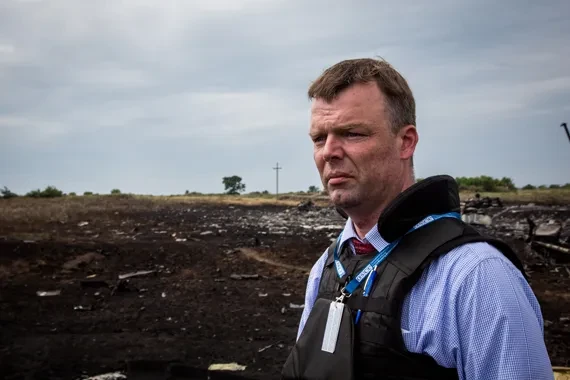
The deputy head of the OSCE mission in Ukraine Alexander Hug is at the site of the disaster. Photo: Peter Shelomovsky
Representatives of the OSCE for a week could not get to the place of the fall of the Malaysian Boeing due to ongoing battles. Fragments of the bodies of the dead are still at the scene of the crash.
-Actually, I always organized the work of specialists while in Kyiv. But when the MH17 disaster happened, I realized that I needed to go "into the fields."
The deputy head of the OSCE mission in Ukraine, Swiss Alexander Khug is calm, restrained, polite and outrageously political correct. He can everyone - from a swearing Deenaner with a machine gun to a high -ranking Kyiv official in an expensive suit - to explain at least ten times what the meaning of the mission is - the main thing is to be understood.
The point is not to hang labels, look for right and guilty and draw conclusions. The meaning is in the fixation of everything that is happening. To be impartial as possible. And as a result, to act as intermediaries between all participants in the conflict.
OSCE specialists were abducted. At the end of May, the separatists detained two groups of observers (eight “monitors”, as they call themselves, and one translator) in the Donetsk and Lugansk regions and released only a month later. The overheads were indignant, demanded liberation, but they did not turn off the mission.
I perfectly remember the absolutely confused faces of Kyiv officials in the first days after the fall of the Malaysian Boeing. They could talk about anything: about the Deenerian terrorists, Russian “beeches”, holes on the state border-but not about what the world public was most worried at that moment, namely, with the remains of passengers, whether aviation specialists will receive access to the crash site, whether it is guarded, whether someone is looking for black boxes. Foreign journalists asked official Kyiv: “How do you negotiate with the DPR? When will there be access to the place when the bodies will be transferred? " Official Kyiv replied: "We are not conducting negotiations with terrorists."
At this time, the OSCE representatives demanded a bilateral ceasefire in order to be able to work normally at the crash site. These requirements were actually ignored by both aspects of the conflict.
The mission continues to demand a ceasefire today. Representatives of the OSCE and international experts could not get to the place of the fall of the aircraft since July 26, which means that they could not continue the search for the remains of the dead passengers - the fighting is carried out in the immediate vicinity of the scatter of the beaten Boeing. And this, perhaps, is the only thing that Alexander Khug cannot restrain emotions: “Understand, I have no right to risk the life of my employees. I can’t send them to where the shooting does not stop. ”
- I took part in so many missions, including in the former Yugoslavia and the Middle East. All missions were very different: everywhere their context, a different military component, the difference in the number of victims. But all the conflicts that I saw unites one thing - a civilian population always suffers in them. And in the greatest danger there are always the least protected - old people, children, disabled people who do not have the opportunity to leave the conflict area on their own.
The civilian population also suffers in Ukraine. This does not happen because one of the parties is trying to purposefully harm ordinary people. But the civilian population is often perceived by this.
Not only residents of Donetsk and Lugansk regions are afraid. It is unsafe everywhere. The feeling of danger is transformed into fear that makes people throw work and leave home. This happens not only in the east of the country, this happens throughout Ukraine.
The mission works here not only because of the crash. It was deployed on March 21 (a few weeks before the start of the anti -terrorist operation). We are engaged not only in Donbass. Monitoring groups also work in Kherson, Odessa, Lviv, Ivano-Frankivsk, Kharkov, Dnepropetrovsk, Chernivtsi, Kyiv. Everyone has one task - to observe what is happening “in the field” and report to the countries of the OSCE participants. Our reports are not secret, everyone can study them on our site.
The other day we investigated the consequences of explosions in the center of Donetsk ( at night and afternoon on July 29 the city was fired, several people died. - Z.B. ). We see an artillery shell, we see that he was in the building, we see how many people suffered and died. But we do not blame anyone. Understand that our tasks do not enter into a finger on one of the sides and say: "They did it." We need to remain extremely objective - as much as possible. But this is not easy - because everything that happens causes us a lot of emotions. You have to constantly remind yourself and participants in the mission that you need to keep emotions under control. And only thanks to this can we conduct a dialogue with all parties. We communicate with the civilian population, every day I interact with the leadership of the DPR, my colleagues in Kyiv - with the Ukrainian government. We are in a unique situation and can act as intermediaries. Thus, we contribute to the very possibility of negotiations between the parties.
- How many representatives of the OSCE currently working in Donetsk and Lugansk regions?
- About 40-50 people in both areas. In total in Ukraine - 250 people. According to the mission, we are allowed to increase the number of to 500 “monitors”. As soon as it becomes safer, we can attract more people. So that we can make this, it is necessary that certain conditions be met: 1) the weapon does not shoot; 2) checkpoints disappear; 3) We have complete freedom of movement.
We are an unarmed civil mission of observers. It is extremely difficult for us to work in an armed conflict. I cannot send my people under the bullets.
- Does the mission have data on the use of prohibited types of weapons?
- We were not eyewitnesses, but heard messages about it. But again, if we see how it is used, we will inform about this, but we do not solve the question - is it legal or not.
- Does the mission follow Russia in this conflict?
- Russia's participation is too broad concept. There is no direct, official government participation. But there are Russian citizens who declare what they say on behalf of the local population. For example, Mr. Borodai.
And, of course, Russia has an impact on the situation in the region.
As in the case of other countries, the support of the region from your state is not necessarily bad. Maintaining ethnic groups close to the title nation of the country outside its borders is nothing special and this is not prohibited, unless, of course, we are talking about sending school textbooks or even financial support.
Many locals told me what they speak Russian, think in Russian, dream in Russian and are carriers of Russian culture. Even outside the context of big politics, the local population is connected with Russia here - and this is normal and natural.
- How does the OSCE assess the situation that has developed around the Boeing crash site?
- We arrived at the crash site on the first day, photographed and monitored changes until last Friday. Changes at the site of the disaster are definitely traced. Some things and objects move. But this does not mean that someone stole something. They raised parts of the aircraft to look for bodies. Personal things from baggage were collected and stacked in one place. But, of course, I do not exclude that something could be abandoned, because the wreckage is in the territory of 30 square kilometers, and there are few protection. However, we cannot confirm this or refute this.
But from last Friday we cannot get to the crash site due to ongoing battles.
We know for sure that there are still fragments of passengers. And the longer they lie under the scorching sun, the more grief brings this to families that cannot get the remains of their loved ones. This should not be a political issue - the ability to search for bodies and work at the site of the disaster. Experts must have access to this place - regardless of which party controls it.
- They say that experts and the OSCE have problems with access to the crash site. Why cannot representatives of the DPR provide you with free access to the place of tragedy?
- Because there was a fight! And this was my decision not to go there because it was too dangerous there.
The Ukrainian authorities and the DPR are fighting among themselves, but I do not want to be part of this game. There were shootings, artillery worked. I cannot endanger my people.
If one of the parties officially told us: “You do not have access to this territory,” I would say so. But both sides assure us that they want us to have access to the crash site. However, then we again rest against the armed conflict. And both sides begin to blame each other for starting it.
It is very difficult for me to understand this ... Each time I inform the Ukrainian government and the ATO headquarters, on what route, at what time, how many cars we will go. The same thing we report the DPR ... and each time we experience great disappointment. Our experts really want to help something, but cannot.
PS The interview was recorded on July 30, 2014 late in the evening. On the afternoon of July 31, there were reports that some international experts were still able to get to the crash.