
Translated material
Self-isolation
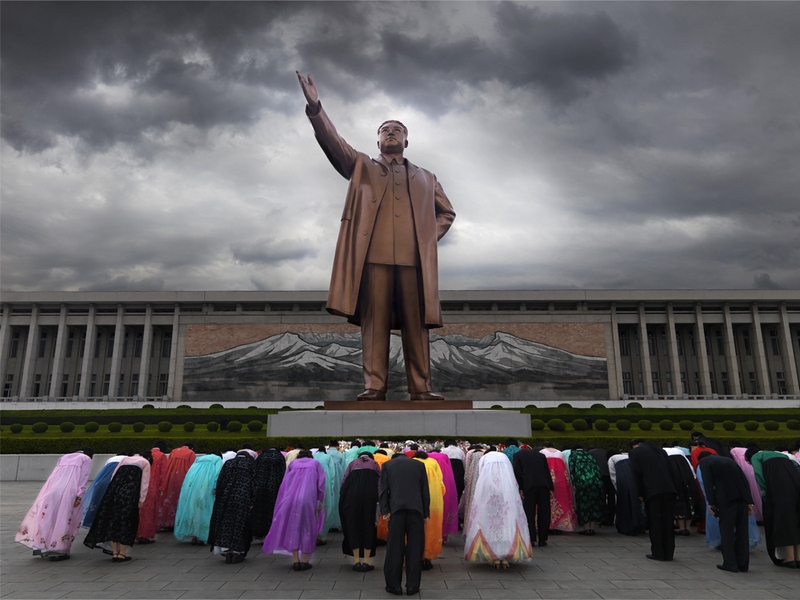
We begin the publication of the cycle of articles of a wonderful vestibule, and the Ssociated Professor University of Kukmin (Seoul) Andrei Lankov about how North Korea lived under Kim Il Sene when she was the most controversial society in world history.
In their majority, “real socialism” did not experience much enthusiasm about the possibility of uncontrolled communication of their subjects with the outside world. The common people should only know about life outside the borders of the borders that the central seal considered it necessary to inform. However, few informational control was brought to such a level of perfection that could be observed in North Korea of the times of “developed kimirsenism”, that is, from the beginning of the sixties to the beginning of the nineties.
In 1967, North Korea became the only country in the world that in peacetime introduced criminal liability for owning a radio receiver with free setting. All radio receivers sold in North Korean stores still have a fixed settings for the frequencies of official stations. An exception to this rule is the receivers in hotels of the North Korean Intourist and other places regularly visited by foreigners, as well as receivers in the houses of ShoGyo (Huatsiao), that is, China citizens who are at permanent residence in North Korea. If the DPRK citizen buys a receiver in a foreign exchange store or brings it from abroad, he is obliged to immediately hand over this dangerous Divais to the police, where specialists will turn off the settings mechanism and then return the radio to the owner.
To make sure that the owner of the receiver did not restore the settings mechanism, all the radio receivers were sealified, and the integrity of these seals was checked during selective checks of private houses (the so-called ““ squeezing ”“ Sukpakkkomyol ”place, which was subjected to any North Korean household several times a year). Theoretically, the owner of the receiver can even be sent to jail, but in practice now those who have money can be relatively easily bought off from troubles.
Since the beginning of the 1960s, all foreign publications of a non-lactic nature were supposed to be sent to special security. It is characteristic that no exceptions were made even for newspapers of socialism countries - not only “Figaro” and “Washington Post”, but “Pravda” with Zhenmin Zibao were considered ideologically dangerous. All Soviet and Eastern European literature fell into special security-including the works of patriarchs-subscriptions, masters of Soviet socialist realism. Moreover, in the special guard there were almost all the works of Marx, Engels and Lenin - for the needs of the population, only a few of their works were published (in edited and stopped), as well as the quotes were prepared. In the end of the sixties, the DPRK residents were generally forbidden to keep foreign literature at home, although observing this prohibition ceased to be controlled by 1980-85.
Troubles abroad were harshly controlled. Until about 2002, private trips abroad were banned at all, so that the Northern Koreans then went on a business trip outside the country, or if they reacted to the elite - to its very top. The exchange of students with the USSR and the countries of Eastern Europe, very active in the fifties, was suspended in 1959-60. And recovered (in a much smaller volume) only twenty years later.
Foreign tourists in North Korea were the Malo - at the same time in the DPRK of the Kimirsen times, the largest, several hundred foreign tourists were, in their most part - from the USSR and the countries of the socialist camp. Tourists moved in groups, each of which looked after two guides (in addition to supervision of tourists, guides controlled each other). The marriages between the North Koreans and citizens of foreign states were banned in the early 1960s, and most of the North Koreans, who at that time were married to foreigners, were forced to divorce. After that, their spouses, for the most part, from the Soviet Union and the Socialist countries of Eastern Europe - were sent to their homeland with children. True, on the territory of Korea, several thousand Chinese were allowed to stay - China citizens who had been living there for more than a decade.
All foreigners who were in the country under Kim Il Sene were either diplomats or specialists sent there as part of technical assistance projects. Only those DPRK citizens who were supposed to communicate with these people could communicate with these people. The conversations on political topics were not encouraged and the situations were quite common when the North Korean engineer, too inclined to non -negligent conversations with Soviet specialists, suddenly disappeared without a trace. A foreigner was forbidden to visit private houses, and most Koreans on the street prudently evaded too long conversations with him.
I must say that the DPRK leadership had reasons to pursue such a policy, no matter how strange and even paranoidal it seemed at first glance. The main problems for the DPRK created the existence of South Korea-or rather, the impressive economic successes of this twin state.
When Korea was divided in 1945, the future territory of North Korea was the most advanced industrial region throughout East Asia outside Japan, while South was a backward agrarian district. Now the situation has changed: the GDP of South Korea per capita exceeds $ 20,000, while in North Korea this figure is only $ 800-900. For the Government of North Korea, this economic inequality is a huge problem.
The leadership of the Kimirsen DPRK created the entire unique system of information self -isolation primarily in order to hide the existence of this gap from the people in the interests of domestic political stability. The official media told the DPRK citizens that everything is either bad or very bad abroad - and the information blockade significantly increased the chances that citizens would really believe in this.