
Translated material
Thunder arrows
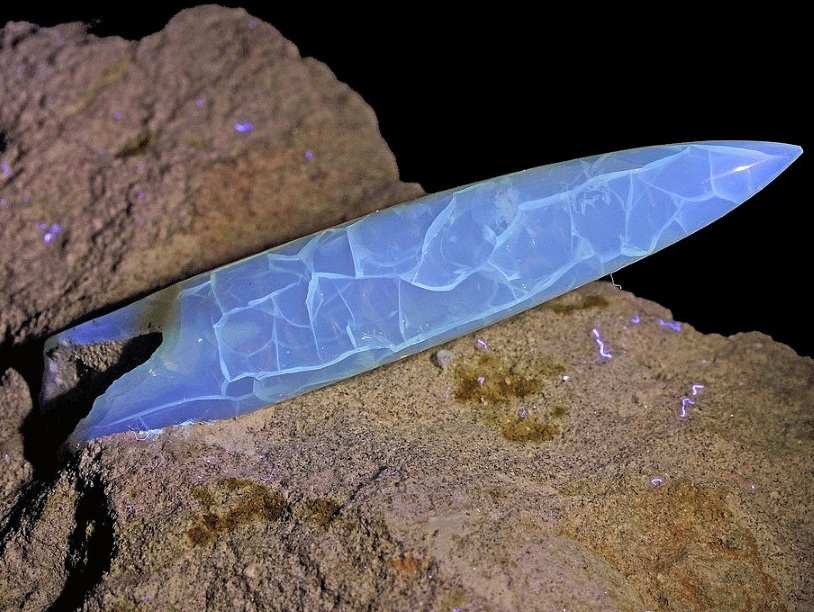
In many mythological traditions, the deity of thunder and lightning amazes with its weapons of opponents. At the same time, it happens that there are objects of the real world that the myth represents as the material embodiment of this weapon. In the Slavic tradition, such objects are known as “Thunder arrows”.
Real objects, which were called "thunder arrows" can be divided into three classes. The first includes Fulgurites . They really arise after the lightning strike. Silicon oxide, which is a lot in the soil (for example, in the sand), melts during a zipper, and then gets stuck, forming a tube, sometimes branched. The length of large fulgurites can reach several meters, usually they are about a finger or a little more long.
Fulgurites.
But Fulgurite rarely comes across people, therefore, objects were much more often as thundering arrows, the origin of which was in no way connected with lightning. For example, the second type of “thunder arrows” is nothing more than the tips of the real arrows, only made by people of the Stone Age. They sometimes came across people during field work, the tip of the arrow was well recognized in their form, and in order to explain their origin, a legend arose that connected them with lightning.
Neolithic tip of the arrow (France)
As a result, stone tips began to be used as amulets that protect against lightning, and at the same time against other misfortunes. They were placed under the roof of the house or carried with them. Sometimes faith in their mystical power was so great that they were crushed and used as a medicine.
Together with stone tips, arrows sometimes found stone axes. This did not stop the tradition. If the thunderer can use arrows, then why not the combat ax for the same purpose for the same purpose.
One of the most ancient evidence of such amulets in Rus' is contained in the “Novgorod feedmark” (1280): Streets and axes of loudy Nech (EU) Tiva and Bogomerzka ѩ thing. The compilers of the book threaten people who use these arrows and axes to treat diseases or expuls the demons.
Do you know, perhaps, the idea that the godfather God is armed with a hammer by Mölnir (etymologically the word mjöllnir related to Russian lightning ) arose in ancient Scandinavians under the influence of the type of stone axes. We note, as an analogy, that among the peoples of Dagestan, lightning is quite often called a fiery or rain ax, and in the Orochi living in Primorye, they said that stone axes, which sometimes find in the roots of the trees torn during a thunderstorm, belong to the spirit of thunder and lightning of the Agnida.
A little deviating from the topic, we can recall that some other archaeological artifacts in the old days were perceived as natural objects. So it was with clay burial urns, which were used by the inhabitants of Central Europe of the Early Iron Age. Until the beginning of the 19th century, there was an assumption that these urns arise in the soil. In 1589, Petrus Albinus wrote that pots grow in the puddle and thylfia in the ground.
One of the first researchers who expressed the idea that these arrows and axes - the guns of ancient people who had not yet known metal was a minerologist and doctor Mikhail Mercati in the first half of the 16th century (1541 - 1593), a brown garden in the Vatican who collected several such finds in his collection of rarities. But the work of Mercity Metallotheca , where these ideas were expressed, was published only in 1717.
In the 18th century, examples of stone tools used by the Indians of North America became known to scientists of Europe. This has become an important argument in favor of the fact that the “thunder arrows” of Europe were of similar origin. Estherling in the work “On the funeral urns and stone weapons of ancient Huttes” wrote: “If there is someone who would have decided to deny the existence of such a gun among the Germans. Then let him go to the inhabitants of Louisiana and other savages of North America, who still use sharp stones instead of knives and weapons. ” However, the completely idea that stone arrows and axes are the work of human hands prevailed only in the 19th century.
Finally, the third type of thunder arrows is the most common. These are the petrified remnants of the cephalopods of the Behemnites who lived on Earth in the Mesozoic era. Belarusians were similar to modern squids, but possessed a solid inner shell, part of which (growth) is well preserved in geological deposits. In many areas, the petrified growths of Belarusians are numerous, they often came across to people and caused many legends.
Belemnit (reconstruction)
In Russian dialects, they are known under the names Thunder arrow , thunder , thunder , Lord arrow , heavenly arrow . Ukrainian and Belarusian names - pp Ila , arrow , Serbian and Croatian - arrow ( Strije ), Strelitsa ( Strijelica ), Bosnian - Shard Odn thunders , Bulgarian - arrow , Macedonian - arrow , Slovenian - Strela , Polish - Strzał a , Strzał ka, Strela , Strela, Strela . Strzał ka piorunowa , Czech - Hromovnk Ká Men , Hromovè Klí n . In Belarusian, Ukrainian and Polish dialects, the words of Perun and Thunder were found to designate Belarusians. In some areas, the Russians believed that thunder arrows are of two types: fiery (lightning) and stone, which go into the ground.
Most often, the whitemenites were considered the guns of God or the prophet Ilya, with which he tries to impress the devils. In Bulgaria, there was also a legend about the battles between the dragons - the defenders of the villages (they were called the snake of J or Snake ) and the heavenly dragons ( hala ), where lightning and stone arrows were also used. It was usually believed that the thunder arrow goes underground, and then gradually rises. The deadlines were called different: from 40 days to 40 years.
Belarusians often served to protect the house from lightning. To do this, they were placed in the attic, the windowsill, in the red corner or buried under the threshold. In the XIX century, a special ritual was recorded in the Czech Republic, during which an amulet protected from witchcraft and damage was created from the Belemnites. He needed seven black “thunder stones”: six small and one long. It was also necessary to recruit the lands taken there, “where the messenger hit”, that is, at the place of lightning strike. Pour the ground to half a shameless pot, then put the “thunder stones” there: large in the middle, small around. After that, fall asleep the pot to the top, close the shared lid and bury it under the threshold. Only all this must be done secret, otherwise the ceremony will lose strength.
In addition, the Belemnites could serve the happiness of the talisman, be used for fermentation, protect cows from diseases, treat people from toothache, burns, frostbite, wounds and even epilepsy. Sometimes stones were sewn into the clothes of soldiers who went to war, or children who were afraid of thunder. Sometimes such wonderful stones were inherited in families. But the fishermen believed that Belemnit is a hindrance in their business. If it is in a boat, there will be no catch, since the fish is afraid of it.
Rostris of Belarusians
Another group of the names of the Belhemnitsky shells connected them with the fingers. Among the Slavs, they were most often called damn fingers (among Russians, Ukrainians, Belarusians, Poles), the name of God's finger was known in Polesie, similarly in Poland - Boż Y Paluszek . The Saratov province spoke jacks of a finger , in the Astrakhan - a joke finger , in the Belgorod - wolf finger , in the Serpukhov district of the Moscow province - Dedushkin’s finger , in the Chernihiv region - a cuzinets , in Dalmatia - Kamen Svetog Pavla .
In this case, there were its own legends. A.E. Nelikhov in a report dedicated to the popular ideas about the Rosters of the Behemnites gives tradition from the Smolensk region. According to this legend, the devils break their fingers when "at midnight they beat each other on the fists." He also talks about the Ukrainian legend that when the devils were dropped from heaven, they began to cling to the clouds, and Archangel Michael chopped off their fingers with their sword.
The names connecting Belarusians with lightning and/or with arrows, and many other peoples have the corresponding legends. These are English Thunderbolt 'Thunder arrow', Thunder stone 'Thunder-Stone', Elf-Bolt 'Elven Strela', German Donnerkeil , DonnerHammer , DonnerStein and even the Mongolian Tsahilgans Suma Lightning Arrow. The Chinese name of Jian-shi Behemnites consists of hieroglyphs “arrow” 箭 and “stone” 石.
A number of names refers to unclean power: the German teufelstein 'damn stone', the Italian Dita del Diavolo 'Fall of the Devil', Udmurt Vumurt Chiney 'Fingers of Vumurt (Water)', shaitan Chiney 'Devil's finger'. The main name of the Belhemnits shell in the Komi language is Kulchun "Devil's Person." A.E. Nelikhov also cites the names of the bastard 'finger of the Demon' and the Chudchun 'finger of the Miracle'. The dictionaries also note the name Grekchun 'sinful finger' and guluchun 'pigeon finger'.
The Komi has a legend about the emergence of the Belemnites, which in the report of A.E. Nelikhov is told as follows: “Once the good god Yong accepted the image of a potter to save the world from evil spirits. He sat down by the road, where the devils saw him. They began to brag about their strength, swelled and increased in size, but Yong asked if they could fit in three small pots? Demons turned into midges and flew inside, and Yong clogged pots and began to bury in the ground. One of them slipped out of his hands and crashed. The demons jumped out of Yon so quickly that they crumbled their fingers that are still lying along the banks of the rivers. ”
Sometimes the fingertips are not representatives of evil spirits, but quite positive characters. In some parts of England, the name "Fingers of St. Peter" ( St. Peter ' S Fingers ) is used.
The Scandinavian peoples have an option that did not meet in other places, in which the Belemnites are not fingers, and not with arrows, but with candles: Danish and Norwegian Vættlyys 'Candle of Trolls'.