
Translated material
On the way to the world
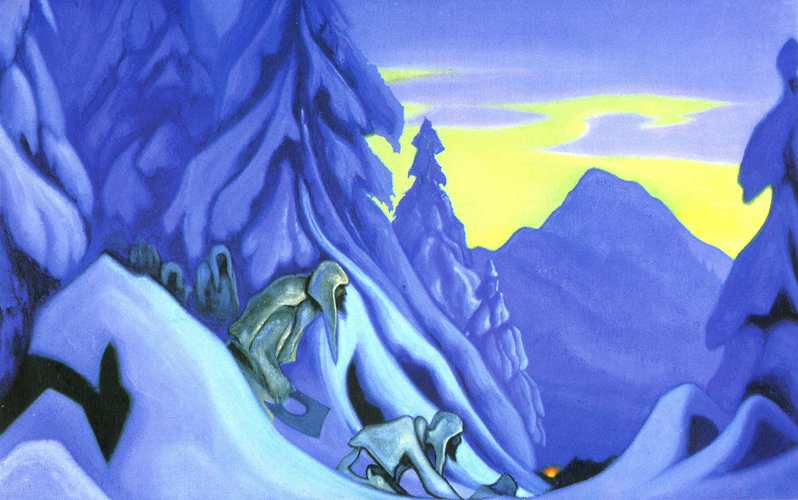
Three branches of the Goethe-Institute-in Paris, Moscow and Munich-were prepared by the online Dosier " Artists and World War I " . This is an attempt to answer the question of how the world war that began 100 years ago influenced European art and the fate of German, French and Russian artists. COLTA . Ru participated in the creation of this dossier. The first article is dedicated to Nikolai Rerich.
Nikolai Konstantinovich Roerich does not belong to the number of artists who left documentary evidence of the First World War. We will not recall his front -line sketches, we will not call works, which would affect the immediate impressions of hostilities, pogroms or the changed social landscape of cities filled with refugees and disabled people. The only realistic image of the modern war in the work of Roerich is the painting “Partisans” (1943); However, the realism and modernity of this plot - the bearded icon -painting elders in white hoods and camouflages lurked among the fir trees in the snow forests, or the Karelian, or the Himalayan, and doubt. Roerich did not see the war of German, as it was called in Russia, in person, as it was called in Russia: in 1914-1915 he lived in St. Petersburg, and since December 1916, according to the recommendation of doctors, he settled on the Ladoga coast in Sortaval (then-Cerminest) and met the February and October Revolution in the Karelian fool. We will immediately say that he was not a direct eyewitness to the tragedies of World War II, since since 1936 he lived and worked in Nagar, in the north of India. Nevertheless, in the eyes of contemporaries, Nikolai Roerich became one of the deepest artists of the war, as later Alexander Blok will become one of the deepest poets of the revolution. In 1915, in Petrograd at the exhibition of the World of Art, where, among other pre -war “prophetic” paintings, “a city doomed” was shown, Maxim Gorky called Roerich “the greatest intuivist of modernity”, which predicted the world battle of peoples. A similar impression was made by Rorich's work on Alexei Remizov, Sergey Ernst, Alexander Gidoni and many others.
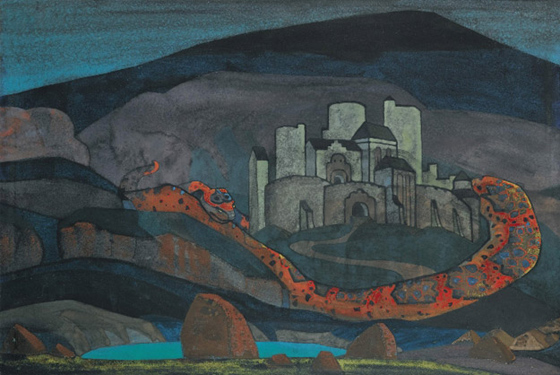 Nikolai Roerich. "The city is doomed." 1914
Not only an artist
If you adhere to only biographical facts, then with complete confidence we can say that the First World War influenced the activities of Rorich-Jourist, a lawyer of the cultural heritage of mankind. As you know, in parallel with the Academy of Arts, he graduated from the Faculty of Law of St. Petersburg University, protecting a diploma on an exotic topic "The legal status of artists in ancient Rus'." In the matter of protecting the monuments of culture, the interests of Roerich-artist and Rorich-legal evidence happily coincided. Back in his student years, he became interested in archaeology, became a member of the Russian Archaeological Society, taught at the St. Petersburg Archaeological Institute, in 1899 he was sent to excavations in the Novgorod, Pskov and Tver province. In 1903-1904, the artist independently traveled more than forty ancient cities of the Russian Empire, making sketches and sketches of a historical and archaeological nature, subsequently recycled in his easel paintings and monumental and decorative ensembles, church and secular. Based on the results of this trip, a report was made in an archaeological society and a number of articles on the deplorable state of the monuments of antiquity and the need to take measures to protect them were written.
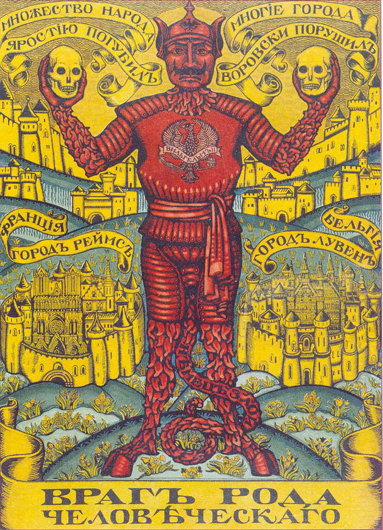 Nikolai Roerich. "The enemy of the human race." 1914
It is not surprising that with the start of the Great War, when it became obvious how destructive for the European cultural landscape new types of weapons and new methods of battle and how insufficient the points on the protection of cultural objects in general international declarations are, the ideas of Rorich received harmonious legal execution. The artist was shocked by news of military destruction in Belgium and France. In the fall of 1914, he first performed in the genre of a military, or rather, anti-war, propaganda poster: the chromolithography of the “enemy of the human race” depicted Vilgelm II in the form of a Kaiser-Dyavol against the background of two medieval cities-Belgian Luvene, where the German army bombarded the university with the famous cities-Belgelm Luvaine. The library, and the French Reims, where the facade of the cathedral was badly affected by the artillery shelling. Only in this poster, intended for sending into zones of hostilities, but, unlike the military rays of Kazimir Malevich, who did not incite intranal hatred, and can we find the response of Rorich to real military events. Then Roerich turned to the supreme command of the Russian army and the governments of the United States and France with an appeal to conclude a special international agreement on the protection of cultural values during military conflicts, and a year later made a report to Emperor Nicholas II and Grand Duke Nikolai Nikolaevich, proposing to take state measures to protect cultural monuments. These proposals were a prototype of the international agreement, which will subsequently be finalized by the artist along with prominent Parisian lawyers, presented in the League of Nations and, after several international conferences, was ratified on April 15, 1935 in Washington as a “Rerich Pact” , and then, after the author’s death, the Hague Convention on the Protection of Cultural Values in the event of an armed conflict adopted on May 14, 1954.
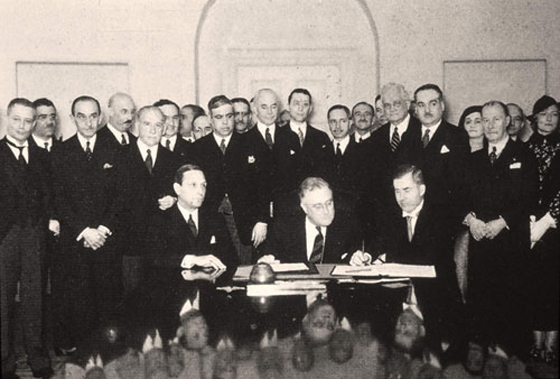 The signing of the Rorich Pact in the White House, Washington, USA, 1935
Do not destroy, but save
Of course, the idea of protecting cultural monuments at Roerich went beyond jurisprudence, becoming a kind of aesthetic manifesto. In that “guardian” project, his artistic position, the position of the Passyist of the “world of art” and the opponent of futurism showed: while the futurists welcomed the war machine ready to destroy the old world, he defended the anti -analysis principles of its preservation. However, to portray this ideological confrontation in the form of a simple scheme with multidirectional vectors, where the futurists are directed into the future, and Roerich's gaze is turned into the past, it would be wrong. Roerich was also completely absorbed in thoughts of the future, about the future of the unity of mankind, the basis of which will become the commonality of spiritual culture - the protection of its material incarnations was the first practical step towards the construction of utopia. Perhaps in 1915, these ideas could seem only a belated rethinking of the L'Art Pour L'ART program, but in the future, closing with mystical, theosophical and historiosophical searches, they resulted in the aesthetic-religious teaching of Royrich, into a peculiar religion of art.
20 years later, on the eve of the next World War, his Credo will be formulated as follows: “Art will unite humanity ... The light of art will illuminate countless hearts with new love ... The events of cosmic greatness before humanity. Humanity already realized that what was happening was not by chance, the time of creating the culture of the spirit came close. In front of our eyes, there was a reassessment of values. Among the breasts of depreciated money, humanity has found a treasure of world significance. The values of great art triumphantly pass through all the storms of earthly upheavals ”(“ The Sheets of the Diary ”, 1938).
 Nikolai Roerich. "Heavenly battle." 1912
Of course, speaking of the “greatest intuitionist” and wishing to acquire a “hail” to the Tempera, which was immediately donated to him, Maxim Gorky could hardly have imagined how far pacifist and cultural -agent ideas would be taken away, and did not intend to see him as the founder of the new religion. Already in 1915, the artist’s pre-war paintings created in 1912-1914, such as “Heavenly Battle”, “Sword of Courage”, “The Last Angel”, “The Scream of the Serpent”, “The Grad Doomed”, “Golevo”, “Human Things”, “Crows”,-began to be perceived as an insight about the global clash of civilizations, the fall of empires and the “Sus of Europe”. Just like working with icon -painted motives - “righteous Procopius for unknown floating praying” (1914), “three joys” (1916), “Panteleimon Healer” (1916) - will be retrospectively perceived as a prayer about the world, and “cosmic” visions in the “sign” and “widespreads of the sky” (both - 1915) - as prophecies of about post -war renewal of the Earth.
The themes of the insights, revelations and spiritual searches of Rorich usually lead the writers to mystical and/or conspiracy reasoning, but, leaving aside his political and sectarian activities, it can be noted that the battalion-apocalyptic leitmotifs are characteristic of Rorikhov’s painting from the very beginning, literally from the thesis in the Academy of Arts “Riden Rod” (1897). These leitmotifs are associated both with the historical-archaeological and mythological hobbies of the artist, and with work in the theater, especially on the scenography of “battal”, “heroic” operas for ancient Russian and ancient German plots, like “Prince Igor”, “The Legend of the Invisible City of Kite”, “Valkyrie”, “Tristan and Isolde”, “Valkiria”, “Valkiria” where his knowledge in archeology and iconography came in terms of fully. In the sketches of the productions of the 1900s and the first half of the 1910s, it is not difficult to find almost all those symbolist stamps-bloody skies, heavenly battles, fiery serpentes, impregnable fortresses, lanterns with swords-which will then shock the audience of 1915 in the “prophetic” pre-painting painting.
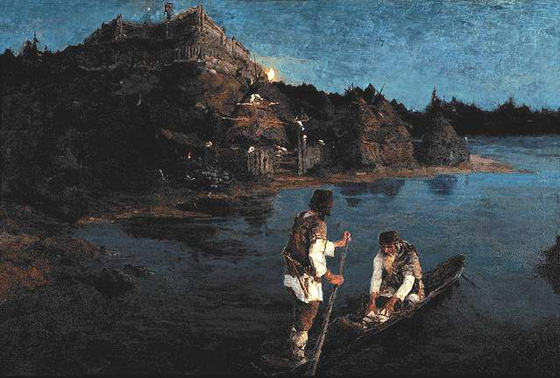 Nikolai Roerich. "Remove the family on the clan." 1897
"Culture of the Spirit"
However, the “opera” nature of these paintings does not mean that the artist himself did not give them the visionary meaning, did not imagine himself an oracle of the world battle, unfolding not only on Earth, but also in the sky -high spheres. Note that on the eve and during the Second World War, Roerich, leaving the Himalayan landscapes, will again return to the opera icon painting plots, which develops in the next “prophetic” cycle: “Svyatogor”, “Tower of Horror”, “Forging of the Sword (Nibelungs)”, “Victory Lights”, “Alexander Nevsky”, “Boris”, “Boris”, “Boris and Gleb” “Novgorod Pogost”, “Igor’s campaign”, “Martiality of Mstislav with Rededa”, “Victory”, “Slavic land”. The news of the surrender of Germany in May 1945 Roerich celebrates the temporium “Spring Spring”, a pagan festival of the celebration of the natural element, whose ballet scene rhymes with the aforementioned “sign” of the 1915th. The “sacred spring”-with its synthesis of paganism and Christianity, the whitewater and the “Shambhars of the shining”, the Russian north and the Himalayas, nature and art-can be called the image-icon of that all-human kingdom of the “culture of the spirit”, the creation of which Roerich prophesied in anticipation of the Second World War. It is interesting that the search for this all -human spiritual synthesis led Roerich in the Himalayas, which attracted the ideologists of the Third Reich, which was enthusiastic about the occultism, but this is the topic of a separate study.
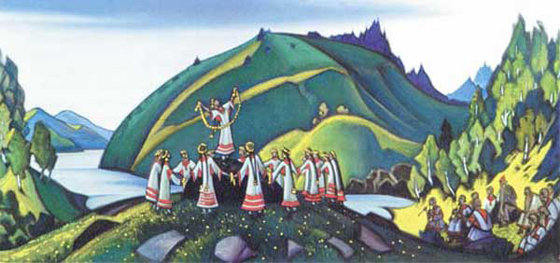 Nikolai Roerich. "Spring Spring." 1945