
Translated material
"It will be easier to make media abroad"
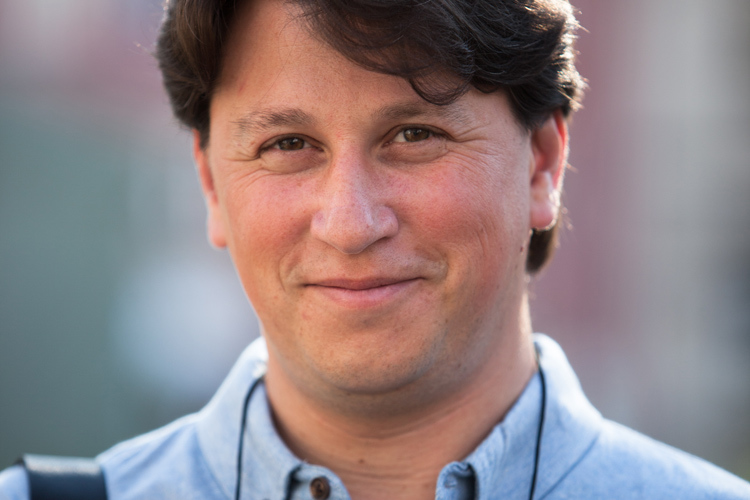
- The first thing I want to clarify after The noise that rose around Galina Timchenko’s column is for your publication-is the “spectrum” connected in any way with Mikhail Khodorkovsky?
- No, at all.
- Tell us then who is the owner of the project.
- This is the project of the Baltic news agency Delfi . The initiator is the Latvian unit of the agency, and Delfi units are in all Baltic countries. Delfi decided to make a Russian -speaking publication for the Russian audience and for this purpose invited me to take the content part of this project into my own hands.
- Saying the Russian Audience, do you mean Russia? Or the Russian -speaking population of the Baltic states?
- The project is designed for both of those and others, of course, because it is impossible to separate one part of the audience from another, but first of all, the project focuses on the Russian audience. It is about users and readers in Russia. This is due to the fact that in Russia itself many enough good publications have recently been closed and there is a feeling that the information field has become somewhat sparse there. It was this feeling that the agency was conducive to conduct such an experiment and try to launch a project that will discuss life and important events for Russians, being outside Russia. Our goal is a professionally and qualitatively made magazine. We have no task of taking an opposition or, conversely, a loyal niche. We want journalism in Russia to return to the state of the Public Institute, so that it would not be an instrument serving someone's interests, but exist as an independent value. This is the goal of the “spectrum” - to put at the forefront of the high -quality work of the journalist and the quality of journalistic material.
- Given the situation in Russia and recent cases of blocking a number of network publications, are you not afraid that the “spectrum” will have to defend the standards of the unspeakable journalism in conditions of serious pressure?
- Well, what can I say in response? You see, it turns out that it is simply a high -quality performance by journalists of their work that makes the publication opposition. In an amazing way, this happens by itself. You just need to work well, and you will find yourself in opposition to the authorities. I don’t think that I can offer some cardinal solution here, but the thought that came to the mind of Delfi is precisely that, being outside of Russia, it will be easier to make a professional journalistic resource. In this case, it is somewhat more difficult to carry out hard pressure. And to attempts to block the addresses, you can always respond with mirror domains, it is not difficult to make them.
- On the "spectrum" there are already texts of Timchenko, Panyushkin , an interview with Alexander Arkhangelsky . And, for example, a person like Prokhanov can have you?
- Specifically, we have not yet contacted Prokhanov, but in principle, yes, maybe. We have no restrictions. Even in the very name of the resource, we wanted to reflect this thought. We want to make a platform to express different opinions, but they must be mutilated by intelligence.
It turns out that the publication makes the publication as opposition to journalists.
- Is this a commercial project? Are you facing economic tasks?
- Of course. We are going to make a professional, high-quality Internet magazine. And, of course, I want him to pay off. We understand that this will not happen right away, but in the future the goal is precisely this is also worth it. It should be an independent, full -fledged resource.
- You can say what the budget of the “spectrum” is?
-So far we have agreed on the budget for the first two to three months. There is nothing supernatural here. The budget (at least the one that I smoke) is laid only on the payment of the authors' fees. I would not want to call accurate numbers, but believe me: everything is modest enough.
- Maybe at least designate the order?
- This is tens of thousands of euros in the near future.
- And how is everything structurally arranged for you? To whom, for example, do you report? Who is your immediate supervisor?
- I am very tightly cooperating with the editor -in -chief of the Russian -speaking version of Delfi in Latvia Anatoly Golubov, as well as with the editor -in -chief of the Latvian version of Delfi by Ingus Berzins. In addition, since they are members of the board of directors of the company, in their person, I believe, I report to the board of directors. I think that there will be communication with the leaders of other national versions of DELFI , because we plan that the materials of the Spectra will be released in Russian -language versions of the Agency in all Baltic countries. In addition, the most interesting materials will still be translated into national languages, because they aroused interest among local residents. We work for everyone, although again I will clarify that our main audience is readers in Russia. But for Russian -speaking inhabitants, it will also be clearly useful here, since it will become an alternative look for events for them.
- And who makes the project with you?
- It is difficult to talk about it so far, because there is a team that provides a technical component and design. All this is done by beautiful, wonderful programmers and designers Delfi . As for the content, while the “spectrum” has one person who raises topics, sets tasks, communicates with the authors. Actually, this is me. And around the “spectrum” I have already gathered ... It is difficult to say - a team, rather a group of authors who have already begun to write for him, and we will continue to work with them and try to further attract increasingly interesting and thinking people. We will attract authors not only for journalistic statements, we make both reports and interviews. In general, a variety of genres.
- That is, while you, it turns out, is the chief editor for yourself.
- Yes, so far. This is all a trial attempt if the “spectrum” turns out to be interesting primarily to the Russian audience, of course, we will expand.
- And what will happen? What indicators?
- I was not put a concrete task at a certain level of attendance. I think that the board of directors will reflect on such tasks based on the results of the first time of work. Now we have worked for only a week, so far there is nothing to talk about. I can say that on the first day after launch we were visited by more than 20 thousand people. True, Galina Timchenko, around which such a stir was erupted, did not do without the help of the column of Galina Timchenko.
We want to make a platform to express different opinions, but they must be mutilated by intelligence.
-You somehow started very quietly, not counting the noise in connection with the text of Timchenko. No press releases, manifestos, presentations.
- modestly started, I agree. But what to do, how to start, so started. This is in our Baltic style.
- How do you plan to promote the "spectrum"?
- We will just continue to work. We will try to attract interesting authors, make good materials. I think that this is not the fastest, but the most reliable way to promote the “spectrum” is just to make good texts.
- And how did you end up in the Baltic states? Tell us about yourself.
- Everything is very simple here. Until recently, I was a foreign correspondent "Lenta.ru" in the Baltic states. I worked as a significant part of my journalistic career in Tape.ru. I worked there almost from the very base of the project. He was a simple editor, and releasing, and leading headings. After the dismissal of Galina Timchenko, I also stopped writing there. And then Delfi addressed me with the proposal. I left Russia about seven years ago, when I became a foreign correspondent "Lenta.ru". First lived in Croatia, then in the Baltic states.
- Now the topic of emigration is very popular in Russia. The journalists are leaving, including. What motivation did your departure have?
- My departure took place a considerable time ago, but my motivation is probably not much different from the arguments of those people who are leaving now. It became difficult to work, life in Moscow is hard, there are many such factors together. In my case, it was still complicated by the fact that I have a family, three children, and it is much more convenient for us to live not in a big city, but in a more calm environment. In pure form, it is probably impossible to name my emigration. Of course, I am not enthusiastic about what is happening in Russia, especially from what is organized by the Russian legislative system in recent years. This does not please me, of course, but this is not the only one. Then everything came together in my case. Both professional and personal reasons.
- And how does the Russian -speaking population of Latvia perceive the latest events related to Russia?
-In different ways, probably, like any population. I cannot speak on behalf of the entire Russian -language population of Latvia, I can only tell about my impression. For example, I was surprised at how much support among the Russian -speaking population of the Baltic states sometimes finds the policy of the Russian authorities. This is a completely natural business, although I would not have suggested this before. I think that this is partly due to the fact that some part of the Russian-speaking population considers itself in an oppressed position, and perceives Russia as its ancestral home, ally and support. Well, of course, the influence of Russian television, which these people watch here, affects. Although the situation with the antagonism between Latvians and Russians is strongly and meaninglessly inflated. I would say that this problem exists more in the media space. At the level of people's relationships, it seems to be not at all. This, of course, is not one hundred percent of the myth. There are some things at the heart of this myth, and they are explainable historically, but nevertheless the situation is exaggerated very strongly and artificially supported by media and politicians.
- After the events in the Crimea and in the east of Ukraine there were alarming assumptions, including in Western media, that if the Russian -speaking population of the Baltic states asks for protection, Moscow may respond. Are there any grounds for such fears?
- The word “fantastic” for such forecasts sounds too modest. This is beyond the reason. Yes, this is found in Western media, but how adequate it is, you can probably judge under the article in The Telegraph , where the author did not manage to correctly indicate the geographical position of Daugavpils.
- Interesting your opinion about the state of Russian media - you were directly related to them, and now you can already look from the outside.
-Somehow it became too free-in the sense that they became just physically smaller. At the same time, a huge amount of information unmarks appeared. If earlier, in order to keep abreast of events, one or two resources that take quite a bit of time could do, now, now, to understand what is happening, you need to spend several hours. You need to read, shove a huge amount of information. And in the conditions of the propaganda war, everyone completely covered everyone. And although there are some more media - for example, “Elephant”, “Vedomosti” - which successfully confront this chaos, the fall of such a pillar as “Lenta.ru” makes the information space in Russia sparse.