
Translated material
The last word of Alexei Gaskarov
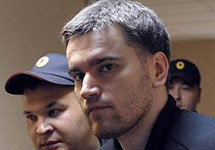
The verdict in the "Swamp case of four" will be announced in the Zamoskvoretsky court on August 18 . The prosecutor requested 4 years of general regime for Alexander Margolin and Alexei Gaskarov, for Ilya Gushchina - 3 years of 3 years of general regime, for Elena Kokhtareva - 3 years 3 months with a conditionally trial period. All defendants are accused under Part 2 of Article 212 of the Criminal Code (participation in the riots) and part 1 of Article 318 (the application of non -hazardous violence to a representative of the authorities).
On August 4, Alexei Gaskarov performed the last word. We publish the full text of his speech.
The so -called swamp business has become symbolic in the sense that through it the public perceives how the power interacts with the opposition, with those who have a point of view excellent from the general line.
The first thing I would like to say is a topic that was not touched on in our trial, but, it seems to me, it is important: why such a large number of people on May 6, in spite of what, decided to participate in some events, and not just standing the extra two or three hours in lines, and ultimately did not allow themselves to beat themselves with impunity.
The demonstration on May 6 was already the seventh in a row the mass event of the opposition. If earlier, until December 2011, several thousand people came to the protest rallies that I witnessed, when you yourself know that the idea of replacing power is not the best for Russia, the asset has expanded significantly. And these people did not go to arrange riots, they went to observe the elections in order to understand and fix how the legitimacy of the political processes that occur in our country is formed.
On December 4, everything fell into place. Despite the fact that the institution of elections in Russia itself was destroyed much earlier, the mass of people who went to the elections, saw how the legitimacy of the current government was formed. I myself was an observer in this election, and what we saw was quite unambiguous. Indeed, there was a strange situation when you are trying to find at least one person in your environment, who would say: “I voted for United Russia. In fact, there were no such people, there were no mass support of the authorities. When they tried to contrast the worshiper, more than a thousand people could voluntarily collect in support of the current government.
The topic itself was extremely important, but, unfortunately, was not sufficiently in demand by the authorities. Still, honest elections are the only legal way to change the political system, and, having changed this system, you can solve social and economic problems. A huge number of people went out into the streets. There was actually no reaction from the authorities. The protest was peaceful, it was numerous, it was obvious that the requirements that are put forward are real and those problems that are mentioned, take place, but instead we saw only an unwillingness to conduct a dialogue, but at some point and generally frank mockery.
Now many do not like how frostbitten characters in Ukraine call people from the southeast. But here we had the same thing when people who went to Bolotnaya Square, the president of the country called Banderalogs, cited many different comparisons of unflattering ones. It was said: you are only 1%, only 100 thousand people from the 10 millionth population came out, this means nothing at all. And subsequently, when they nevertheless allowed honest elections, as it was in the elections of the mayor of Moscow, it turned out that not 1, but 40% - a significant part of society. And I want to say that we must rejoice in general, that the events on Bolotnaya Square occurred in this way.
In all developed democratic countries, protests, the ability to express other than in power, the point of view - this forms political competition, which allows the country to find the optimal path of development. By the way, some problems in the economy began just in the III quarter of 2012, because it is impossible to build a stable economic and social system, when you completely demotivate and exclude such a significant part of society from it. And the fact that this part of society is essential was obvious.
The first signal that follows from our business: is there any right to protest in Russia in Russia, which is in all developed countries? Now, as we see, Russia is deprived of this right.
Beating Alexei Gaskarov on Bolotnaya:


And the second signal that cannot be paid attention to: is human laws preserved in Russia? A person should be protected from the actions of the authorities not only with a system of checks and counterweights, but also by the opportunity to directly appeal to the law in the form in which he is formulated. It seems to me that in our case it is just visible: there is a 212nd article of the Criminal Code. She may be unsuccessfully formulated, but she is formulated as she is. And it is wrong, it seems to me, such obvious issues to bring to the stage of trial, because the law is formulated completely unambiguously. We read a lot of comments on the Criminal Code and did not find anywhere that the corpus delicti can qualify on an alternative basis according to the signs that are indicated there. Nevertheless, this is consistently ignored. Even in those sentences that attached to the case file, this topic deviates in every possible way.
Hustard itself is the most important of the institutions that allows you to protect human rights from the state. And, of course, one cannot but pay attention to a certain selectivity of application to citizens of the law. I understand that our right is not a case, but one cannot but notice that if you, for example, a nationalist, overlap the roads, set fire to shops, but at the same time you do not speak out against the actions of the authorities, you are just a bully. If you go to stocks where they shout: “Putin thief!”, You accordingly fall under a serious criminal liability.
And the last point that follows from our business, which I would also like to pay attention to. This, it seems to me, is sent a signal: if you are loyal to the authorities, then the maximum favorable regime is included in your respect; If you are disloyal, you will be in prison. This is about the assessment of the actions of the demonstration and actions of the police. It is too obvious that not all police officers behaved the way they were supposed to behave. I understand that specifically this topic was not the subject of our proceedings, but not a single criminal case against the police was instituted. In fact, in the framework of our case, the police wanted to make a caste untouchable. When there was a public discussion around the swamp business, the same phrase always sounded: "The police cannot be beaten." Even in our situation, out of 30 people who were involved in the swamp business, only three were struck by the police. Moreover, the whole complexity of this situation was primitated by one phrase: "The police cannot be beaten."
But, it seems to me, such a statement of the question throws and completely destroys any criticism in relation to power. We can’t forget that many terrible things were happening in our country (for example, in the era of great terror), and all these crimes were committed by people in uniform, and everything that they did was actually legal. And now they tell us: no, there should be no critical rethinking of this situation, you just need to stupidly obey the thesis, which repeatedly repeated on the discussion of our business.
The main thing that I would like to say: I would very much like, that, your honor, it did not happen that after our process, to talk about law as an expression of the principle of justice will become a sign of a bad tone. I would like our process not to pursue any other political goals that were imposed, were designated - and all this is in the case file - but we would judge us for really committing us. But if in this country the path to freedom lies through prisons, then we are ready to go through it. That's all.