
Translated material
In the Ivanovo Plyos, on the second attempt, the paintings of Levitan were stolen. The best forces of the Ministry of Internal Affairs are abandoned in search
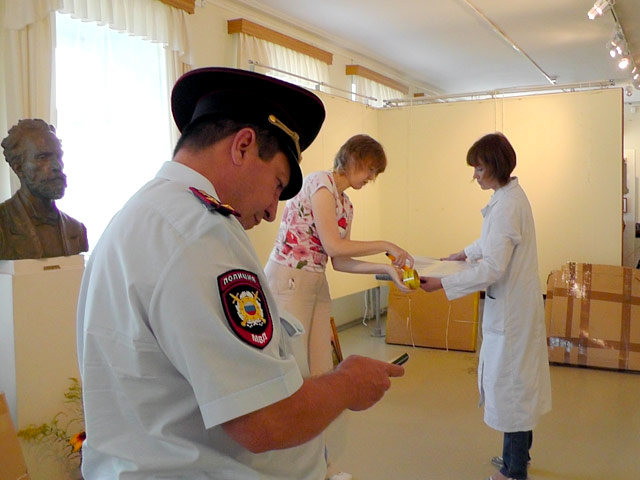
Five paintings were stolen from the artist Isaac Levitan, located in the Plyos of the Ivanovo Region, the cost of which is estimated at 77 million rubles. The worked -out alarm did not help prevent theft, and the attackers went on a motorcycle from the patrols directed to the interception. On the canvases of Levitan, exhibited in the museum, have already encroached.
The theft was committed on the night of August 5, the website of the Ivanovo police reports. Five paintings of the famous landscape painter were stolen from the exhibition hall. It was not possible to detain the suspects in hot pursuit. It is known that two people participated in the theft, weapons were found and seized from the scene of the crime.
The leadership of the UVMD in the Ivanovo region created a specialized investigative and operational group, which included the most experienced threat employees and investigators. Citizens who have significant information for investigation are proposed on a confidential basis. True, the police do not promise awards.
And the leadership of the Ministry of Internal Affairs of Russia decided to connect to the investigation of the theft of employees of the Main Directorate of the Threat of the Ministry of Internal Affairs of the Russian Federation, Interfax reports with reference to the press center of the department.
From the museum in Plyos, the paintings "Polustyk", "Roses", "Rooting with a fence", "River Back (Pondik)" and "Quiet River" were stolen. Each of these paintings was insured for amounts from 13 to 20 million rubles. The museum received part of the paintings as a gift, part - acquired in the late 80s of the twentieth century.
The commentary on the website of the Government of the Ivanovo region states that a new security and fire alarm was installed in the Levitan House-Museum in 2010 . At the time of theft, an alarm was issued to the centralized surveillance of the private security guard in the Volga region. The alarm worked at 3 hours 20 minutes. What time did the police arrive at the scene, is not specified.
According to the head of the Department of Culture and Cultural Heritage of the region Svetlana Shmeleva, this was not the first attempt to penetrate the Levitan Museum. The previous time the thieves tried to profit about a year ago, but then the protection system prevented them.
The Private Store website draws analogies between the current theft and the kidnapping from the museum in the play of the painting by Ivan Shishkin "Meadow at the edge of the forest", which occurred exactly 10 years ago, almost day a day - August 9, 2004. Then, in the search, Interpol was involved, and in the fall of 2005 the picture was found in Moscow and soon returned to Plyos. Then the experts called the return of the canvas a miracle, since the disclosure of such crimes strives for zero.
Komsomolskaya Pravda, citing sources in the police, writes that the theft, apparently, was ordered - thieves were interested in certain paintings. The publication became known that the attackers climbed into the museum through a pre -broken window. In order to take out five paintings, it took them only a few minutes, and the blocked roads they traveled on a motorcycle.
Isaac Levitan is considered a recognized master of the “mood of the mood”. He lived and worked in Plyos in 1888-1889, creating many of his best and most famous works. The artist accidentally hit these places while traveling along the Volga and then returned to the summer seasons. Picturesque landscapes brought Levitan world glory, and Phallus gained popularity among Russian painters.
The house-museum in Plyos opened in 1972. His collection includes 18 paintings by the artist.
Isaac Levitan was born in an educated impoverished Jewish family in Lithuania. In the early 1870s, the family moved to Moscow in order to give children education. Thirteen -year -old Isaac, together with his older brother, entered the Moscow School of Painting, Sculpture and Architecture. His teachers were Perov, Savras and Polenov. A few years later, Levitan is orphaned and collided with extreme poverty. Savrasov gave him the opportunity to earn and continue education.
After the decree of Alexander II, the 18-year-old painter was expelled from the city on the ban on the accommodation of Jews in Moscow and settled in the suburbs. He managed to graduate from the school in 1885, but instead of the artist’s diploma, he was awarded the diploma of the calligraphy teacher. Subsequently, having gained wide fame, Levitan returned to this school as a teacher.
When recognition allowed Levitan to correct the financial situation, he ran into a heart disease caused by hungry childhood and hard work.
The artist lived only 40 years, but left a huge creative heritage - pastels, watercolors, illustrations, graphics and soulful picturesque canvases. Many of his paintings were bought by Tretyakov directly from the expositions. Under the pressure of Polenov and Repin, he was accepted into the community of the Wanderers.
There is an opinion that the picture of Levitan “over the eternal peace” is the “most Russian” of all ever written on a Russian theme.