
Translated material
"World - Monster"
The publishing house “New Literary Review” was published by Olga Egoshina’s book “Theatrical Utopia of Leo Dodin”-a large-scale study of the creative biography of one of the leaders of the Russian scene, with the Anti-Petersburg Small Drama Theater-the Theater of Europe , and its artistic director Leo Dodin. The right to publish a fragment of the book Publishing House “New Literary Review” kindly granted CoLTA.ru: Olga Egoshina tells about the history of the creation of the legendary performance of Leo Dodin “Gaudeamus” , first shown almost a quarter of a century ago in Leningrad - this spring the production was resumed for tour in Paris, and a month later its St. Petersburg MDT will open it your new season.
In parallel with the "demons" the trainees of the theater proposed independent work on the "Stroybat" by Sergei Kaledin. It soon became clear that eight people, of which were an internship group of MDT, is clearly not enough to set up an army story. And Lev Dodin proposed a building “Stroybat” to his newly recruited acting and directorial course.
 © "New Literary Review"
In the exam after the first semester, the show of 56 sketches based on Stroybata took 22 hours. And after that, it was decided to combine the work of two groups - students and trains of the theater. From January to April, Lev Dodin regularly looked and analyzed the shows of work. And in May, active rehearsals on the stage of MDT began. On June 30, 1990, an act of acting was held on the stage of MDT - the play “For fun we were given young years” (later called “Gaudeamus” ). Working on a modern story from army life, which is going in parallel, can be seen as an attempt by an alternative path. Instead of four years - one season. Instead of a painful analysis of each line, literally every word of the writer is a quick transition to independent sketch improvisations to the images and situations with kaledin. “In“ Stroybat ”we must try to compose such a minimum of words,” Lev Dodin set the task at one of the first rehearsals (hereinafter: Leo Dodin. Traveling without end (St. Petersburg, 2009). Rehearsals of the play “For fun we are given young years ...” (“Gaudeamus”) . P. 158). In Dostoevsky - an epic accommodation of real life history pointed to the grotesque. In Gaudeamus, the everyday story of several days before the demobilization in the 4th company of the Stroybat fighters was told by the language of a kind of absurd ballet. Smoking Anashi, cleaning the soldier's galles, rape of a colleague, murder by negligence was told by the language of music, singing, dance, pantomime using a minimum of the author's text ...
Better the worst theater than the best platoon of soldiers.
Two performances grew nearby, echoing, influencing each other (“one corrects the other,” noted Dodin (p. 154)). The analysis of the shows of the works of interns on the "demons" smoothly flowed into the conversation about "Stroybat". In the discussion of sketches on Stroybat, parallels with Dostoevsky arose now and then. It was in these works that the main principle of the existence of MDT was gradually recognized: each new work for itself forces existing performances to change. The experience of previous names, searches and finds naturally enters new samples, but the prime minister also makes the staging existing next to her change.
The experience of army existence with his usual and therefore even more terrible humiliation of man was included in the work of Dostoevsky. As the experience of purely plastic scenes was included in the Dostoevsky, absurd violations of the causal relationship of events.
For Leo Dodin, army life was and remains one of the most unnatural and terrible options for human existence. “Better the worst theater than the best platoon of soldiers” is a maxim often repeated to them. At rehearsals, he talked about the dangers of a closed male community, not busy with any creative labor, a community where the hand rises so easily and habitually to hit or kill. About the usual badger of army life, which they are trying to diversify with booze, women, drugs. “The world is a monster. This is all “undead” - precisely because almost nothing goes to work of the spirit, goes to everything else ”(p. 162).
Rushing the first production with freshmen-students in their life, Leo Dodin devoted a lot of time to the tasks purely pedagogical, explaining what the ability to concentrate and what the storage of the director is. Why, if the actor is not interesting in a particular scene, his boredom is transmitted to the hall. Why does the slightest sloppiness of execution immediately destroy the “contract” of the scene and the public. Students rehearsed the performance and at the same time mastered the basics of the directorial profession, its main and main commandments.
 © Viktor Vasiliev Scene from the play "Gaudeamus"
On one of the conversations with foreign interns, Lev Dodin told how painfully the episode “At Tatyana” was invented: “A whole year in the process of rehearsals, a variety of options tried. Tatyana finished the life of suicide. Tatyana was killed, something else. In general, this scene has become some kind of impenetrable place. There were a lot of options, and what to do, it became completely incomprehensible. This scene is described in a few words, there are no details ”(p. 111).
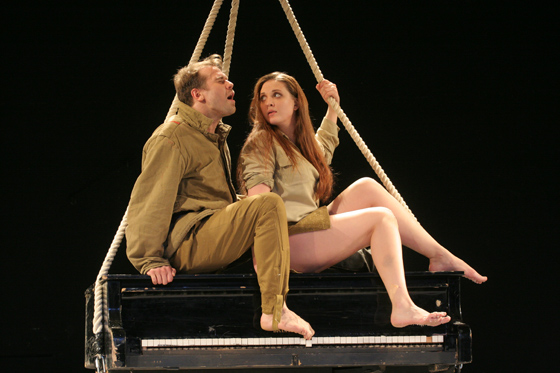
The performers of Gaudeamus gambling suggested and developed any idea “to complicate the form”. Say, Lev Dodin offered not small items, but dimensional and heavy - bedside tables, beds as partners for a waltz in the barracks. A dance with iron beds arose. Then the performers tried to dance not in tunic, but in quilted jackets. And then it was proposed to get into the sleeves of the quilted jackets, and this related step, the mixed -up order of clothing gave an additional touch to a crazy dance (requiring acrobatic dexterity and remarkable physical strength). Rehearsing the love scene between Zhenya and Lucy, Dodin suggested that Igor Chernevich and Natalya Kromina pronounce the text playing the piano. The actors learned the melody. The task was complicated. “Try to play this melody with your fingers, sitting on top of the piano,” Dodin suggested. Chernievich and Kromina mastered this task. “And now the piano will rise up, and you will make dance exercises to the sounding music,” the director developed the scene ... In this form, the sketch of the “piano” and entered the performance.
In the scene of the rape of the colleague, wrapped, bent old (Sergey Kuryshev) suddenly straightened up and sang in the Italian aria. Boris Tintintsev wrote after the premiere: “It was amazing and excellent how this bent, from whom a servant soldier ran away with a cry, suddenly straightened up on the piano and sang a“ in love soldier ”, turning into some kind of radiance.” The transformation of the clumsy thickness of life into music is one of the frequent techniques of director Dodin. It can be a young trumpeter in the scene of the death of Kalina Ivanovich in the “House” or jazz improvisations in the “play without name”, the song “Fly, pigeons, fly” in the “Moscow choir” or the farewell melody of the winds in front of the gas stove in “Life and Fate”.
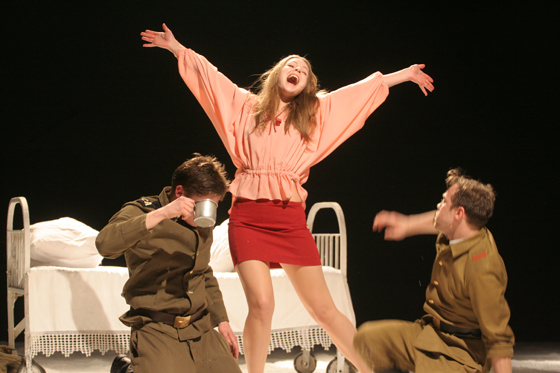
Rehearsing “Gaudeamus” , Dodin sought from the performers of the constant “condensed, concentrated energy”. Each of the 19 episodes was twisted into a tight spring exploding in a common dance, in a march, in a solo song, in a love acrobatics or an unexpected strike of the bar.
 © Viktor Vasiliev Scene from the play "Gaudeamus"
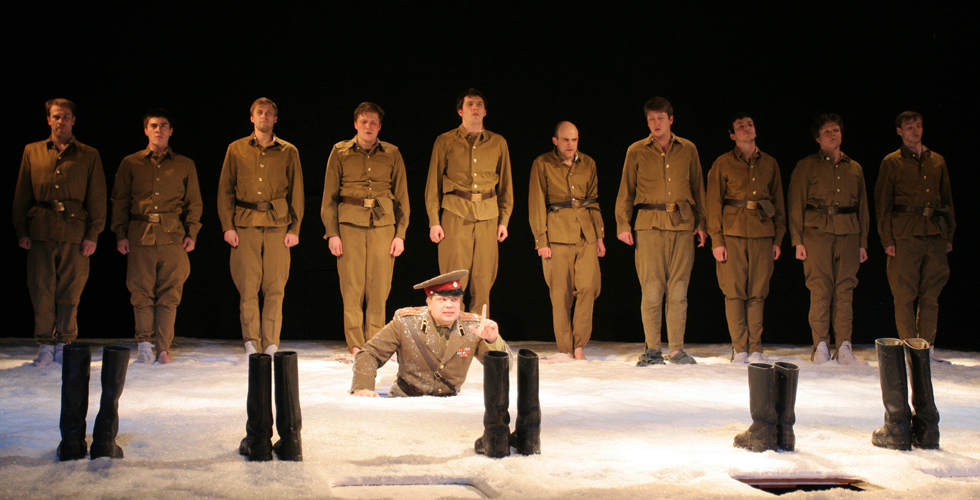
On the snow-white inclined platform (scenography of Alexei, Mopy-Koshitsa), the figures of performers suddenly appeared from black lies, like diets from a snuffbox. Captain Lysodor-Alexander Koshkarev-precisely from there, from Galyun, began his long speech-sharing about the main responsibilities of the soldier. Having been carried away, this singer of the drill service was enthusiastically broadcasting in front of the line of soldiers' boots, varying his only idea of the inadmissibility of leaving the drinking comrade lying on his back in every way, since he could choke on vomit ...
Black sang could turn into an ice hole where the girl washes her head. The same black holes in the next scene turned into soldiers' pebbles, to clean a small team of demobilizes. A spectacular fireworks of matchboxes of soldier's analyzes flying out of black holes was one of the most ridiculous and memorable scenes of this rapidly pulled out to the quotes of the play.
Shortly before the premiere, all occupied freshmen-register-in-laws shaved “under zero”. Having loaded about the hair, their example was followed by the trainees of the theater (Sergey Kuryshev then played Kirillov in the “demon” - the frenzied one; in reviews they wrote about his resemblance to the young Mayakovsky).
The fierce energy of the performers literally fascinated the hall. The crowding of young bodies gave rise to a special condensation of air, fraught with an explosion every minute. The nineteen sketches recreated the exhaustive picture of the terrible army life that grinds everyone and everyone. “A variegated diversity is cut, flattened, bleaching, becoming homogeneous, like these shaved skulls and faded tunics. At the same time, the Brekhtovsky move holds us in constant bifurcation: we understand the life source that feeds the acting, and we see young intellectuals, masters, intellectuals that can extract music from this nightmare, ”wrote Anatoly Smelyansky (“ Music Lessons ”,“ Moscow News ”, 1990, November 11) shortly after the premiere). Analyzing the performance, the critic accurately guessed the reasons that caused the new aesthetics “Gaudeamus” , but his remark that “the director, who worked in the real life zone for many years, was not in vain to change the skin,” was clearly hasty.
“Gaudeamus” was more than restrained by Leningrad criticism (already from the “lord of flies” a reproaching director for the departure from the “brothers and sisters” line) and is warmly accepted by the audience (“bravura and sparkling performance, a real kitsch with moments of funny horror, caused an indescribable delight of the audience,” Boris noted melancholically Tulintsev).
This performance, as well as the Claustrophobia staged after the stories of modern Russian prose writers, had a happy touring fate. There were a lot of performances-frauds in the Russian theater.