
Translated material
Buy food for the last time
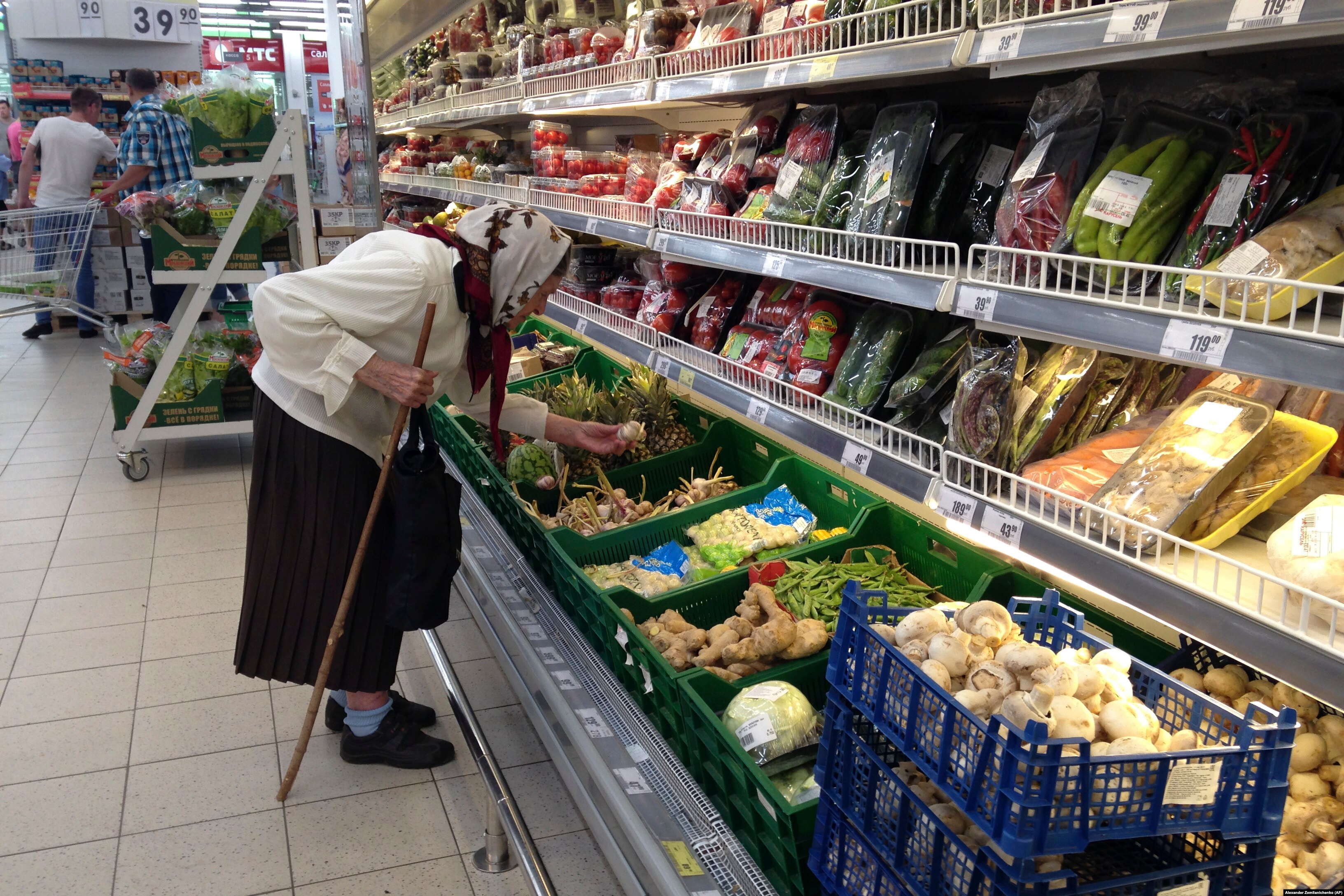
Russia refuses to import food from countries that imposed sanctions against it because of politics in Ukraine
Prime Minister Dmitry Medvedev signed a government decree on the introduction of an embargo for the supply of certain categories of food from countries that imposed sanctions against Russia because of its actions against Ukraine. The list included dairy, meat, fruit and vegetable products, as well as fish from the USA, European Union, Canada, Australia and Norway. On Wednesday, President Vladimir Putin demanded that such sanctions demanded by his decree .
Russia is ready to abandon food, agricultural products, as well as raw materials for their production from countries that have previously supported various sanctions against Russia in connection with the Russian-Ukrainian crisis. According to the Kremlin press service, the decree of Vladimir Putin on the application of special economic measures was signed in the "purposes of protecting national interests" of the country. So far, the validity of Russian sanctions is determined during the year, but it can be changed, this report said.
Russia introduces a complete ban on the supply of beef, pork, fruit and vegetable products, that is, vegetables and fruits, poultry meat, fish, cheeses, milk and dairy products
After the appearance of the presidential decree, the assistant to the head of the Federal Service for Veterinary and Phytosanitary Supervision (Rosselkhoznadzor) Alexei Alekseenko made it clear that the list of imported agricultural products prohibited for import into Russia would be "as wide as possible." In particular, according to him, Moscow is ready to completely abandon vegetables and fruits from the countries of the European Union, as well as from all agricultural products from the United States, including poultry meat. The list approved by the government was even more extensive. "Russia introduces a complete ban on the supply of beef, pork, fruit and vegetable products, that is, vegetables and fruits, poultry meat, fish, cheeses, milk and dairy products," said Dmitry Medvedev . Baby nutrition, as expected, did not fall under the ban, and so far there is no wine and other alcohol products on the sanctions list.
Now Russia is the most dependent on imports of fruits and nuts, milk powder, certain types of vegetables, cheese and beef
Since the beginning of the 2000s, according to the Institute of Complex Strategic Research , the import of food products and agricultural products has grown six times-up to $ 43 billion in 2013, and imported products have about 40 percent of the cost of food for food. Moreover, in recent years, a significant increase in certain categories of goods has been noted in the structure of supply of imported food. Now Russia is most dependent on imports of fruits and nuts, milk powder, certain types of vegetables, cheese and beef. President Vladimir Putin in its decree invites the government to take measures to replace these goods - both at the expense of suppliers from other countries, and by increasing domestic production. A separate requirement of the head of state is to prevent price growth.

Russia refuses to import food from countries that imposed sanctions against it because of politics in Ukraine
The text of the copyWidth PX Height PX
The url has been copied to your clipboard
No Media Source Currently Available
0:00 0:03:04By announcing the decision of the government, Prime Minister Dmitry Medvedev said that Russia “until the last hoped that our foreign colleagues would understand that sanctions are a dead end, they didn’t need anyone. But they did not understand. And the situation was so that we were forced to take response.” But which of the parties in this situation will suffer to a greater extent - foreign suppliers of food or its Russian consumers? Here is the opinion of a professor at the Faculty of World Economics and the World Policy of the Higher School of Economics Alexei Portan :
If we have to tighten our belts, then this is not the first time for us, we have passed it repeatedly
- It is quite difficult to compare, especially considering that the population, citizens of those countries that now fall under our sanctions (the European Union, USA), they are more active in the political and social sense. Therefore, let's say, European farmers can more actively protest against their governments, demanding that trade relations with Russia are resolved than our absolutely clear reasons. It is quite difficult to compare the damage. If we have to tighten our belts, then this is not the first time for us, we have passed it repeatedly. Therefore, it will be difficult to finally conclude how much this damaged us. Here the question arises about our sensitivity. Will we feel it? Will we express our dissatisfaction with the fact that we have disappeared French cheese? Or will we not care? Therefore, a comparison here in itself is a rather complicated thing.
- The president and the government, nevertheless, are still quite optimistic ...
We must look how much we are able to replace those products that will disappear. When replacing, I must say, after all, prices are inevitable
- We need to look at how much we are able to replace those products that will disappear. When replacing, I must say, after all, prices are inevitable. It is clear that those suppliers who will come in return for European or American, in most cases will offer higher prices: friendship friendship, and business business. They will use the situation. This will negatively affect consumers, that is, on us. This will spur inflation, so the negative here is inevitable. And for some products, perhaps, replacement will not happen so quickly. Something such temporarily somehow disappears from the shelves or will be quite expensive. As a result, it seems to me that the consumer will feel this, although it is clear that the leadership, the Russian government will make a maximum possible so that the consumer does not suffer. But it will be very difficult to do.
- You said that prices will certainly rise. But Vladimir Putin instructed the government to prevent prices. From the point of view of a market economy, is it possible to do it in Russia now?
- From the point of view of a market economy, this is very difficult to do. The order of the government is a guideline, having which the government should work in front of itself. But it is extremely difficult to prevent prices in these conditions, in a market economy. Perhaps this manages Belarus, where Mr. Lukashenko somehow knows how to do this. But there is not quite a market economy. It is unlikely that we can use the levers that Alexander Lukashenko successfully use. Therefore, what President Putin said is a landmark is an indication of action. But to what extent will this indication be executed? Probably still not 100 percent.
- Belarus and Kazakhstan are included in the Customs Union, and they did not apply sanctions in relation to Western countries. Can not it turn out that this is imported food prohibited for import into Russia, some “gray” schemes will go through Belarus and Kazakhstan?
- Of course, there is such a probability, we already know examples. After 2006, we forbade wine, drinks and fruit canned food from Georgia and Moldova, but Borjomi came to us through Belarus. This is a well -known fact. Therefore, according to the "gray" schemes through the same Belarus, some products may well come to us in the future. But again, it will be more expensive, it will certainly be more expensive.
-And if Russia begins to fight this, for example, with the help of some cordons. Is this the end of the Customs Union?
- I have repeatedly said that we have already hastened a little in the construction of the Customs Union. When, after June 9, 2009, we proclaimed the acceleration of the construction of the Customs Union, we were signed a significant part of the documents a year later, immediately with the introduction of the Unified Tariff of the Customs Union, customs control was abolished within the Customs Union. This was not necessary to do this. In the EU, it took 35 years to abolish customs control within the Union. And we did it right away. Now we see that we hastened, but, of course, no one in the government will recognize this. Just now, customs control posts would be very, very useful. They came in handy without this to combat smuggling, but now they would be useful especially. I don’t know if they will restore it or not. Somehow you have to fight in these conditions. For the Customs Union, this is certainly bad.
- sanctions and norms of the World Trade Organization. The WTO is now real to do something, somehow influence Russia, on other countries? Or the WTO in this situation of mutual accusations is no longer able to do anything?
Both sides will prepare their claims, prepare to defend. This threatens with some collapsible receipt of claims on both sides. Such a WTO did not know yet
- And until recently, we said that we would complain in connection with the sanctions of the West. And now, when they announced Putin’s decree, the EU representative already said that as soon as the list of prohibited products appears, they will study it and prepare complaints and claims against Russia in connection with these prohibitions. I believe that in this case, maybe our partners, in particular the European Union, will have a chance to win a dispute more than ours, since what we introduce are more obvious prohibitions in the trade in goods. That is, these are more obvious direct barriers in trade than the sanctions that have introduced the US and the EU. Therefore, yes, formally no one has canceled the WTO rules. Probably, both sides will prepare their claims, prepare to defend themselves. This threatens with some collapsible receipt of claims on both sides. This was not yet aware of this, ”said Alexei Portan.
On Thursday, Vladimir Putin talked on the phone with the presidents of Belarus and Kazakhstan Alexander Lukashenko and Nursultan Nazarbayev about the coordination of actions after the prohibition on importing imported agricultural products into Russia, nothing was reported about the details of the conversation. In Minsk, it is believed that the new situation opens up the excellent possibilities for local business elites to obtain additional taxes from the re-export of foreign products to Russia. The interlocutor of Radio Liberty is a Belarusian investment analyst in Poland Thompson Reuters Stepan Svidersky :
For the environment of Alexander Lukashenko, as one of the Belarusian officials already said, the new situation is Klondike
- European goods through Belarus have long went to Russia under the brand of Belarusian. The fact is that the current situation with sanctions is fundamentally not new, since Russia from time to time introduced restrictions on the supply of one or another product from the countries of near or far abroad. And there were always “gray” schemes according to which, for example, Belarusian meat could go to Russia as Ukrainian, Ukrainian as Belarusian, and Polish meat could go to Russia in Polish trucks, only according to documents as Belarusian. Today, the situation is much larger than all previous trade wars, but it is fundamentally not new. For the environment of Alexander Lukashenko, as one of the Belarusian officials already said, this is Klondike. They hope for superprofits due to the resale to Russia of European food as Belarusian.
- To what extent are these hopes justified?
If Russia achieves some concessions from the West, such a large -scale embargo can be revised in the direction of a less large -scale
- In my opinion, in a large one, of course, the Russian government does not decide to unscrew the situation with the sanctions back. In the warehouses of Russian retail chains, as well as Russian wholesalers, there is a sufficient amount of food from the EU and the USA. With these products, you can fill the shelves of Russian stores for several months. And after that, if Russia achieves some concessions from the West, or, on the contrary, will go in its policy a backward, large -scale embargo can be revised in the direction of a less large -scale.
-Do you admit that under the Belarusian brand in Russia can appear exotic goods for the economy of Belarus: any mussels, Spanish ham or something like that? Or are such comic cases excluded?
-Theoretically, this is possible, but still, I think that for the supply of mussels there is some new Zealand.
- Is it possible to calculate the possible profit for the Belarusian economy from Russia imposing sanctions?
- I do not have objective data on volumes that can be set through Belarus. But the possible profit is not for the economy of Belarus, but, let's say, for a certain group of Belarusian entrepreneurs, it can be very high.
- And Belarusian goods (dairy products, meat) will not pour a wider stream on the Russian market?
-Belarusian enterprises of the dairy and meat industry have been active in the Russian market since the mid-2000s, but their production capabilities have been quite limited. By and large, 10 millionth Belarus cannot replace such huge regions as the EU Ilik of the United States with Canada. Of course, some profits and some advantages in this situation can be seen for Belarusian manufacturers. But still, in my opinion, Belarusian resellers of European products are most happy about the situation.
- Ukraine, the main exporter of agricultural products to Russia, previously also got into the blacklist of Moscow. Is large -scale re -export of Ukrainian agricultural products through Belarus possible?
Ukrainian production workers can pay attention to Kazakh, Turkmen potential partners, Turkish
- Naturally. I think that Russian consumers, European, Ukrainian, partially American food exporters will also look for other states that could become a food offshore for re -export to Russia. For example, Ukrainian industrialists can pay attention to Kazakh, Turkmen, Turkish potential partners. There will be re -export, and now many people have become strangled, as if to organize it optimally.
- The Belarusian political classes and Belarusian entrepreneurs calculate, simply put, to "make" on this situation. Is there any flip side of this medal? Any minuses for Belarus?
- The main minus for Belarus will be in a serious increase in prices and falling the quality of food in the domestic market of Belarus. It is no secret that the Russian consumer is ready to pay more consumption goods than Belarusian. Naturally, for the Belarusian manufacturer, as well as for food importers to Belarus, it is more interesting to sell their goods to the Russian consumer.
Belarus today can become as Sweden during the Second World War - a transshipment base between the two opposing geopolitical blocks
- There is also the political side of this issue. Russia, apparently, makes decisions, not having previously consulted in advance with its partners in the Customs Union: neither with Kazakhstan nor with Belarus. Can Alexander Lukashenko feel a political resentment associated with the fact that the issue was resolved without it?
- In my opinion, Alexander Grigoryevich quite soberly assesses his position and his significance both in the Customs Union and in the world. Therefore, he will not experience negative emotions about this. Belarus today can become as Sweden during the Second World War, a transshipment base between the two opposing geopolitical blocks, ”said the Belarusian economist and investment analyst Stepan Svidersky.