
Translated material
Less than fifty dollars
COLTA materials series . RU , dedicated to the results of the past theater season, caused reproaches in snobbery, fixation on the cultural climate inside the garden ring and inattention to the theatrical life of the regions of the country. True Audiatur et altera Pars , the editors provides a word to the theatrical criticism Andrei Pronin - especially for Colta.ru, a jury member of the jury held at the beginning of summer in Kolomna of the theaters of small cities of Russia recalled the best performances of Russian theaters from settlements, where less than 50,000 inhabitants.
In Kolomna everyone liked it. The Central Russian landscape and medieval architecture here miraculously mounted with European purity and order. The old city with numerous churches is sterile as a hospital ward: neither you have an empty bottle under your feet, nor a cigarette butt. In vain, the author of these lines peered into the face of the mayor of Kolomna Valery Shuvalov, trying to solve his secret: the usual seems to be Russian appearance, but by all signs in this case it is deceiving. Kolomenskaya purity is not at all bored. The leisure here is reliably occupied by the flesh features of Sergei and the Lyudmila Roldugins, the creators of the whole cluster of unusual museums and the “museum theater” in addition. The museum of the pastille show a dramatic epic from the life of a merchant family, in a climax, resolved by tasting desserts. In the Kalach Museum, the objects of the museumification object sing in opera voices. In the artist and other cultural undergrand of the Art-Communist Party, in addition to Soviet carpets, skates and TV, actor Schidi Sergey Gamov, who recites the written text of the writer Sergei Levitov, is found in addition to the broom. They say that now the Roldugins were called-to the joy of the Thick Baservilles, the museum-theatal creative of the wasteland of Albion, the museum-theatal creative of the museum-theatal creative of the wasteland of Albion. Kolomna, however, promise not to leave for a long time.
The choice of nature for the XII festival of theaters of small cities in Russia turned out to be unmistakable, but also-praise to the art director of Fest Oleg Loevsky-the program did not disappoint at all. When out of 16 competitive performances, approximately half not only pleases with a high professional level, but also causes a desire to revise these productions, this is a reliable remedy for metropolitan snobbery. And, by the way, convincing evidence of the truth is that the substantial theatrical life in Russia is by no means limited by the reservation of megacities. Of course, it is necessary to sing A posture and the theater of nations, the organizer of the festival, who not only brings groups to a common rally, giving them the opportunity to see each other's performances, but also arranges for provincial guests an extensive program of master classes.
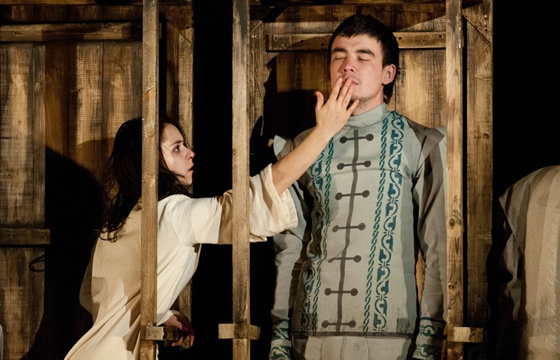 © Theater of Nations Scene from the play "Romeo and Juliet" / Almetyevsky Tatar Drama Theater
The explicit favorite of the festival was the performance of the Almetyevsky Tatar Drama Theater Romeo and Juliet in the production of Iskander Sakaev. He was clapped by competitors from other competing theaters, and a third-party audience, and members of the jury, who eventually awarded the Almetyevites of the Grand Prix in great dramatic form. Sakaev is a former Tsimov undergraduate, student of Valery Fokin, assistant Christian Lupa at the production of “Seagulls” and the head of the directorial department of Alexandrinka. Today his business card does not look so impressive: the next director is either in Izhevsk, then in Nizhny Novgorod, then in Arkhangelsk, then in Ulan-Ude. But the directorial handwriting of Sakaeva is clearly strong. Cultural references so beloved in Qima to the masterpieces of the theater past did not disappear, but in these "Romeo and Juliet" they are more appropriate than ever. Meyerholdian biomechanical sketches - in particular, “Dagger’s blow” - became the basis for the dynamic plastic score of the endless battles of Montecca and Capuletti. And the motives of the engravings of Gordon Craig, mixed with the Tatar ethnic, gave life to a kind of costumes (artist Sofya Trachanov). Not without references to the Square theater of Shakespearean era: the first action of the performance unfolds on a wooden platform surrounded by wooden benches. Decorative materials are intentionally rude and non -huts. Paradoxically, authenticism of the performance adds the Tatar language in which it is performed. A rhythmic, sharp for an unusual ear, he tells the spectacle of brutality, which is not in the textbook Russian translations.
The main theme of Sakaev’s performance is enmity, internecine war, and not given in the anamnesis, but a stronger, developing before our eyes, gaining momentum - from crazy boyish mischief to general dug. The death in the play is personified: if in the first act this arrogant beauty (Nailya Nazipova) is still lurking underground, under the platform, only from time to time jumping out of time, as if from a cellar, to shout into the Shakespearean remarks, then the platform is disassembled in the interval, and the death will walk right among the heroes, collecting bloody harvest. In this conceived world there is no place for a young lovers: neither the charming Romeo (Dinar Khusnutdinov), nor Juliet, who, perhaps, must be said separately. Actress Elmira Yagudin does not lend itself to a common temptation: to turn a winning role into a parade of girlish promance. Her Juliet is stingy on external manifestations and, above all, concentrated: her whole being is subordinated to the struggle for love. The strong -willed immobility of the features and burning gaze - it turns out not only elegant, but also very accurately. The aged fanaticism of the teenager in love, at the same time offensive and powerless, at all times looks that way. The director gives the actress only one sharp gesture. In decisive minutes, Juliet whipping her hair nervously, claps on his forehead, as if trying to put his thoughts in order - and recalling the similar spasmodic gestures of the Elzhbeta Latenite in the performances of Aimuntas Nyakroshus.
The substantial theatrical life in Russia is by no means limited by the reservation of megacities.
The performance of Iskander Sakaev is a grateful material for the description, there are many perfectly invented and executed scenes that will delight Shakespearers. The frightened -whered Mercutio (Ilsur Khairutdinov), who fell into the arms of death and instantly lost his bravado, is remembered. The acting metamorphosis of Ramil Minkhanov in the role of Capuletti Sr., who in the scene of the ball comes to the guests of the shirt, is impressive, but soon transforms into a fierce homemade tyrant: the face of a good man suddenly, as if from a nervous tick, is distorted to grimaces of hatred. I would like to record the farewell of the lovers before the Romeo link: the director puts them on the top of a wooden structure, and, looking from the bottom up, we see defenseless children's figures. In the key episode of the suicide of Juliet, standing next to the laughing eyes, the dead Romeo, the viewer expects that she will also close her eyes and deceive: Romeo opens her eyes, probably reviving with her lover in some best of the worlds. Other heroes have a worst fate. Sakaev does not have a reconciliation of Montecca and Capuletti, the tragedy is resolved by a total massacre, and the newly -produced dead people are crowded at the opening of the crypt with a pressing burst. At this, apparently, you should cut yourself off without knocking out all the secrets of the performance. He was awarded a tour in Moscow, in the Theater of Nations, and the metropolitan public will have a chance to make his impression. You need to add only one thing: this ornamental production created at the junction of the game and ritual theater, it would seem, does not imply modern allusions, but the audience, as if conspiracy, discussed after watching the topics related to the current wars and hostility. The ability of the work is gradually, without pressure, to get into the nerve of time - perhaps the best recommendation.
The winner of the Grand Prix in a low form was the play “Tilsitte Theater” from the city of Sovetsk Kaliningrad Region “Two Poor Romanians who speak Polish”. The result is to a certain extent predictable: the creator of the performance is Evgeny Marcelli, who plays in the super -league of domestic directing, the artistic director of the Yaroslavl drama, and in the not so distant past - the leader and ideological inspirer of the little theater from Tilsit. The Tilsit performance, in general, turned out to be a replica of the Marcelliev production of the play Poles of Dorota Maslovskaya in Yaroslavl. She did not look like a special success: a fairly stopped play lost social specifics and turned into another version of existential intellectual throwing under the “Fair of Paints” Maryli Rodovich. But the fact that the theater and cinema stars Vitaly Kishchenko and the Prima of the Volkovsky Theater Anastasia Svetlova, successful and famous, looked only with the workshop of the game, Tilsitic actors suddenly grew to a wounding public confession. Irina Nesmiyanova and Nikolai Zuborenko turned the history of the outsiders of Gina and Parchi, who went on a fateful journey where, into a bitter pair monologue about the dependent and capricious fate of the provincial artist, whose path from Kerch to Vologda always threatens to turn around the topographic koshmar: “What is overwhelmed by the fucking Romania around”. The fresh Romanian news, by the way, consists in the fact that after the departure of Vilyus Malinauskas, the chair of the chief director at Tilsitte Theater was again vacant.
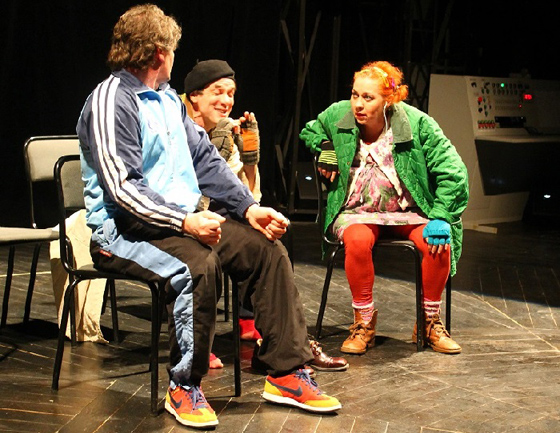 © Theater of Nations Scene from the play “Two Poor Romanians speaking in Polish” / “Tilsit Theater”
They say that for the director the second performance is the most difficult. The most difficult experiments were presented by the young directors (without irony) - Denis Bokurdze from Novokuybyshevsk near Samara and Sergey Metelkin from the Khimki near Moscow, whose debuts (respectively, “Freken Julie” and “Notes of the Young Doctor”) had made a lot of noise a year earlier. With all the differences, they were related by something like a common mistake. Mannered and pathetic " p . S. " Novokuybyshevsky Theater "Gran", staged based on the play by Sartre "Behind the Closed Doors", unfolded in the extruder and darkened space - like hell. The desire for a crystal parable, the refusal to seize the Sartre plot played a cruel joke. If the first minutes of the spectacle with monotonous recitation in the dark and really could seem to be a heavenly punishment, then a successful struggle for the audience attention began: a cascade of sharp acting assessments, the “crook loops” of psychological interactions, the tense stage life of three good artists, deftly and professionally fighting for the interest of the public. As a result, the Sartre conclusion that, they say, “hell is different” seemed almost an advertising slogan. What a wonderful place for communication this hell! The happiness of being heard, understood, the right to a monologue, to subtext, to partnership, uniting the power of frankness. " P. S. " It turned out to be a strange story in which the undoubted professionalism of the director Bokurdze and his artists who cleverly protected the public from a nap, the further, the more meaningful their own plan.
Something similar happened in the spectacular "morphine", decided by the fan of Bulgakov Sergey Metelkin as a sound drama. Impressive installation of attractions, unexpected for the poor theater (which is worth only a trick with a giant fishing rod that clings to Dr. Polyakov to the hook - for the scalp), the director of the director on the electric guitar, a dozen actors, then playing, then performing episodic roles (the Infernal grandmother performed by Mikhail Belov). However, as soon as the compassionate midwife Anna (convincing Larisa Bednova) comes out of the action, the only engine of the dramatic intrigue remains the actor of the role of the Morphonist Doctor Alexander Karpov. His selfless, combining with extreme physical stress, the game cannot leave indifferent a smart audience, aware of theatrical conventions. But how can an intelligent viewer answer the question of his inner idiot: where does the ended drug addict have such remarkable energy to finish this heartbreaking mono almost without directorial support? Hell turned out to be a paradise, morphine - vitamin, and the jury was awarded Alexander Karpov and Alina Kostyuk (Ines in the Sartre performance) in acting nominations. The directors have a chance to successfully prove themselves in third performances, which, as you know, are much easier.
 © Theater of Nations Scene from the play "Vassa" / Minusinsky Drama Theater
For the author of these lines, the most significant impressions of the festival, however, turned out to be two other performances that were awarded only special prizes. About the Minusinsk "vassai" Alexei Porogov at one time argued a lot, in particular, complaining about her absence in the short lists of the "golden mask" . Although with a delay, I can only join the mournful sighs, although it is much more upset that nothing was written about this slutty - at least on the Internet. I already had to say and write that the “vassa” is “a wonderful German performance”, and I will not give up from my words. I’ll only clarify: we are not talking about form - there is no extremely sharp stage decision, nor minimalism of acting coloring (although the playing control vassa -controlled and accurate Alexander Israelson would perfectly come to the court in Schaub ü Hne ). The "Germanism" of the venerable dogovs consists in an unhealthy ruthless social preparation. The first edition of the Gorky play (the one where the Vassa is not Borisovna, but Petrovna, who was performed by Elizaveta Nikishchikhina, which was performed by Anatoly Vasilieva) without pressure was transferred by the director today. The Zhelezovs live in a translucent glazed house (artist Svetlana Lamanova): the upper tier of the scenery is almost not used, only hanging over the heroes and sparkling with lifeless voids. But life boils below: there is something like a living room and a kitchen, a front garden, a stunted bonsai on an advanced. They talk here, meet guests, drink vodka, look at the Plasma “Vesti” and “Let's get married” while the servant is crowded at the stove. Ordinary country life - except that is too relaxed: “business”, the company arises only in conversations - it seems that the participation of this vassa in business, in general, is limited to the selection of revenues. Under the gloomy piano arpeggio of the composer Irina Belova, the modern “merchant” heshes (she is played by Galina Arkhipenkova, and, between us, this is an outstanding role). The vassa of Arkhipenkova is not old, still spectacular and from time to time puts the hairstyle in order in front of the mirror. She is feminine and soft: it is in vain to look in the play in the play of the dog's inner struggle of the shark of capitalism with a loving mother. Moving towards the goal - not to miss a penny from the capital - with the confidence of the tank, this vassa does not rape itself at all, on the contrary, it seems quite instinctive by the behavior. It is equally organic for her to wrap her intentions into a troublesome, wet falsity. Well, if she - so naturally - rushes to her son, so that, having succumbed to the impulse, to put him in an embrace: she definitely decided to sharpen in a monastery. If something-so convincing-babbling about a difficult maternal lot: I definitely realized how to kill a smarent brother. “What are you, mother, amazing,” - without hiding sarcasm, she throws her daughter Anna and coldly watches how hastily Vassa Petrovna burns a letter to Brother Prokhor. Vassa hears sarcasm, but she doesn’t care - tea, not sanctions. By the way, Olga Smekhova in the role of Anna is quite to match the protagonist: the actress plays something like a disciplined office machine. Her sneaks in front of her mother is calm, methodological and measured - and although Anna is sometimes stirring a little, a solid money kush at stake, which justifies all the inconvenience. Alexey Pesogov staged a performance about the victorious cynicism: he is also in the infantile nonsense of Paul and Semen (the theme of male grinding also sounds in the play), and in the lecherous man Prokhor, and in the funny but predatory Natalya (Maria Arkhipenkova), and even in Lyudmilyka (Daria Savinova), whose lines of naivete is difficult to cover up with difficulty. Insatiable thirst for revenge for a broken fate. The director plays a lot with Chekhov's allusions, in particular, emphasizes the theme of the garden. In the final scourge of the Vassa, instead of the mirror, it will be in front of the night window silhouette of dark, ill -plated, dry tree. And he will receive a dumb answer to his question: “I am a man?” You, Vassa Petrovna, a dead tree intended for scrap. A heart -rending laryngeal scream of Vassa. Blackout. Bowns.
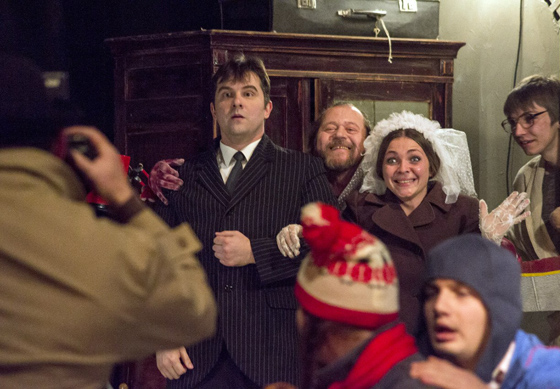 © Theater of Nations Scene from the play “From the Life of Lights” / Yelets Drama Theater “Benefis”
If bitter thoughts remain from the "vassa" of Pesogov, then the "Benifis" of the Yelets Drama Theater "from the life of the lights" - a performance that makes you happy. The name of the director Yuri Melnitsky, a marginal genius from Rostov-on-Don, is widely known too narrow circles, although the Rostovites (yes, at least the same Kirill Serebrennikov) speak of him with an indispensable pet. It is not easy to explain the style of “lights”: it’s some kind of burial, only wild (on the website of the Mellitsky Theater is called “a talented parallest director”: well, I, in fact, about the same). Under the optimistic music of Alexander Ekimov, repeating the annoying Rondimo, the actors in an indescribably sincere manner play some kind of game. The amateur wizard is bewitched to an unhappy woman with acne of a beautiful cop. Педагог-садистка («ошибка, ой, еще ошибка, поставлю ему двойку, ха-ха-ха, ха-ха-ха») получает заслуженное возмездие: ее закидывают тряпками, вымоченными в керосине. Попугай-алкоголик мечтает о карьере аниматора («Красный день календаря — птица пропадает зря»). Простуженный принимает разом все таблетки — и хоть бы хны. Казалось бы, и так довольно странности — но ее добавляет лукавая актерская манера удивительно слаженного ансамбля (ансамбль иногда принимается топать, хлопать друг другу и слушать группу «Ласковый май»). И все это в гиперреалистичной декорации коммуналки от художника Владимира Луника, кажется, реферирующей с ассамбляжами Ильи Кабакова. Мельницкий основательно переписал сюрреалистическую, а-ля оля-мухинскую пьесу Ольги Донец, вставив в нее — ближе к финалу — знаменитый диалог мертвецов из последнего акта «Нашего городка» Уайлдера. Хармсовский абсурд вдруг освещается внезапным пониманием: перед нами игра в жизнь мертвецов, для которых жизнь ценна в каждой ее нелепости, в каждой печали — от одиночества до паралича. И это тот редкий случай, когда режиссер, сразу и с размаху поднимаясь над социальностью до философических высот, обнаруживает не дежурный набор общих мест, а подлинную оптимистическую мудрость.